Yes, I’m back to local political posts on the Maryland side over here. I’ve been a pretty good boy on my Substack about keeping it issue-based but once in awhile I need to point out the anamolies of races. It’s also an experiment because I’ve been having website issues here – another reason I’m relocating to Substack, because I don’t have time to chase down which version of PHP works properly with my plugins because my server is updating.
As you likely know, I keep tabs on the Indivisible movement, including what passes for a local one. And as you may expect, they’re involved in influencing the Wicomico County election with their segment of the traveling roadshow, so named as the base of the eight-twelve activists who would loudly object to whatever Andy Harris said at any local townhall meeting. They tried to look “grassroots” but it was always the same people. Anyway…
They’re attempting to phone bank for the upcoming election for a number of candidates. Of course, it’s predictable that they’re pushing for Wes “for less freedom” Moore for governor, Heather “Mazeur” (sic) for Congress, Brooke Lierman for Comptroller, and local school board Democrats, but they have a couple other interesting names in their push: Muir Boda for Wicomico County Executive and re-electing John Cannon to County Council. Wait a minute, aren’t those guys those eeeeeeevil Republicans?
Well, in Boda’s case the answer is “not anymore,” as he left the Wicomico GOP about the same time I did and rejoined the Libertarian Party. Now he’s the senior of the two elected Libertarians in Maryland, although he was initially elected in a non-partisan election for Salisbury City Council while still in the GOP, so party affiliation wasn’t an issue. On the other hand, Cannon has been a well-known moderate Republican for many years, seeking his fourth (non-consecutive) term on County Council. His website claims he “represents a strong conservative voice for Wicomico County,” but his voting record suggests otherwise.
But it’s not like Democrats had abandoned those races: County Council member Ernest Davis is the Democrat candidate for County Executive, and the Democrats nominated Brad Gillis and Meagan Outten for the County Council at-large seats held by Cannon and Bill McCain, a Democrat who didn’t seek re-election. So I wonder why they were thrown under the bus by the Indivisible regressives? As a matter of fact, Gillis was endorsed by Regressive Maryland while Outten tops him by getting both Regressive Maryland and the Lower Shore Regressive Caucus to endorse her. Is this a head fake to cut into Cannon’s Republican support?
And since any Republican would be questioned for doing this, and what’s good for the goose is sauce for the gander: what is it about Wicomico’s minority community that leads you to ignore the person of color running? Or is it just another ploy to pick off a few GOP votes? Something tells me their target audience in this call scheme is the unaffiliated voter.
Wicomico County is a microcosm of the state in that an outsider conservative Republican won the primary over the establishment choice. But instead of the GOP closing ranks as was always expected of conservatives when a RINO won – the “party over everything” camp – a lot of the establishment crew is leaving the conservatives dry. For example, in the case of former Red Maryland stalwart Brian Griffiths, it’s led to an alliance with the Libertarians in both races. (Perhaps it’s worthy to note that both Muir Boda and state Libertarian nominee for governor David Lashar were at one point members of the GOP. Lashar formerly worked in the Hogan administration for a time.) I suppose party loyalty only goes so far with that crew.
Oh, on another note: I got a text asking me whether I supported Lee Murphy or Lisa Blunt Rochester in my Congressional race.
“This is Ryan with Political Research 2022. Will you please participate in our poll for Delaware’s US House Representative? Please let us know who you support.
Reply (1) for Lee Murphy (R)
Reply (2) for Lisa Blunt Rochester (D)
Reply (3) for Undecided.
Of course, racist sexist me responded 1. (This despite the fact there are actually 4 people in the race, which includes Libertarian Cody McNutt and Non-Partisan David Rogers.)
And you know me…I had to do a search for the number and name of the group. What came up was a radically left-wing group that states as part of its mission:
While threats to human and civil rights may come from any direction, the most robust opposition over the past few decades has emerged from the U.S. Right, which routinely employs harmful scapegoating and clever slogans that oversimplify complex policy issues. PRA counters with reliable analysis, looking beneath the sound-bites to expose the true agendas of right-wing leaders, institutions, and ideologies.
“About” Political Research Associates.
I can’t say for sure it was these guys, but it wouldn’t surprise me they’re looking to see how racist, bigoted, homophobic Slower Lower Delaware is. Chances are I’ll vote for Lee but it’s not because LBR is black or a woman, it’s because she’s way left of me.
While I work in Wicomico County, my wife and I neither live nor vote in Wicomico County. So this misdirection seems a little strange.
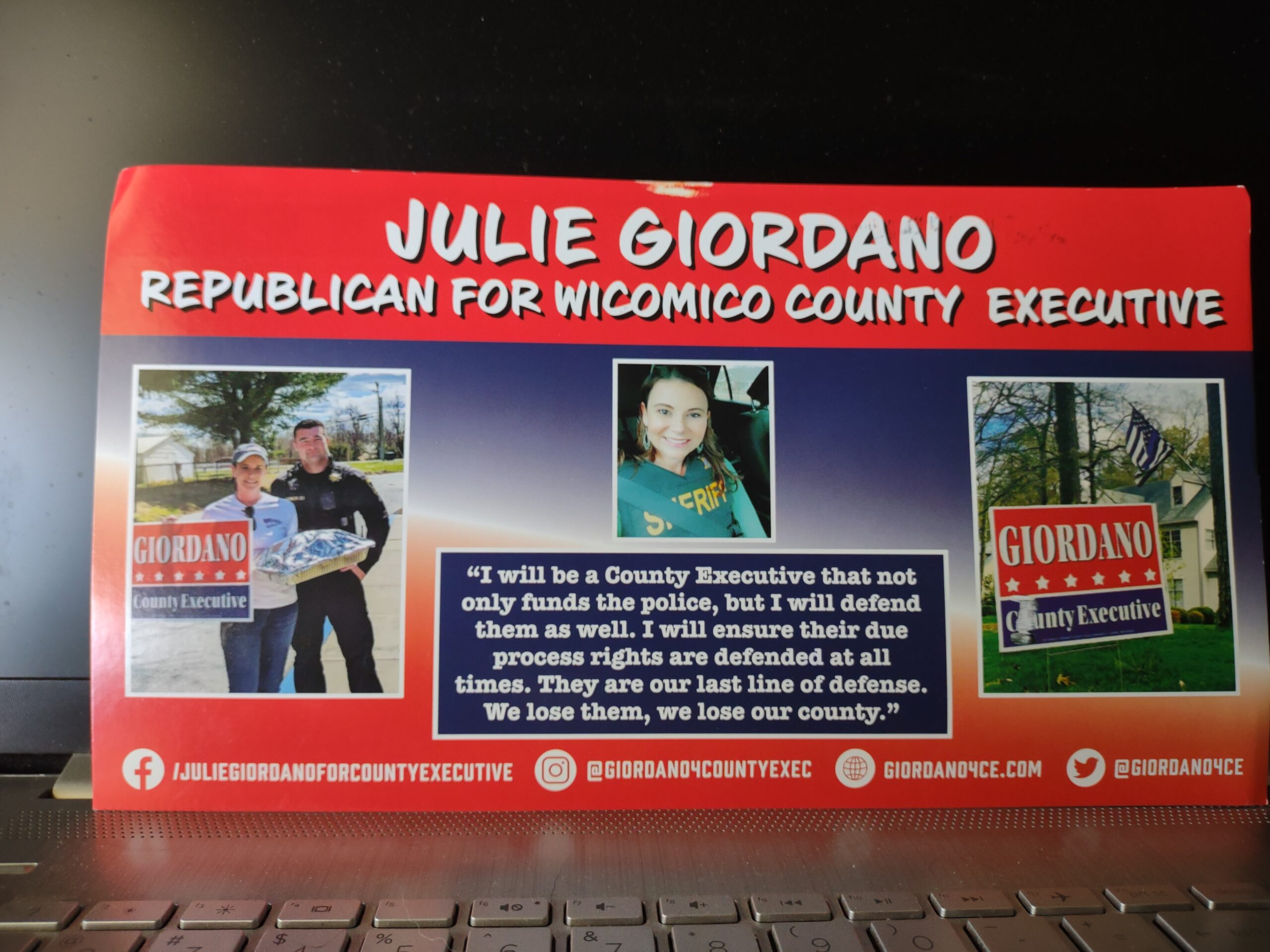
As you can see from the photo, I am in possession of a mailing from one Julie Giordano, who is a Republican running for Wicomico County Executive. (This actually came in our mail for my wife’s “household,” which is logical as she at least is a registered Republican.) I do believe most people who read this are familiar with the fact that I’m a recovering Marylander and ex-Republican who now lives a few miles across the line in Delaware.
So this probable simple mistake by the company mailing this out (not noticing that the address pre-printed on the flyer was in Delaware) got me to thinking about how the political process works now. One thing about my leaving the state of Maryland and the Republican Party is that I don’t get their mailings anymore, but my wife does. However, since she’s not a 4-4 Republican in Delaware yet I don’t think she gets the volume of stuff we (mainly I) received in Maryland. But what she does get seems to reflect the idea of security.
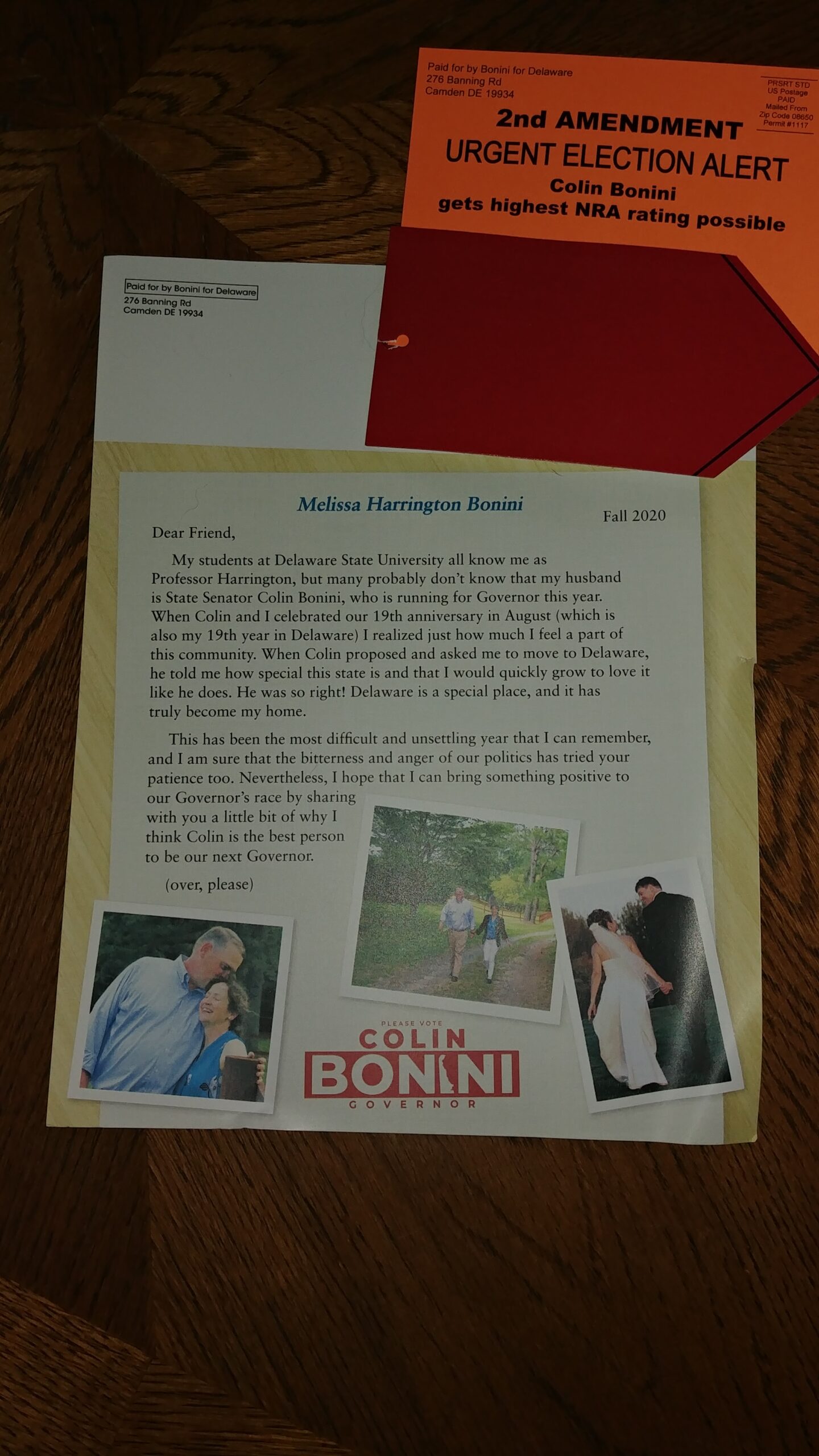
Believe it or not, I took a photo of the total of two flyers my wife received for the entire 2020 election from State Senator Colin Bonini’s ill-fated campaign for governor – one extoling his 2A bonafides and the other as a letter from his wife. (I think I was going to use them for a post I never ended up writing – until now.) It was obvious that Bonini was scanning the voter rolls looking for a few nuggets as well as cutting into the “mama bear” vote in a primary where his main competition was a woman, that being Julianne Murray (who ended up winning.) So here’s that example, a blast from the past.
We didn’t feel at home in Delaware until the political flyers started showing up. But in the election of 2020, this was all we got – both addressed to my wife. Definitely going for the female vote.
To me it’s obvious Julie Giordano is looking to shore up the female vote in an election where she’s going up against the man who’s currently the acting County Executive, but who doesn’t have a ton of name recognition because he’s never sought office before. (John Psota, who was initially appointed as the Director of Administration for the county, is the acting executive who stayed on because County Council couldn’t agree on a formal successor to the late Bob Culver, who passed away in July, 2020. After going through the process twice without success, they threw up their hands and kept Psota in the job until this year’s election.)
While Giordano has a background as a teacher and parent, this flyer talks about security, as in not defunding the police but defending them. On the other side is a quote, presumably from Julie, that says, “If you want to change policing and the end product, I suggest you go to the academy and walk their walk.”
It’s actually a pretty good flyer, but it’s not going to get Giordano any votes from our household because we can’t vote in Maryland anymore. (At least my wife’s name better not be on the list, since I made sure mine was removed.) Maybe they were thinking in terms of donations or word-of-mouth? If so, I suppose she’s getting some pixels but maybe not in the sense she would like. A better campaign would have culled the list before spending a buck or two on printing and postage given she only has about $8,000 in the bank to play with and her primary opponent was bankrolled by some serious coin. (For example, why is lobbyist Bruce Bereano involved in the Wicomico race? That’s a post for another day, particularly since a reporting date is coming up.)
Let’s hope the attention to detail is a bit better if she’s elected as County Executive. (And a message for the current one: can you get your folks to cut some of the roadside weeds around the county? It’s a hazard at some corners.) In the meantime, I’ll be interested to see what shows up in our mailbox later this fall from candidates we can actually vote for.
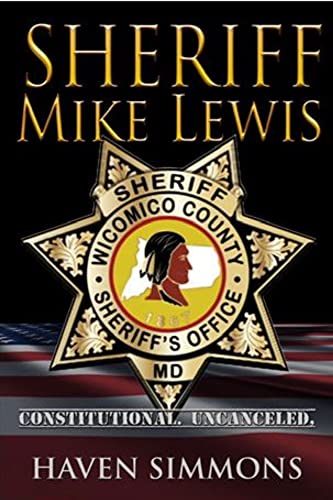
This book came out last month, and it’s an intriguing one. Cover image via Amazon.
One would think I don’t read books anymore, and to be honest I had no idea it had been over a half-decade since I reviewed one here on monoblogue. However, I believed this would be an interesting tome with which to renew the tradition, given the local connection of both subject and author, a retired communication professor from Salisbury University.
Moreover, I thought I could shine a unique light on the book as both a published author myself – someone who knows what it’s like to put together a book requiring hours of research and attempting to make it palatable to a reader who wishes to know more about the subject – and as a former constituent and eventual supporter of the title subject. There were quite a few names familiar to me dropped within the book; as one would imagine that drove a lot of my interest in reading a volume that my wife actually purchased for her enjoyment. (It’s why I’m waiting a week or so to put out this review so as not to give her any spoilers.)
Mike Lewis, however, was not just my sheriff when I lived in Wicomico County before crossing over to Delaware two-plus years ago. Arguably the national platform for drug interdiction and Second Amendment support he’s created via his frequent media appearances make Lewis the third-most recognizable figure of his generation with a Salisbury-area background, trailing only Terminator series actress Linda Hamilton and longtime Weather Channel meteorologist Mike Seidel.
Furthermore, not only are Lewis and I almost perfect contemporaries in age and upbringing as we were both born in the same year and have at least some (in my case) amount of rural background, there’s always been that political aspect surrounding him – once he became a household word in Wicomico during his first campaign in 2006, swamping a four-person GOP primary field with 59.7% of the vote then winning handily that November, Mike got to a point where supporters would have jumped at the chance to help elect him to any higher office he wanted. One interesting tidbit I found in SMLCU is that he once promised his wife he would only serve two terms as Sheriff, but instead filed for a fifth last year. Should he be re-elected in 2022, though, he would match his immediate predecessor, the late Sheriff Hunter Nelms, with five electoral victories. Coming back for a sixth term in 2026 would give Lewis the opportunity to serve even longer than Nelms’s 22 years on the job. (An old-school conservative Democrat, Hunter was appointed in 1984 to finish an unexpired term and served through the 2006 election, where he opted not to seek another term.)
In an epilogue describing his book, Simmons recounts the three themes he was attempting to address: first, Lewis’s ambitions and accomplishments, second, those things that the policing profession entails, and lastly, “the big picture of government and the greater society that places law enforcement in a crucial, albeit vulnerable and often underappreciated position.” Out of the three, the book scores well on the first and last parts, but becomes a bit of a drag on the second portion, much of which comes out as a laundry list of offenses that takes up the book’s second, lengthy chapter – 66 pages out of a book that’s 177 pages, excluding epilogue, acknowledgements, end notes, and photos. (That extra material brings the book to 221 pages overall.)
The problem with that second chapter is that dozens of arrests are detailed, including one I really didn’t need a reminder of – the embarrassing Julie Brewington DUI incident from 2018. (I served with Brewington, a TEA Party leader in Wicomico, for my final two years on the Wicomico County Republican Central Committee.) This list could have been honed down to perhaps a couple dozen of the biggest ones, and the final part of the chapter that mainly deals with incidents in the local schools and at Salisbury University should have been a standalone chapter, particularly as the book then transitions into the seminal case that has occurred under Lewis’s watch: the Sarah Foxwell murder case from Christmas 2009. (One departure from the book: while Lewis talks about tying yellow ribbons to mailboxes to denote yards that had been searched by property owners, I distinctly recall they were asking for red shirts or rags because I remember tying one of my old red shirts to a wagon wheel we kept at the end of the driveway where we then lived in the Foxwell search area so they knew we had checked our property. Perhaps – surprisingly – Mike’s memory is less clear than mine on that one, or maybe it was an either/or situation since most houses don’t have yellow ribbon on hand.)
However, once that slog of a second chapter is complete, the book moves along at a nice pace through the time period and events that made Lewis a household name among county sheriffs nationwide, among them the Foxwell case, assisting at the Baltimore riots in 2015 and becoming an impromptu spokesman for the police gathered there, and Mike’s advocacy for the Second Amendment. We also get a glimpse of then-candidate Donald Trump’s 2016 campaign stop in nearby Berlin and the fact that Lewis initially backed Marco Rubio in the race thanks to a previous encounter with him on a drug interdiction fact-finding mission to South America.
SMLCU also gets its share of ink from a couple local politicians, most notably former Wicomico State’s Attorney turned Circuit Court Judge Matt Maciarello and State Senator Mary Beth Carozza, who gushed that, “Mike Lewis was and is the real deal when it comes to defining a top cop – a leader through and through, who day in and day out, leads by example.” While Wicomico County has strong leadership in that regard, it should be pointed out that there was a modest write-in campaign against him in 2018 that netted perhaps 7% of the vote – most likely from malcontents in the local “defund the police” crowd who don’t like Lewis’s aggressive stance toward crimefighting. I have news for them: it’s clear from this book that he doesn’t like them, either.
Unfortunately, all books have a cutoff date for production and printing, so one loose end that would have been worth following up and asking more about was the effort by Lewis to declare Wicomico County a Second Amendment preservation county last year. It ends with a vow to reintroduce the legislation this year, but the question is whether the county would take up something like that in an election year. There were a lot of disappointed people when Lewis backed away from the bill, which many believe is necessary as a counterweight to the overbearing government in Annapolis and Washington, D.C. The book quotes former Delegate Don Dwyer as claiming, “The role of the sheriff is to be an interposer between the law and the citizen.” Added Dwyer, “Sheriffs do have the power to nullify or ignore a law if it is unconstitutional.” Pointed out several times in the book is the fact the sheriff (as opposed to a police chief) is an elected official, thus the public trust is placed upon the officeholder with the accountability of election always in the background.
In sum, a tidier book may have gotten the point across with more brevity, but overall this is an interesting look at a law enforcement officer who has perhaps gone out of his way to have an outsized influence on people both inside and outside his chosen profession. I recall when Mike was first running that I worried about his outside interests:
Lewis is a wonderful teacher. I sat in last month’s WCRC meeting and was fascinated by Mike’s presentation. I’m not a cop but I learned a lot about traffic stops and drug interdiction from just 20 or 30 minutes listening to him speak. Had Hunter Nelms decided to run for another term, I’m certain Mike Lewis would be starting a second career traveling the country and even internationally as a teacher and expert on drug interdiction. It almost seems like a waste having him as a county sheriff when he could do a great job and touch many more people with a career path like he was contemplating.
As it turns out, he was more of a multitasker than I gave him credit for – since I endorsed his chief Republican opponent for the primary before backing Lewis in the general – and the book overcomes its flaws to make most of those points.
Finally, in the interest of full disclosure, I am (indirectly) quoted in this book as “a blogger.” Simmons quoted a blog post I did in 2013 at the Second Amendment townhall meeting held by Lewis, which is also credited in the end notes. I guess, thanks to this review, Haven now gets unsolicited advice for a second edition of this book should one come about.
It felt good to be out of the rain. No, actually, to shorten up the song lyric, it felt good to be out.
In thinking about doing this post, I got to pondering how long it had been since I’d done a “pictures and text” post – turns out it’s been over two years. These were once staples of my site, but frequency decreased as I became less active politically. It was understandable about the last year since most events (including the proposed 2020 rendition of Plow Days) were scrubbed, but I can’t figure out what happened to 2019. I guess a lot of it was consumed by our house hunting and move, plus a couple family vacations along the way.
Anyway, the nice thing about using the newer version of WordPress is the more intuitive captioning feature so you can truly have pictures and text.
A little about this event: it was the fourteenth annual rendition, although I’m not sure if last year’s scrubbed event was deemed the thirteenth annual or not. While I don’t believe it’s an official ministry of the Salisbury Baptist Temple, many of those involved locally are also active in that church. As they describe it, “We invite you to take a step back in time and learn how country people lived a century ago when rural America had no electricity and very few tractors.”
As far as my history with Mt. Hermon Plow Days goes, I think this is the third or fourth one I’ve attended and what I recall about the previous events was that it generally seemed cold and windy. Perhaps it was the extra week in April – Plow Days’ traditional date is the first Saturday in April but this year that fell on Easter weekend – but as you’ll see, the weather was warm and sunny. I got a little bit of sun to be sure.
I decided to place these in the order I took them.
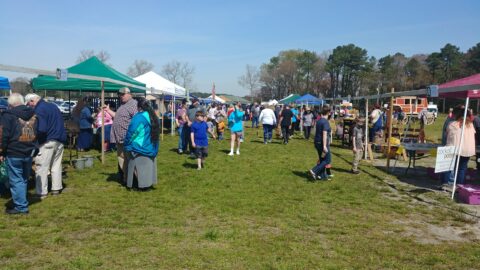
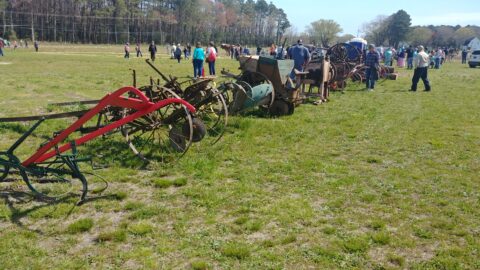
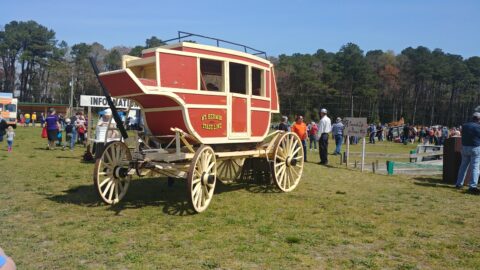
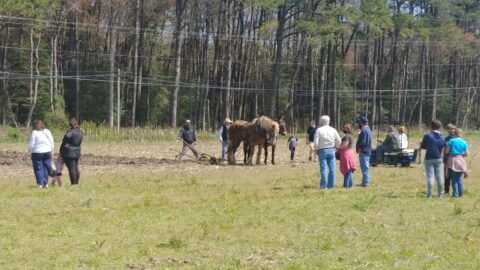
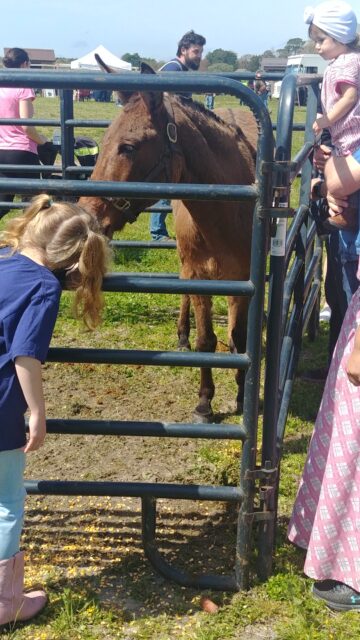
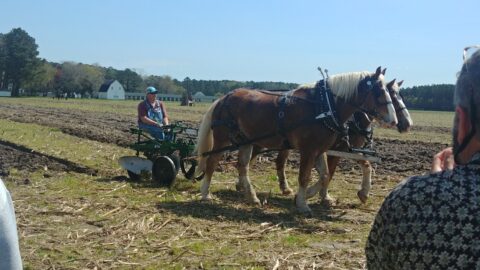
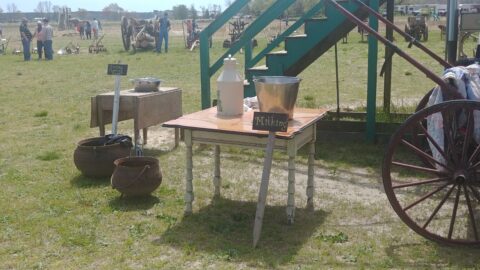
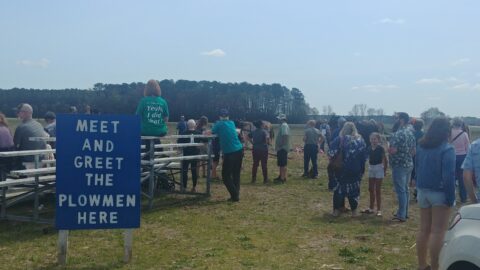
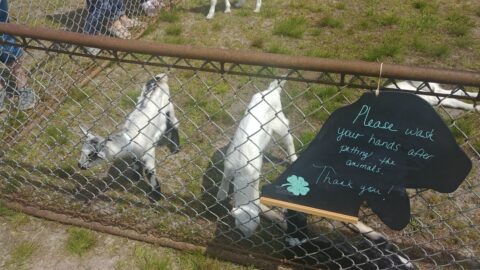
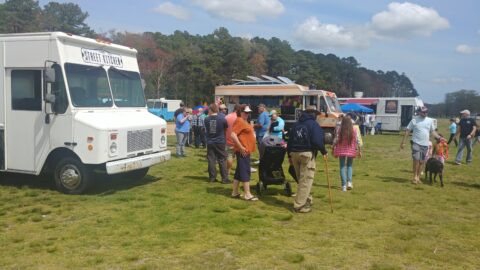
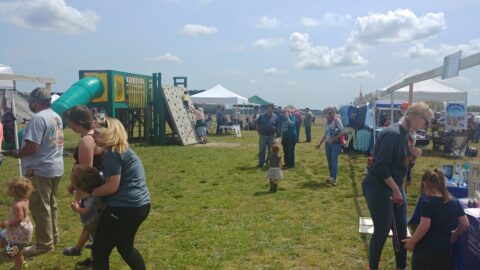
This was the midway when we arrived around 11:30. As you can see, there were quite a few people who were already in shirt sleeves checking out the wares of about ten or twelve vendors selling everything from jelly to cookware to pottery. There was also a petting zoo along here, which I will return to shortly.These were some of the implements old-time farmers used behind their horses. Each had a little sign with its name and particular use. We’ve seen this stagecoach a lot during the summer because they keep it at Salisbury Baptist Temple and use it as part of their “Summer Fun” weekly camps. The sign in the background reads “A Day in the Life of a Plower’s Wife” and there were exhibits regarding that as well.Visitors also got to try their hand at plowing a row behind the horses. It was also a chance for kids to see the horses up close, which they enjoyed. I’m sure it’s a tough and bumpy ride.Not only were there horses there, but also mules (hey, they can pull a plow, too.) They took their turns pulling, although I think this guy was there more for showing the kids.Lucky kids got to ride in the rumble seat of this old beauty. It wasn’t quite a century old (the front plate said 1930 as I recall) but close enough. Seemed to run pretty well, although I didn’t get to see if it came under its own power or on a trailer.The leader of the band, so to speak, is Oren Perdue. The founder of Salisbury Baptist Temple, Pastor Perdue is still active with this event (as well as with his church and the Summer Fun camp, although he’s handed those day-to-day reins to others.) I think I’ve featured the good Pastor a couple times in my coverage of the Wicomico County Fair, where we’ve played hooky from our church to attend his annual service there.A closer view of how the professionals do it. Not sure which of the seven teams featuring 11 different drivers this was, but they came to this event from as far away as North Carolina. It was actually a down year for participation – because the event was pushed back a week from normal, a few teams didn’t come out. Normally we have teams from five or six states.This was part of the “Plower’s Wife” exhibit I referred to. There were also three tents on the other side of the steps, but I didn’t like how that photo came out so you just get this one.I don’t think they were selling autographs, but it was nice that people had an opportunity to ask questions and generally make these visitors feel welcome. Many of them have made it to most of the renditions of Mt. Hermon Plow Days, which has become an April tradition for them. Also, I believe the vehicle in the lower right of the shot belonged to one of the local TV stations so they were out covering the event, too.This is my “awwwww” factor shot. Not many kids can resist the opportunity to pet these kids. (Nor can my wife!) Just wash your hands and make sure to sanitize after stopping by the petting zoo along the midway.Actually, it was a good idea to wash your hands anyway because there was food there – not just these three food trucks, but also a tent selling oyster sandwiches (that closed early due to high demand), a former short bus selling slushies, and a booth with kettle korn. My wife waited in line 40 minutes while I took a few of the photos above and grabbed a shady picnic table spot. Next year they might need a couple more trucks!The last photo is of the midway from the other side – I believe the line to the left was at the souvenir shirt booth. As you can see, the kids had plenty to do besides the animals.
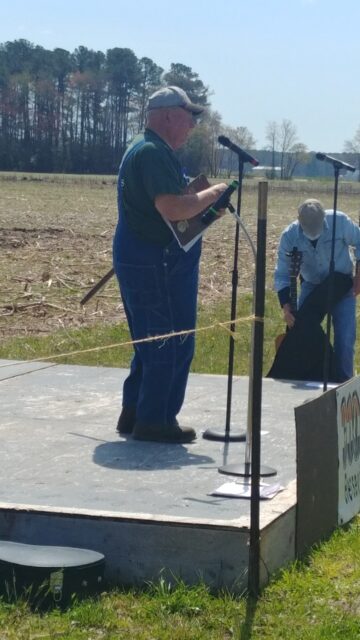
A couple things I missed in my trip around: one was the band, which was a five-piece string group called (what else) the Mt. Olivet String Band. They were just finishing up by the time I walked over there, so I caught them breaking down and that’s not a good picture. I also missed the introduction of dignitaries (generally Wicomico County local politicians and a couple media personalities) who were there. I saw the politicians enough in the last ten years, so I didn’t get up from eating lunch to grab photos. (I did cross paths with Sheriff Mike Lewis enough to say a quick “hi” as he rushed by.)
And we didn’t stay long enough to check out the horse-powered treadmill shelling corn.
If they can guarantee the same weather for next year, we may swing by again. Just teasing – I’m sure we will stop by if our schedule allows. Plow Days is a nice introduction to spring and I’m glad it came back without the wokescolds complaining about how few out of the 1,500 to 2,000 I’m guessing were there yesterday for at least part of the time were wearing face diapers.
It’s time to reach back across the Transpeninsular Line and look at a situation where I used to live, in Wicomico County, Maryland.
In my ten years on the Wicomico County Republican Central Committee, there were two accomplishments I was quite proud of: helping to secure an elected school board and expanding the Republican majority to 6-1 on County Council in 2010, then maintaining it in 2014 while electing a Republican county executive.
Unfortunately, while we kept the Republican county executive in 2018, the GOP dominance on County Council was eroded by a number of factors: first of all, there was the retirement of a Republican stalwart who represented a heavily Democrat district and the failure to recruit a good replacement for him – the candidate who ran was a last-minute Central Committee selection as no Republican filed for the office. Secondly, there was weak candidate recruitment for the county at-large seats, meaning we essentially gave away a spot to a retread Democrat who would have been defeated by a better Republican (or one willing to give up a district seat to run countywide.) Once the smoke cleared the GOP majority was a bare 4-3.
Fast-forward to the summer of 2019, when the Central Committee was tasked with sending names to County Council to replace Republican District 2 member Marc Kilmer, who resigned for family reasons and relocated to his native Idaho. Eventually the Council selected fellow Republican Nicole Acle, who had never run for office before but would now need to defend the seat in 2020 thanks to charter changes which allowed for special elections to fill seats vacated in the first 18 months or so of an elected official’s term. (Similarly, there will be a district school board race for the replacement of a deceased member but only one person is running.)
On the Democrat side, the lone contestant was a familiar name: Alexander Scott, who ran for the same seat in 2018 against Kilmer and lost by a 63%-37% margin. But in 2018 that was a race among many others and this time it’s a special election with considerable focus – and the potential to give the Democrats control of County Council for the first time since 2006 (as well as the first time in the County Executive era, which began with that election.) The state Democrat party (or at least their state committee member Allison Galbraith) as well as local regressive groups have taken note of the opportunity, soliciting support from other quarters of the state for a district of about 20,000 people.
Obviously the propaganda aspect of this race is huge – a flip in the Eastern Shore’s largest county would be noticeable and may be seen as the end of GOP dominance in that part of the state. More importantly for Wicomico residents – and workers like myself – it would put the same party which advocates for the Green New Deal, ending the Trump tax cuts, and gun control in charge of the local legislative agenda.
So who is Alexander Scott, and – more importantly – who is backing him?
On his website, Scott bills himself as “moderate” and “a conservative Democrat.” He’s even found a handful of Republicans to back him (more on that in a bit.) However, Scott is also the owner of a bar called The Brick Room, which has previously hosted drag queen events and proclaimed it’s “proud of” Black Lives Matter, in part because of a “racist Confederate sign” they helped to remove. (The sign, which actually faced the opposite direction from the bar, was a historical marker placed by the state in the 1980s.) I’m not sure that’s the agenda of a “conservative Democrat” but it is the agenda of a Democrat. Granted, I don’t necessarily expect wholesome entertainment from a bar, but that seems a little more like Times Square than a small town.
Yet there were some interesting backers for Scott’s candidacy. In looking at state campaign finance records, I found that his campaign was using ALCEs (Affadavit of Limited Contributions and Expenses) until the end of August. An ALCE is a statement declaring the campaign will neither raise nor spend a total of $1,000 during the period in question. Many ongoing campaigns file these in off years; my treasurer and I filed these on a regular, annual basis when I had a campaign account as a Central Committee member because I never came close to raising or spending that much.
After the August filing, however, the Scott campaign received a number of large donations from real estate and construction interests, particularly ones known for work in downtown Salisbury. It’s the area where The Brick Room is located, but not in the district he would represent. This also means Scott has a relatively significant war chest for a County Council campaign, with a few four-figure donations arriving in the early weeks of the most recently closed filing period. Considering Scott raised less than $1,ooo in total for his 2018 run, there are people who smell blood.
Initial seed money came from the Gillis Gilkerson group – between Chris and Joey Gilkerson and Brad Gillis these donations totaled $1,600, and that was enough to get him started. Members of Green Street Housing, a firm that is “getting affordable housing done” have chipped in an additional $2,000.
On the other hand, Acle has subsisted on mainly smaller donations, with the largest of $250 coming from State Senator Mary Beth Carozza. Her district barely intersects with Acle’s so it’s more a gesture of support for a fellow Republican.
The birth of Republicans for Scott, however, stems from the controversy that arose in the search to replace the late County Executive Bob Culver, who died in office in July. Of the three candidates interviewed by County Council to be Culver’s replacement, the odds-on favorite was Delegate Carl Anderton, Jr. However, a four-member segment of County Council led by Acle decided on the more unheralded Dr. Rene Desmarais as their choice. When public furor prevailed on Desmarais to withdraw his name from consideration, a second round of interviews featuring Anderton and another hopeful led County Council to decide to keep the Acting County Executive John Psota in place until the 2022 election.
The story Scott’s allies have been spreading was that Anderton was refused his due because he was too willing to work with Annapolis Democrats to advance his district – a conservative purity test, if you will. However, from what I recall about Desmarais and his 2014 Delegate campaign, he wasn’t the most conservative aspirant out there. Others have been critical of Anderton’s being less than forthright initially with the situation surrounding his high school graduation, a story which he recounted after the initial vote. (The subject never came up during his time as Delmar mayor or in his runs for Delegate, though.)
Regardless, this is one of those times where the county government hangs in the balance. With the temporary appointment of Psota as acting County Executive, most of the county’s direction (including redistricting) would be led by a Democrat majority that has both the element of “getting even” for the last six years of Republican rule and a heavy influence from the city of Salisbury: all three Democrats and Scott (via The Brick Room) donatedto Salisbury Mayor Jake Day’s 2019 re-election campaign. It should be noted that several “Republicans for Scott” also donated to Day.
As I see it, the priorities will shift radically under a Democrat council. For one thing, the city has been demanding a tax differential from the county for several years, with the county reticent to do so as county residents outside municipalities would have to take up the slack. This may also extend to the desire by groups like the Greater Salisbury Committee to revisit the revenue cap that has been in place since 2000, a cap put in place when County Council raised taxes significantly a few years before.
Other items on a Democrat wish list may include significant zoning restrictions on agricultural land and development outside the urban core, making it more difficult for farmers but allowing the well-connected real estate developers downtown to cash in further.
I may have moved from Wicomico County, but I still work there and would like it to continue to succeed. Regardless of how conservative any Democrat claims to be, the fact that they are Democrats belies any claim of conservatism. Simply put, their agenda isn’t good for Wicomico County.
Even in a wave year for Democrats both locally and nationally in 2018, District 2 voters opted to maintain their conservative representative. The time to address any issues with Acle will be the 2022 primary. Don’t punish the rest of the county because you disagreed with her choice for County Executive.
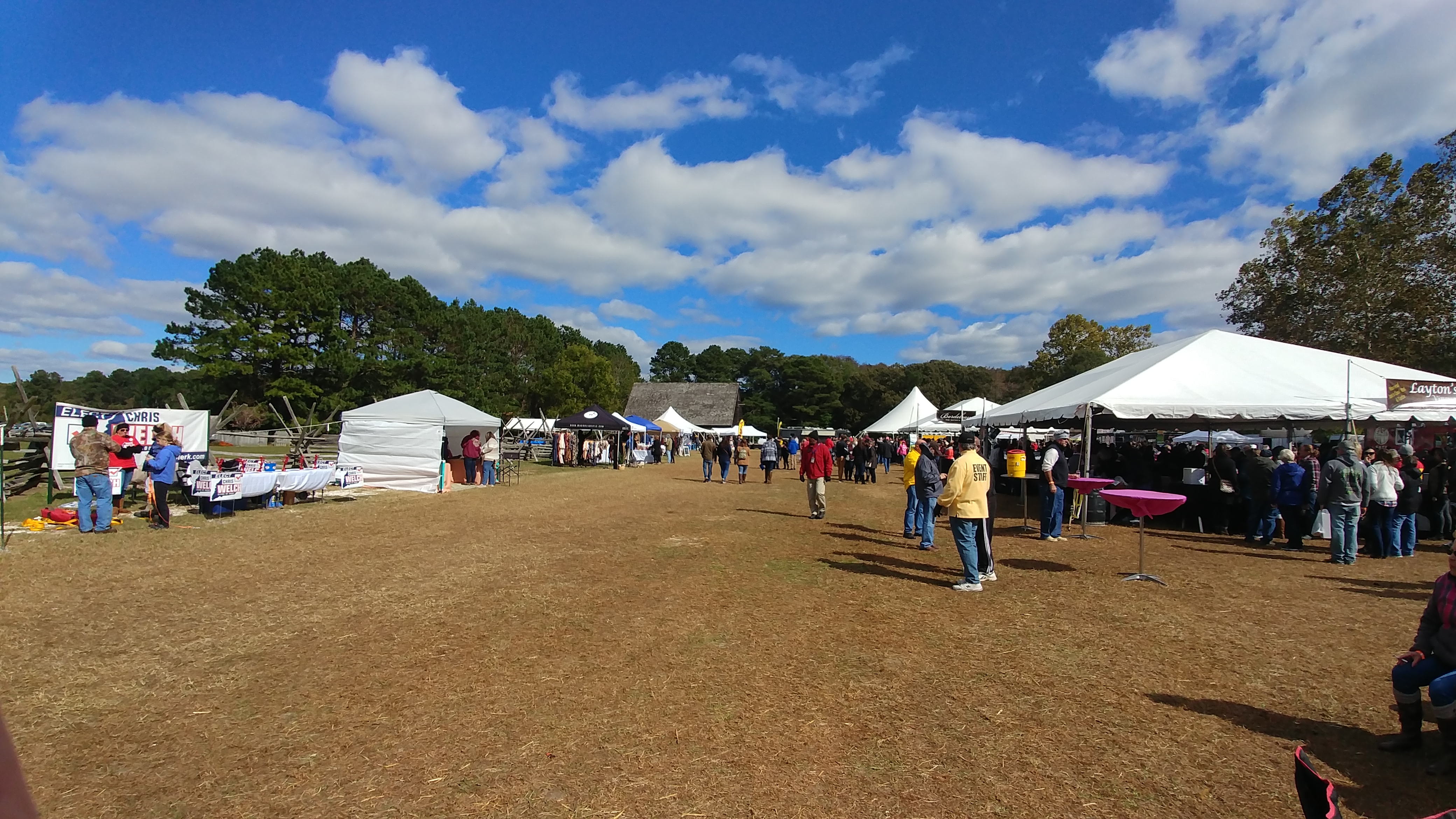
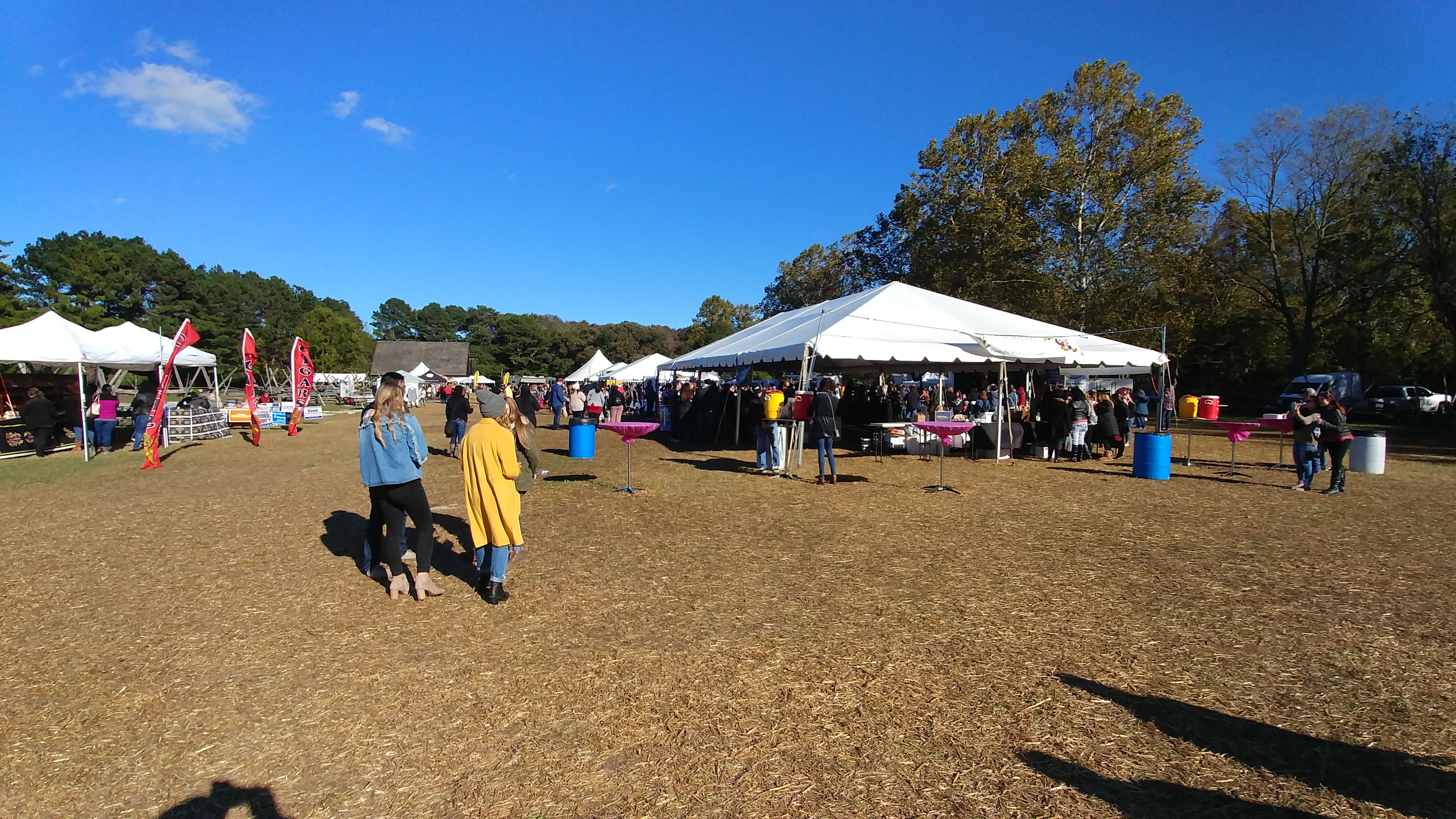
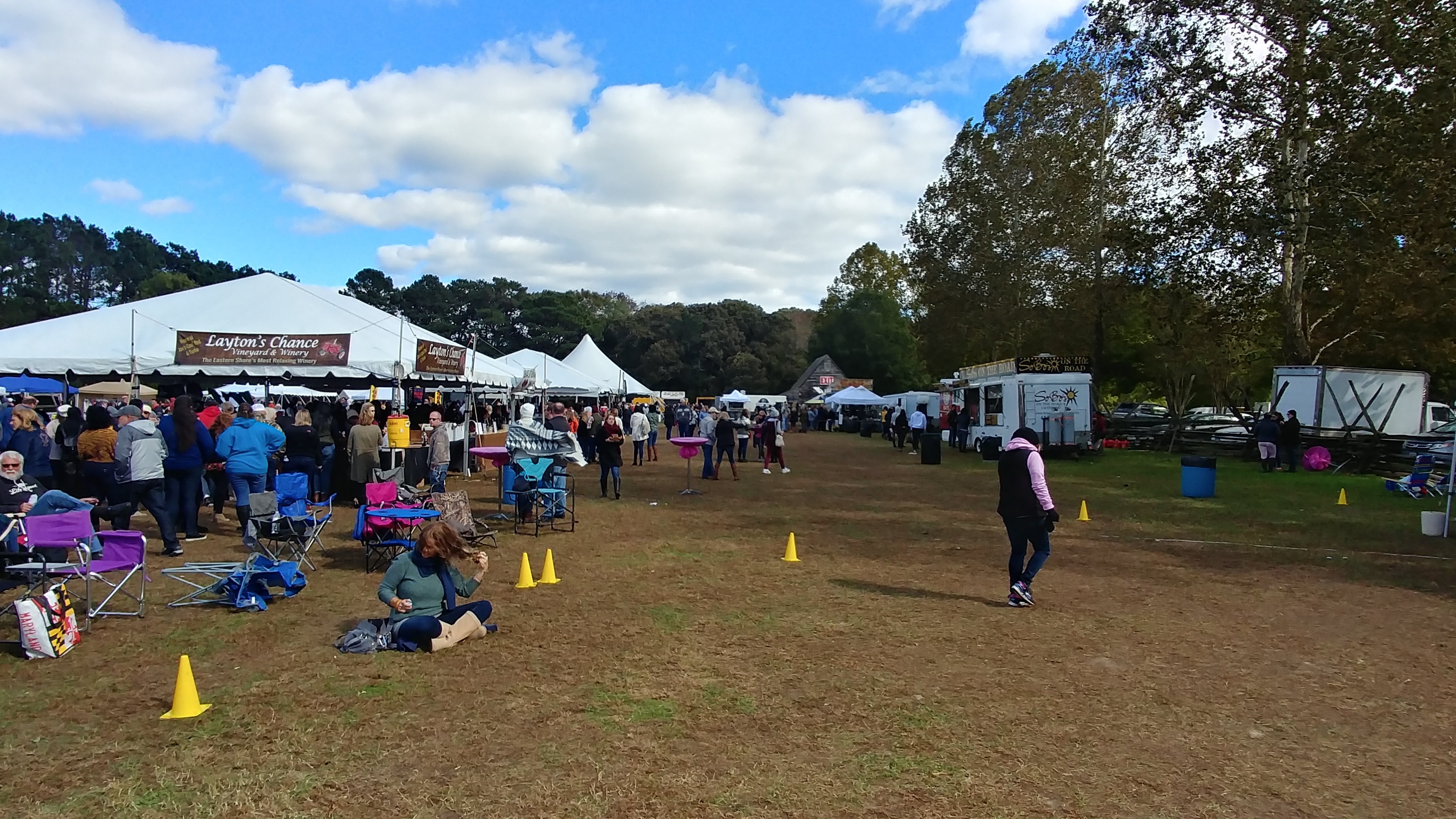
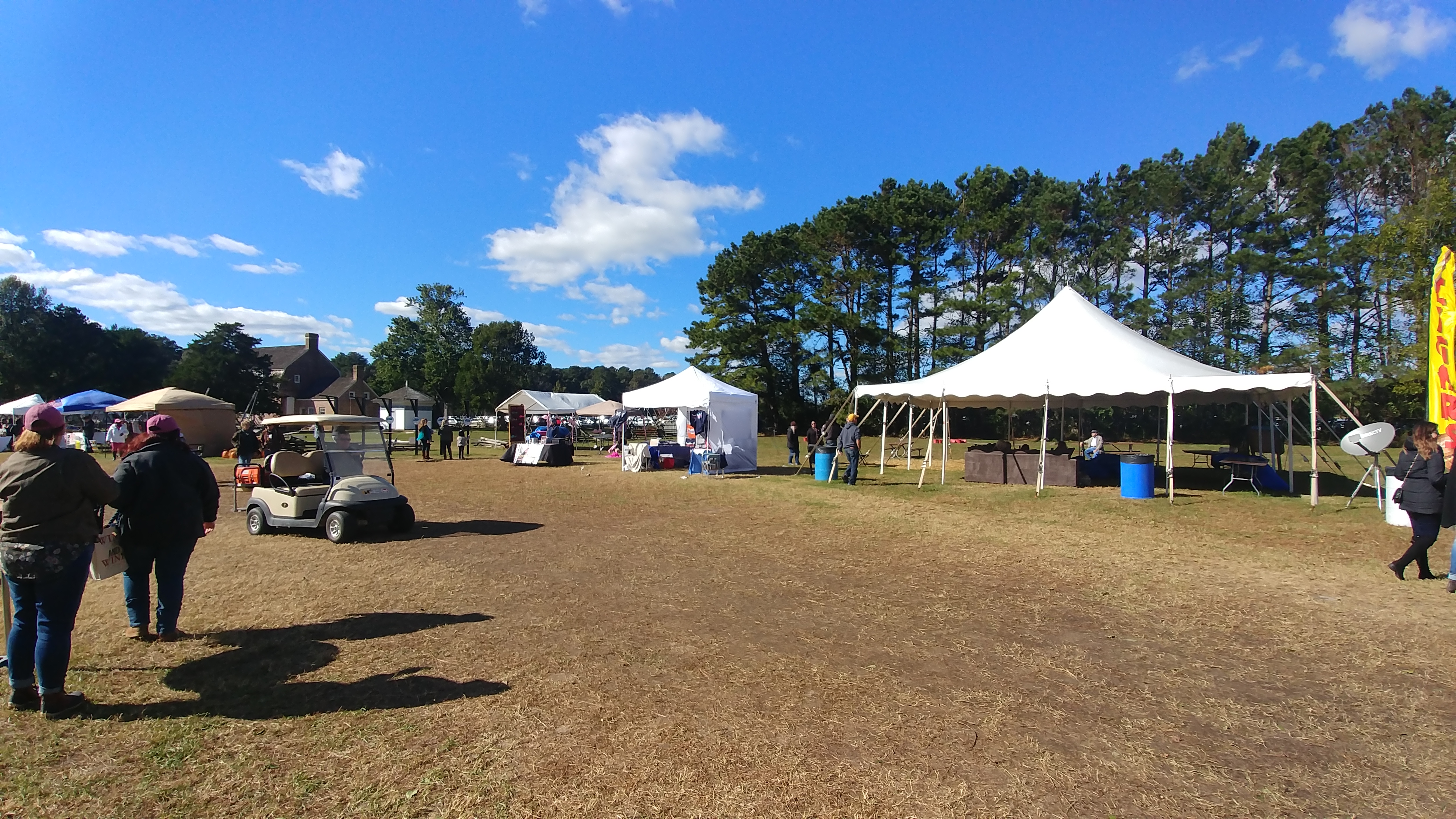
Just like the Good Beer Festival last week, my photographic series on the Autumn Wine Festival returns after a three-year hiatus. And like the GBF, a lot has changed over the last three years, but not necessarily for the better. The best thing is that it gives me a break from political posts.
Once again, I can allow the captions to help tell the story.
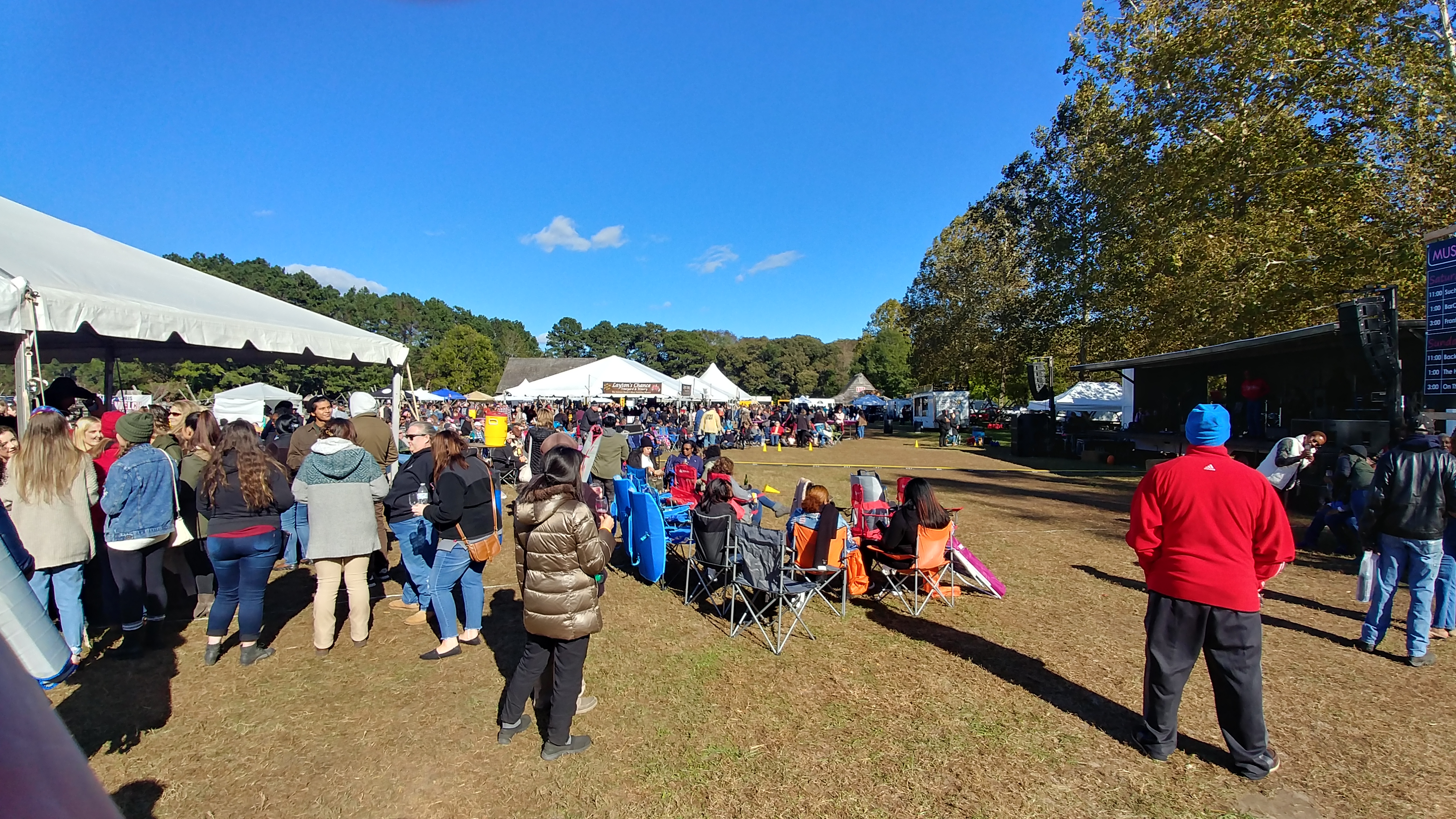
As we arrived about 1:30, the party was already underway despite a blustery, chilly Sunday.
I’m not going to have a ton of photos this year. Unlike other years when I was somewhat of a captive to the event as the guy who coordinated the GOP tent for almost a decade and hence was there almost the entire time, this time I was a “civilian” who was simply serving as DD for my wife and generally just tagged along for about 2 1/2 hours Sunday – enough to get a flavor of the place. So a lot of my photos were taken of the two bands I saw as part of an upcoming WLR segment.
Speaking of political hostages…
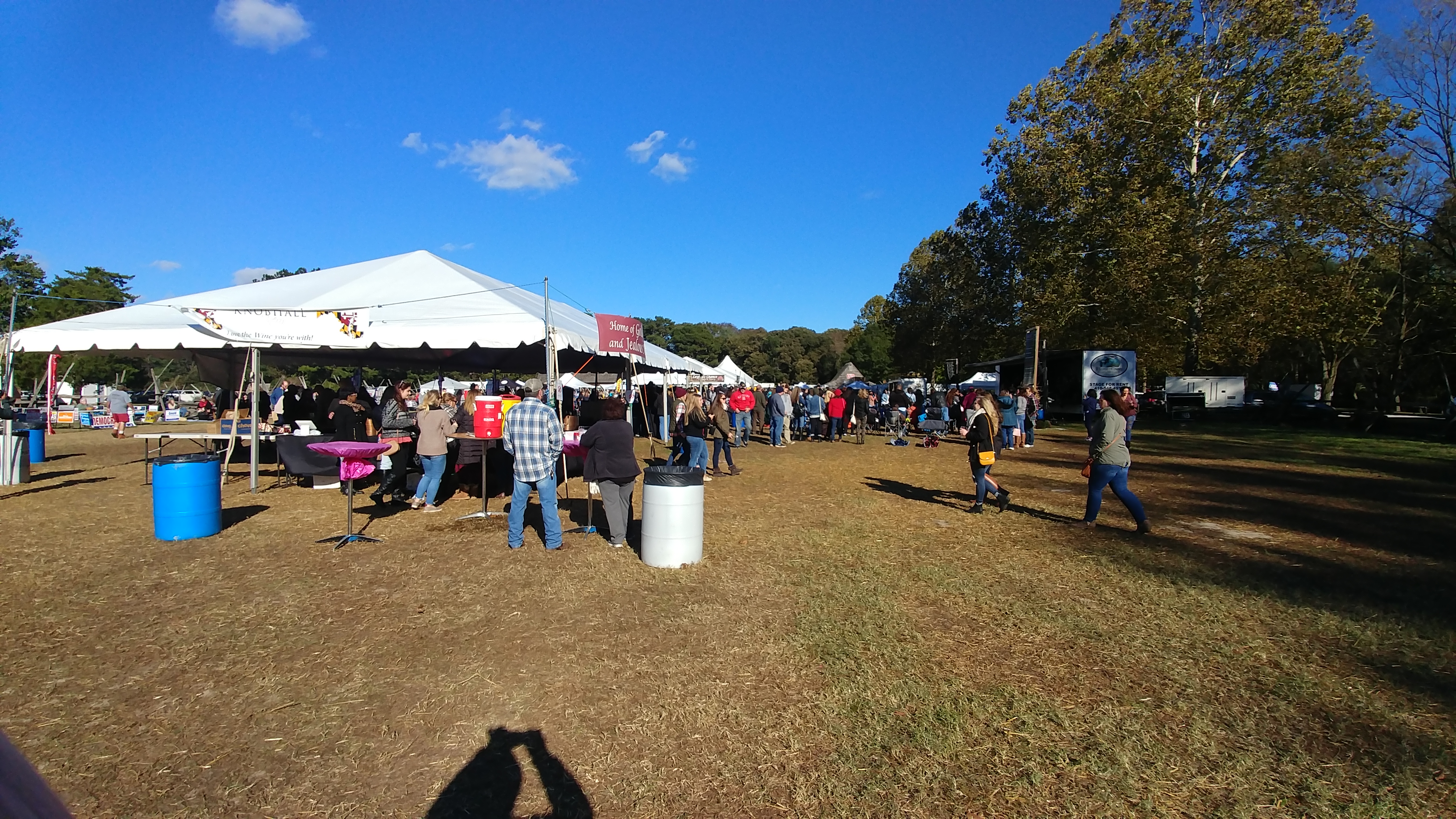
Notice anything missing? The Democrats didn’t have a tent – however, they were not the only ones baring it in the sunshine.
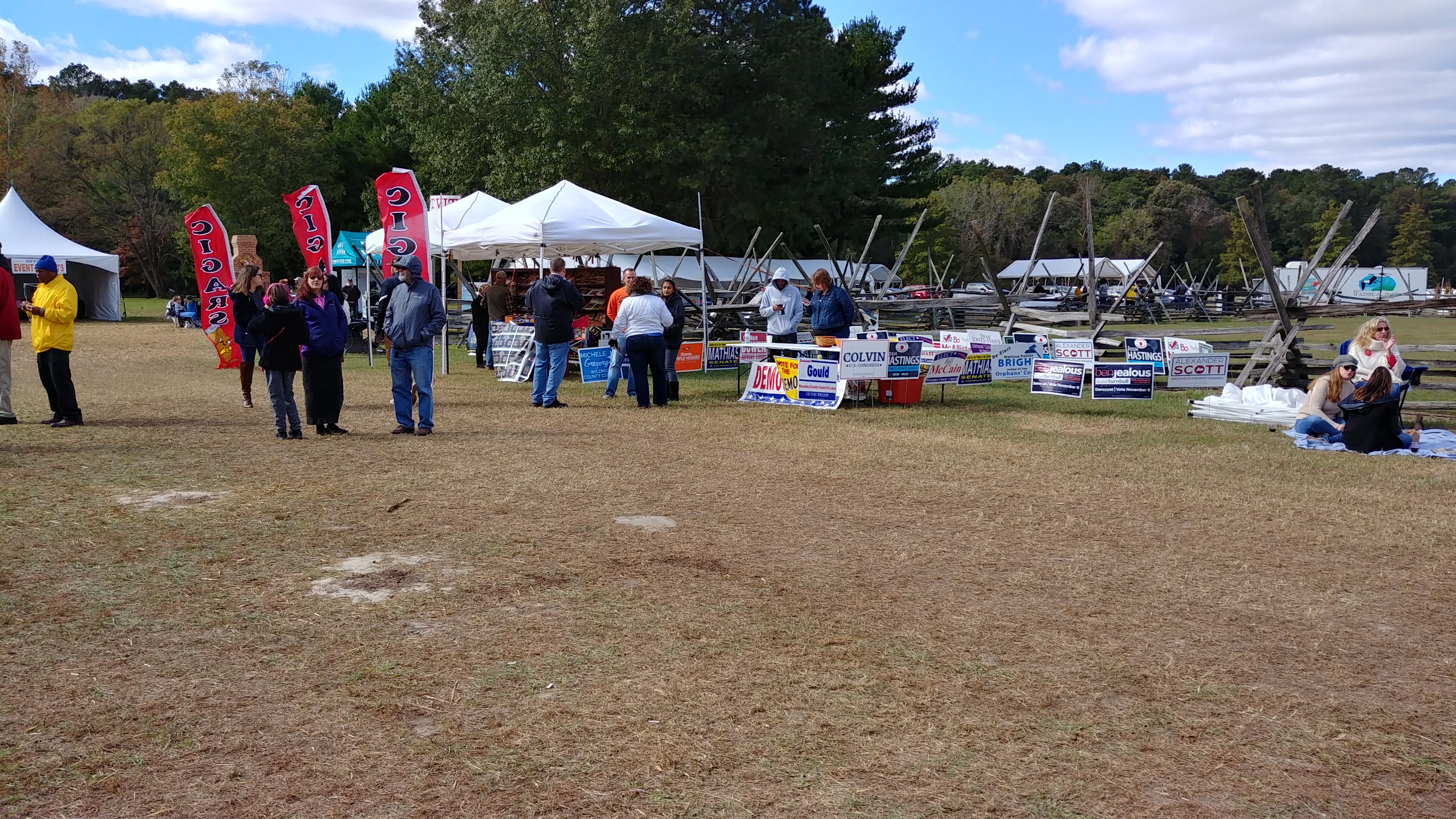
This was the Democrats’ space. In looking at it in the photo, I’m wondering how much extra property they took outside the 10′ x 15′ square you’re usually assigned to get all those signs up – including perhaps the only two Ben Jealous signs in Wicomico County. (Okay, I’m kidding on Jealous – but I don’t think I’m kidding by much.) But seriously – it looks like they are way outside their boundaries.
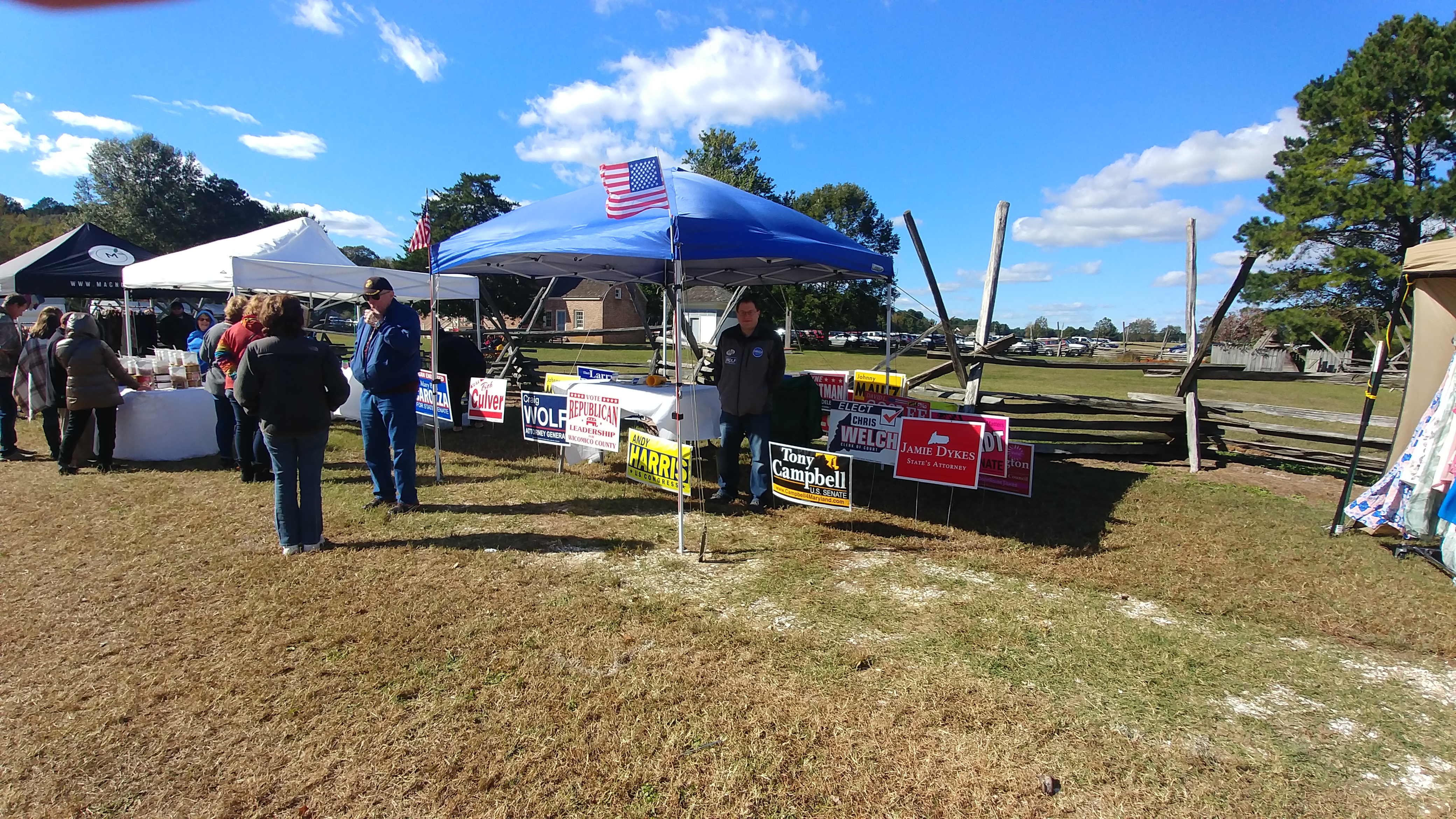
Shawn Jester (behind table), Woody Willing, and a little of my finger were representing for the GOP.
By comparison, the GOP wasn’t overstepping by too much. They had a reasonable business going, but not spectacular. Nor did I see a whole bunch of folks at the competing spaces for Bo McAllister and Chris Welch. I got Welch’s space in the photo below.
On the left is the tentless space of Chris Welch, whose crew abandoned the tent on Sunday morning thanks to the high winds.
I thought I caught McAllister’s tent in a shot but it turns out I did not. It was just to the right of this photo, and you can see the dearth of people on this side.
Just off the right side of the photo would have been Bo McAllister’s tent. By the time 3:30 rolled around this end was about dead.
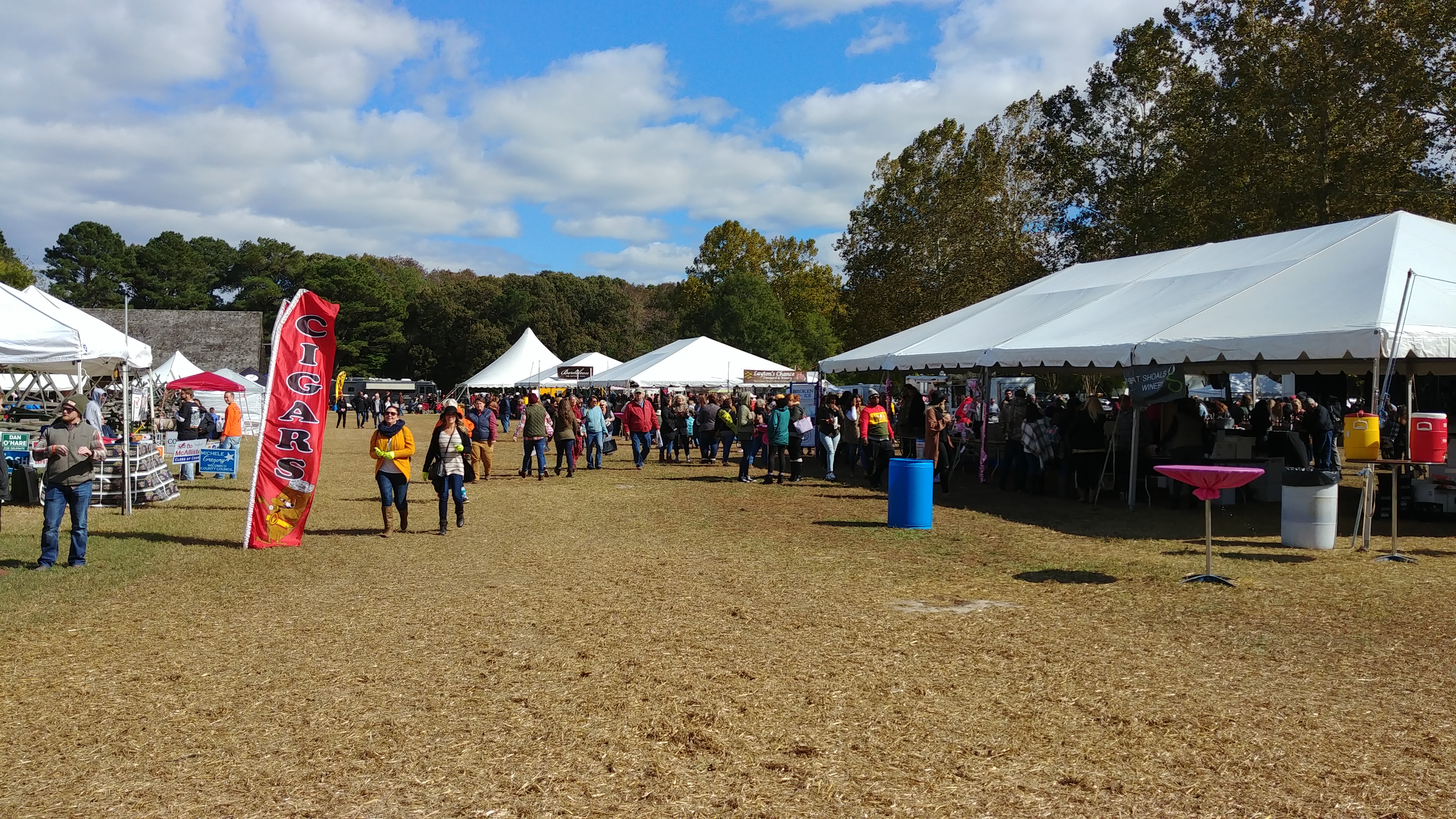
I’m looking up toward the food court here. The arrangement was somewhat similar to the GBF as far as the food and stage were concerned.
I will say the food selection was excellent. I tried a place called The Street Kitchen, which is the white truck way off in the background of the shot – good pulled pork and outstanding slaw some may kill for. Come on back to the next festival!
Unlike last week, those who wanted to sit and watch the game on a comfy couch were indulged. Or maybe they had the Hallmark Channel on, I dunno.
One thing I did before piecing this post together was read my previous posts (2007-15) from the AWF. (2007 was the first year I worked it, so the cool thing is the institutional knowledge – which will get even better when I dig up the photos missing from a couple of those years.) Once upon a time they had a VIP area, so I wonder why they did away with it?
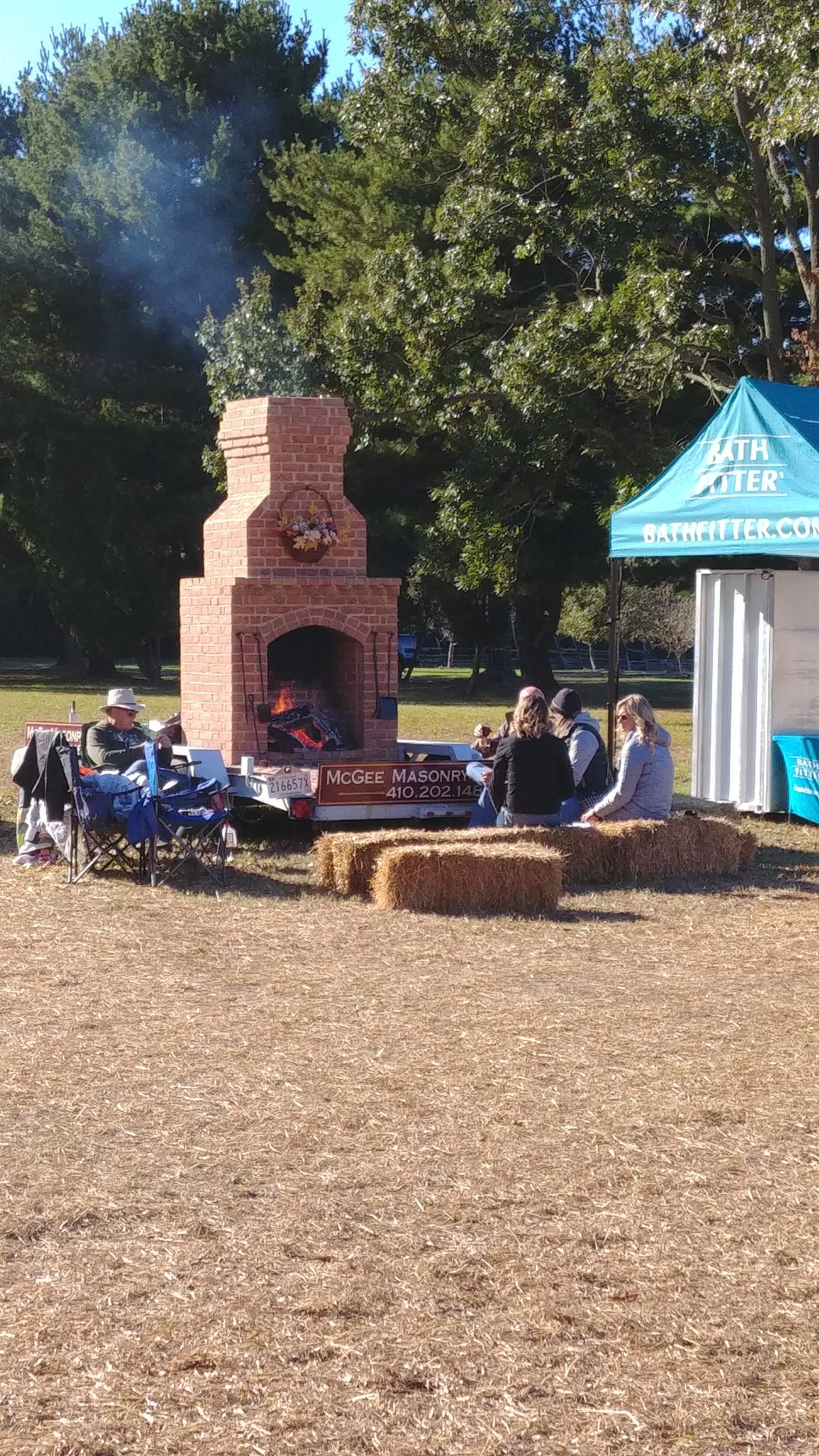
The real VIP area on this day would have been smack dab in front of this fireplace. If you could see the stage from this spot I think there would have been a whole cast of people camped out there – including me!
Here is another vendor who can come back. I walked by there coming in and felt the heat.
I noted the stage in my last caption. These are views looking toward the front of the stage at 3:00 and 3:30.
They were already beginning to camp out in front of the stage by 3.
I’m looking down from the south end of the winery tents toward the stage. People had pretty much vanished from the end tents by 3:30-4:00.
Even the lines to the porta-potties were practically non-existent by the time we left, right around 4:00. To be perfectly honest, the vendors could have packed it in about 3:30 and Kim said a couple were.
So I took some shots of signs and wine bottles I liked.
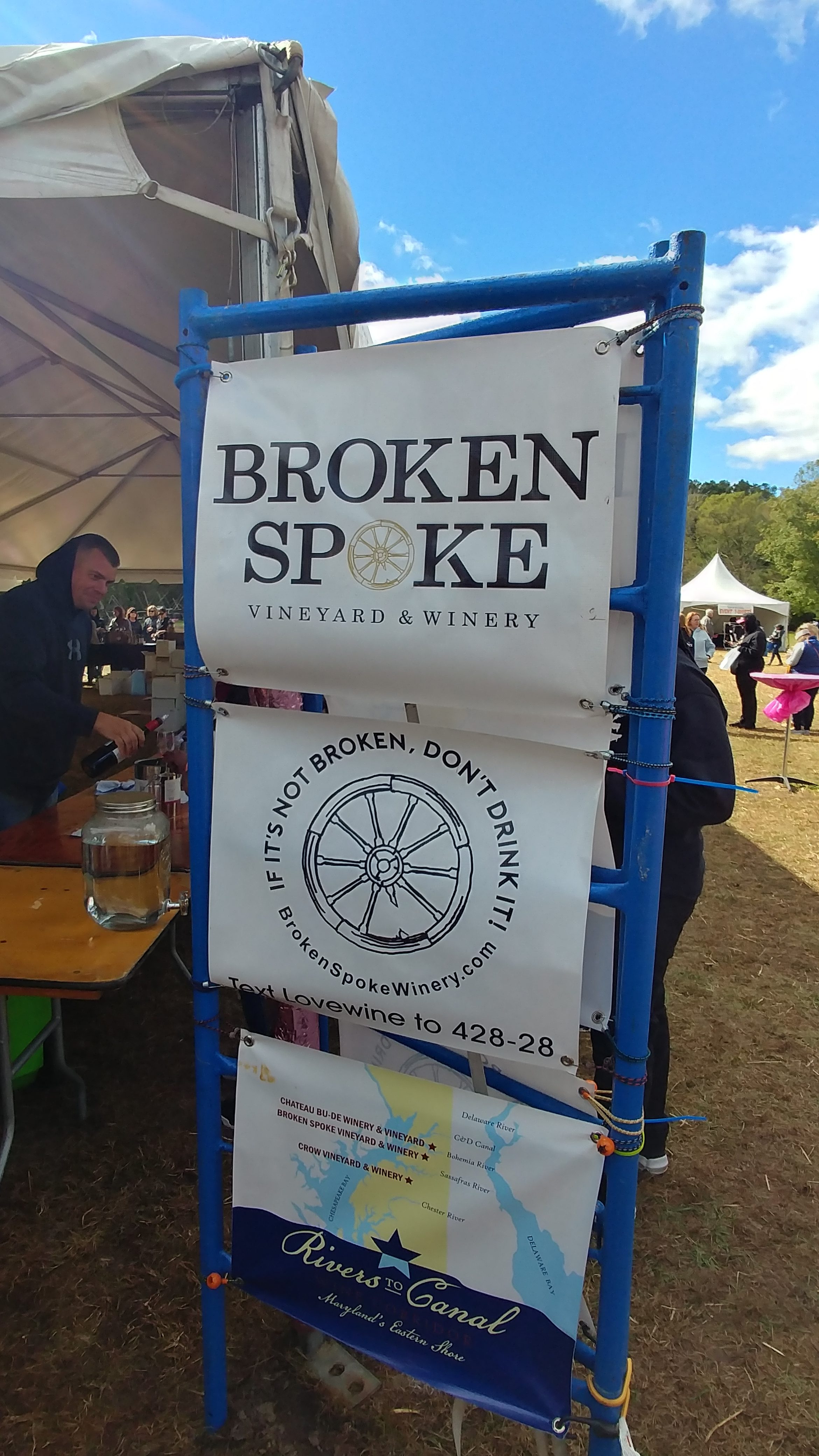
Love the play on a phrase.
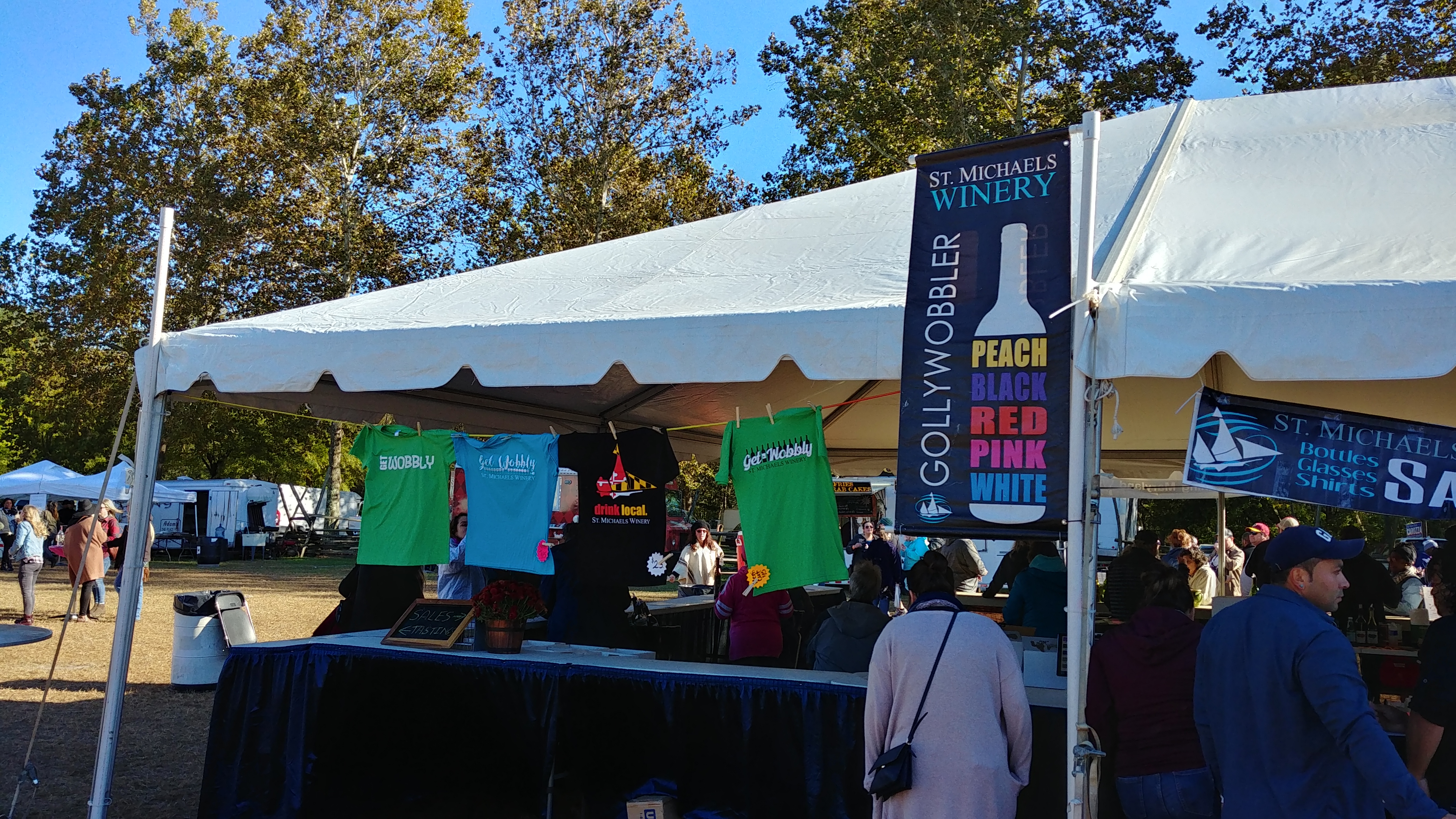
New variations on the old Gollywobbler theme. It’s a popular drink.
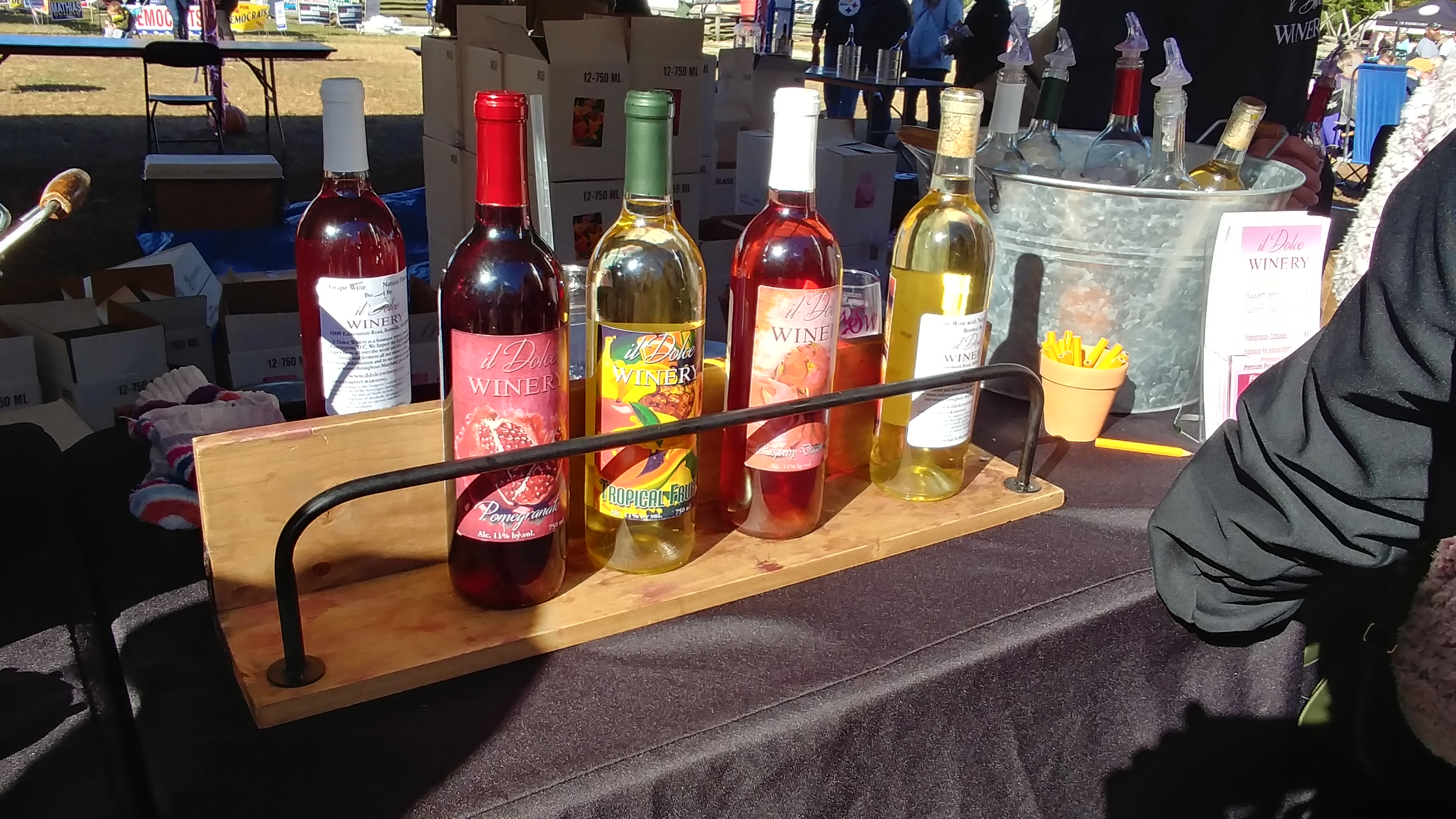
The old sun + wine bottles shot, in this case courtesy of il Dolce Winery.
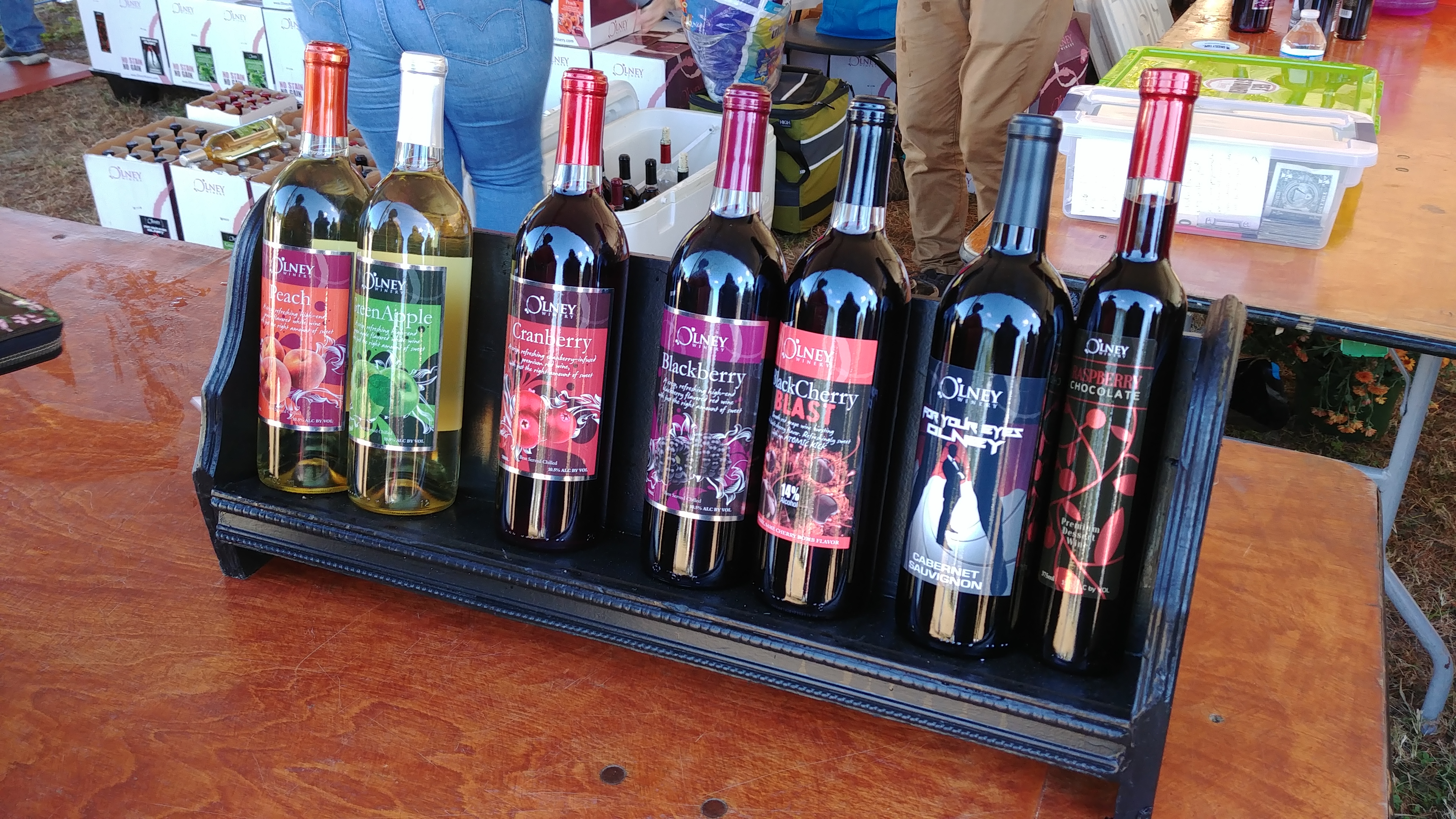
Olney Winery had the neatest bottles, though.
In speaking to a vendor (in this case, the wife of a candidate) I was told they had 2,400 people there Saturday – in that case it seems like a down crowd. Granted, it was cloudy but it was also about 10 degrees warmer and about 1/4 as windy. According to the vendor application, though, the county expects an attendance of 3,500 for the weekend.
So I think they were probably about there, and even though I’m not a great judge of crowds it’s sort of sad to see the lowered expectations. In doing some digging I found out the event eight years ago drew 4,651 (and the first-ever GBF had 2,378.) But the problem for the vendors is that they need to sell probably a net $500 worth of merchandise just to cover all the fees associated with the event, let alone make up for the time. My older pictures of the event show long rows of vendor tents, but this year’s had some large gaps in them.
And when you think about it, what is the county providing? It’s their property, but it’s paid for. You have to pay for two nights of security and rent of generators for a couple days as well as pay the talent and for the printing of the tickets, I know this (as well as the GBF) is supposed to be a fundraiser, so then the question becomes how cheap is too cheap?
I’m a guy and I don’t drink wine, so right there I seem to be eliminated from their target audience as Women Supporting Women is a lead sponsor. But I am also the DD for someone who is in their target audience, so you may want to rethink a couple things next year.
In the more immediate future I’m thinking you’ll see two WLR posts over the weekend as I clear out that docket.
It’s been a few years since I got to share my experience at the GBF, for various reasons: I involuntarily skipped the 2016 event (because I couldn’t go that Saturday and Sunday was rained out) and last year I went but lost all my photos when my phone crapped out a few days later. So since the last time I got to do such a post a whole lot has changed – including the captions I can add.
I’m going to begin by thanking my DD, who is better known to most as my wife. She got this photo coming in to pick me up.
We were nicely welcomed to the grounds of Pemberton Park. You can tell she was coming to pick me up by the sunshine. Photo by Kim Corkran.
One major difference was having the GBF move to a Friday evening – Saturday schedule. From what I could gather from asking around, attendance Friday night was decent but not earthshattering – probably akin to a normal Sunday. But since photography isn’t nearly as good at night and being an amateur photojournalist is half the fun for me at the GBF, I chose to only attend Saturday.
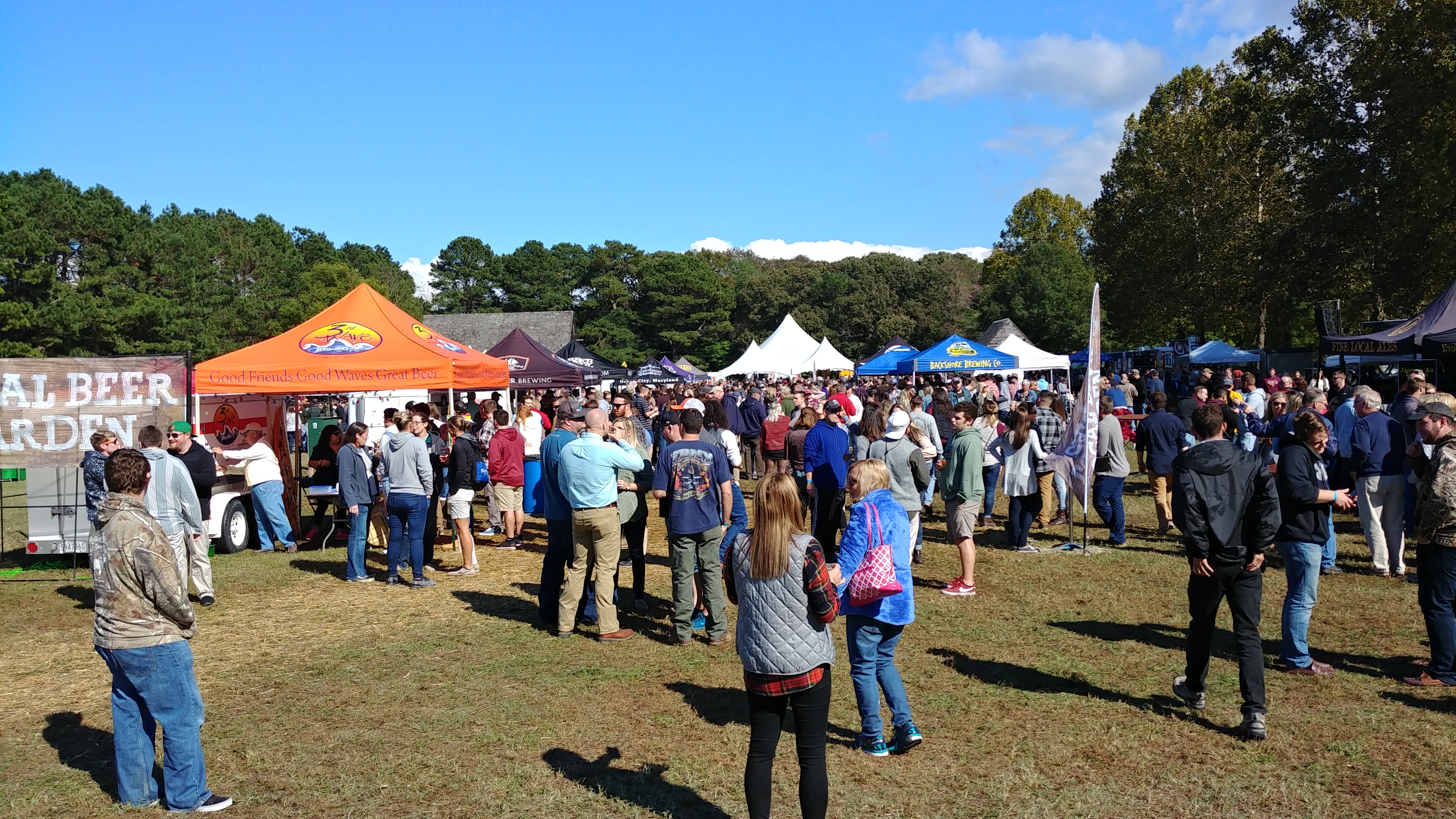
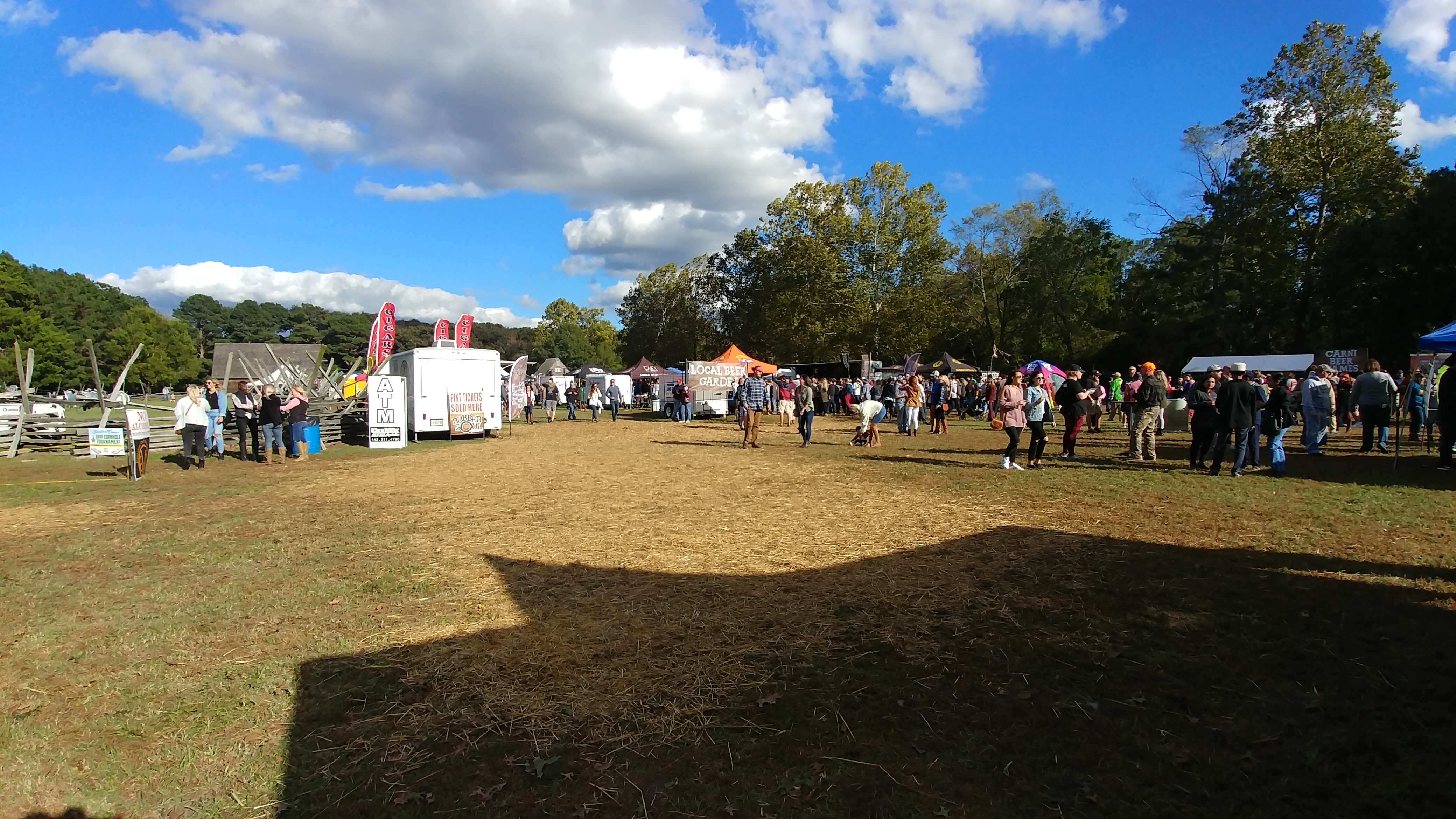
I arrived there a little after noon for a 12:30 opening and the crowd was pretty strong already.
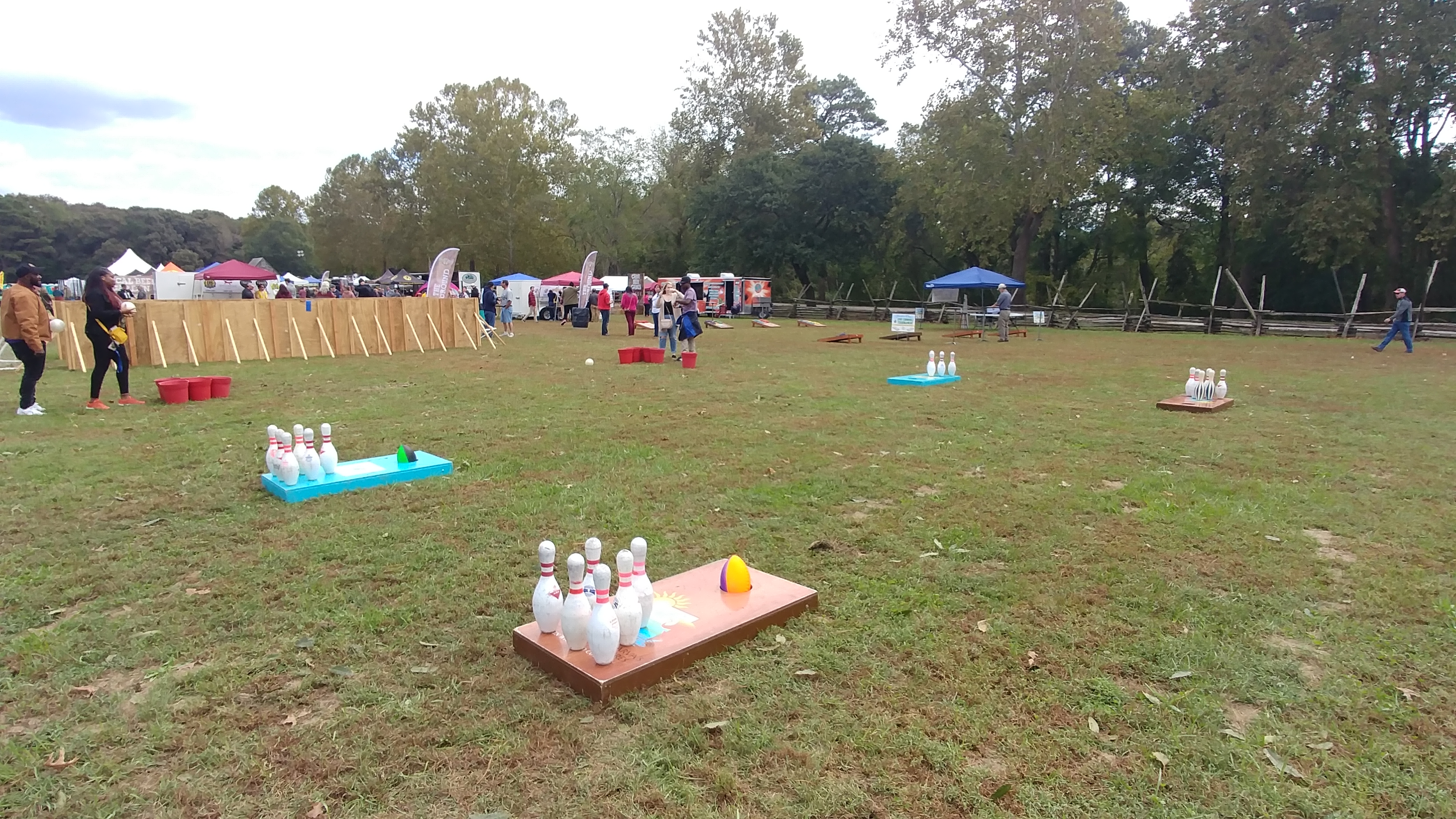
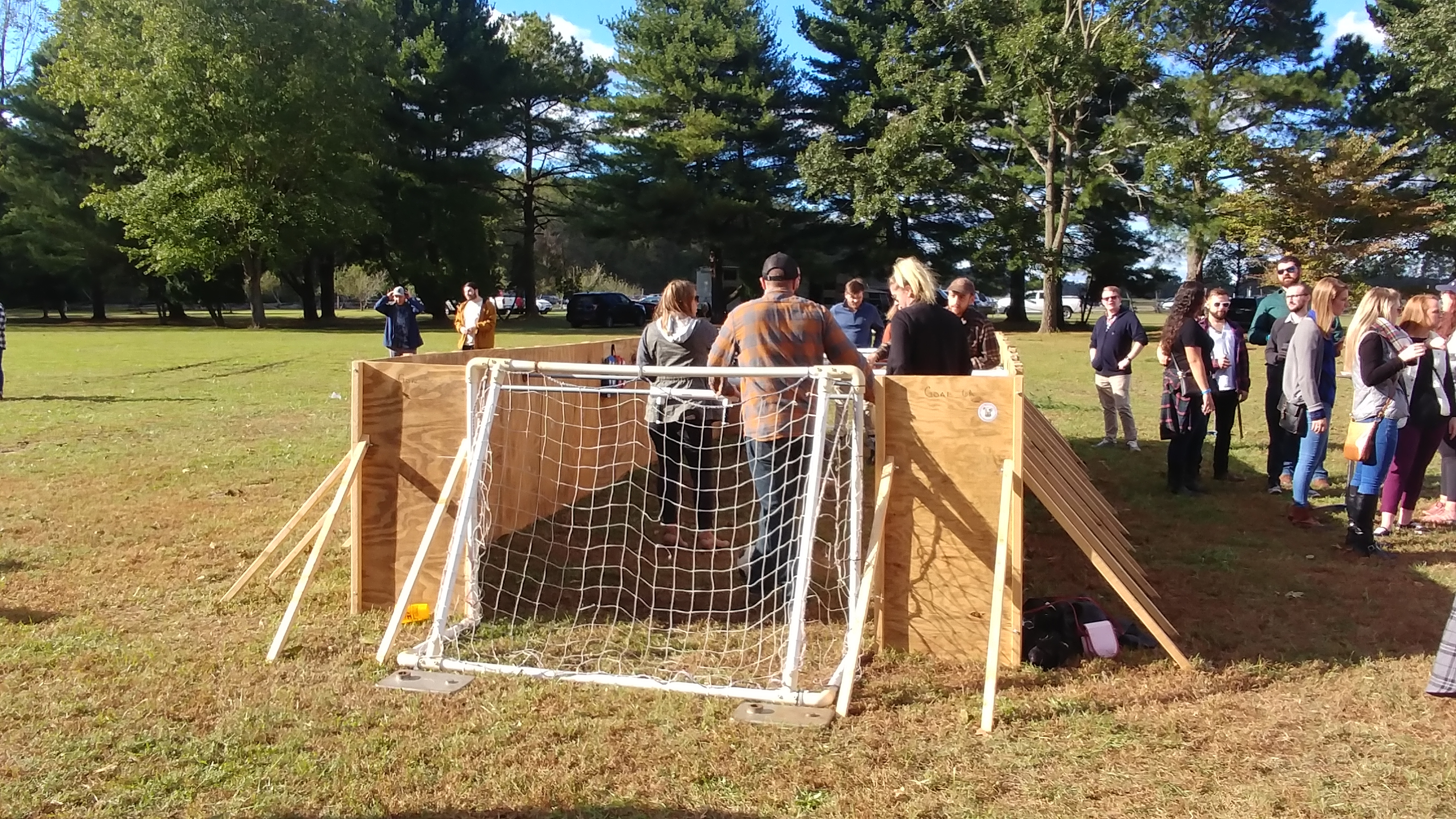
They added a few different games for the people to try, like the large-scale beer pong and unique bowling alley.
This is harder than it looks. I think I’ll stick to the bowling where they return the ball to me.
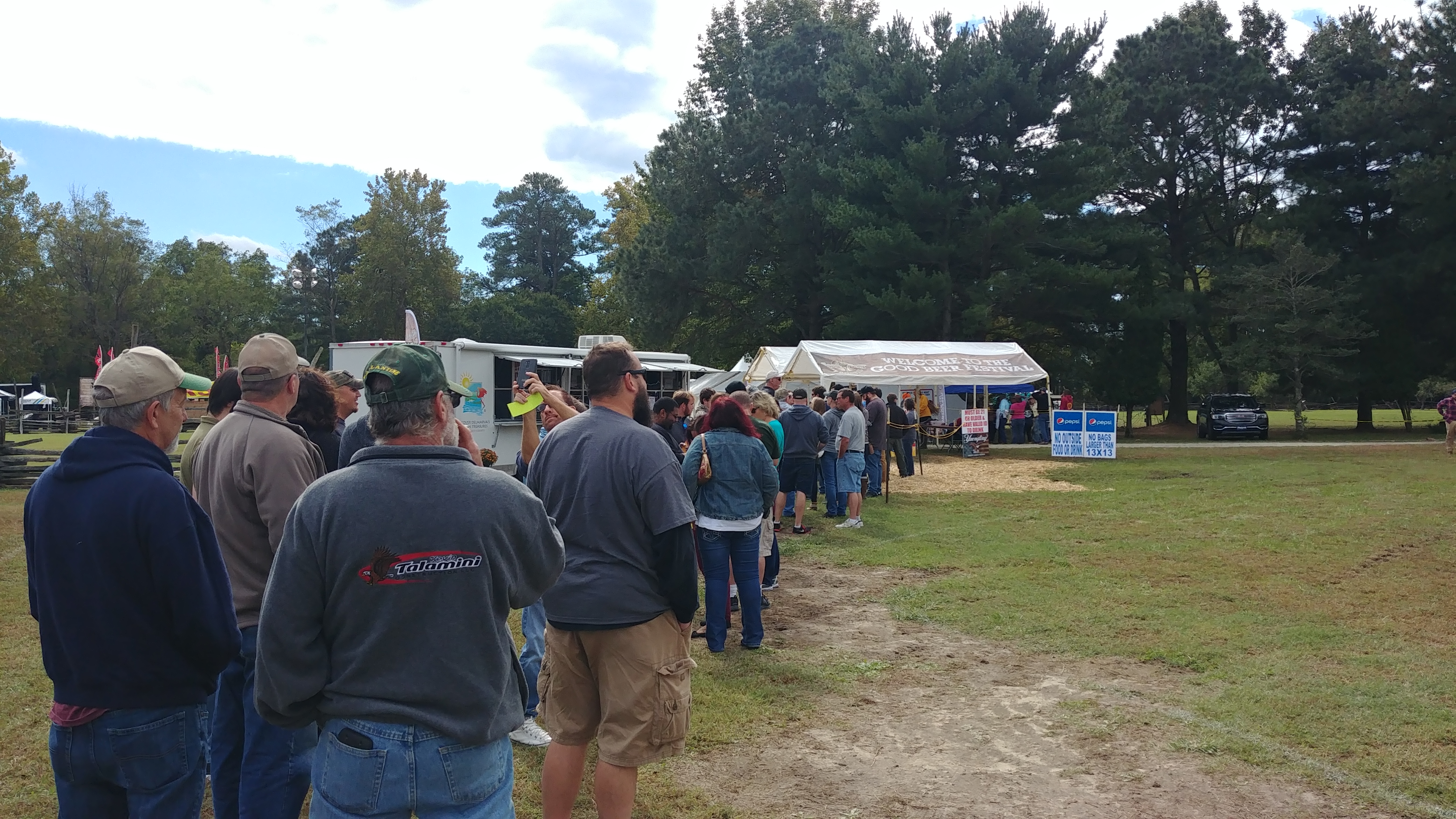
It was a modest beginning to the day. Seemed like a lot of people in line, but once they scattered it looked a lot emptier.
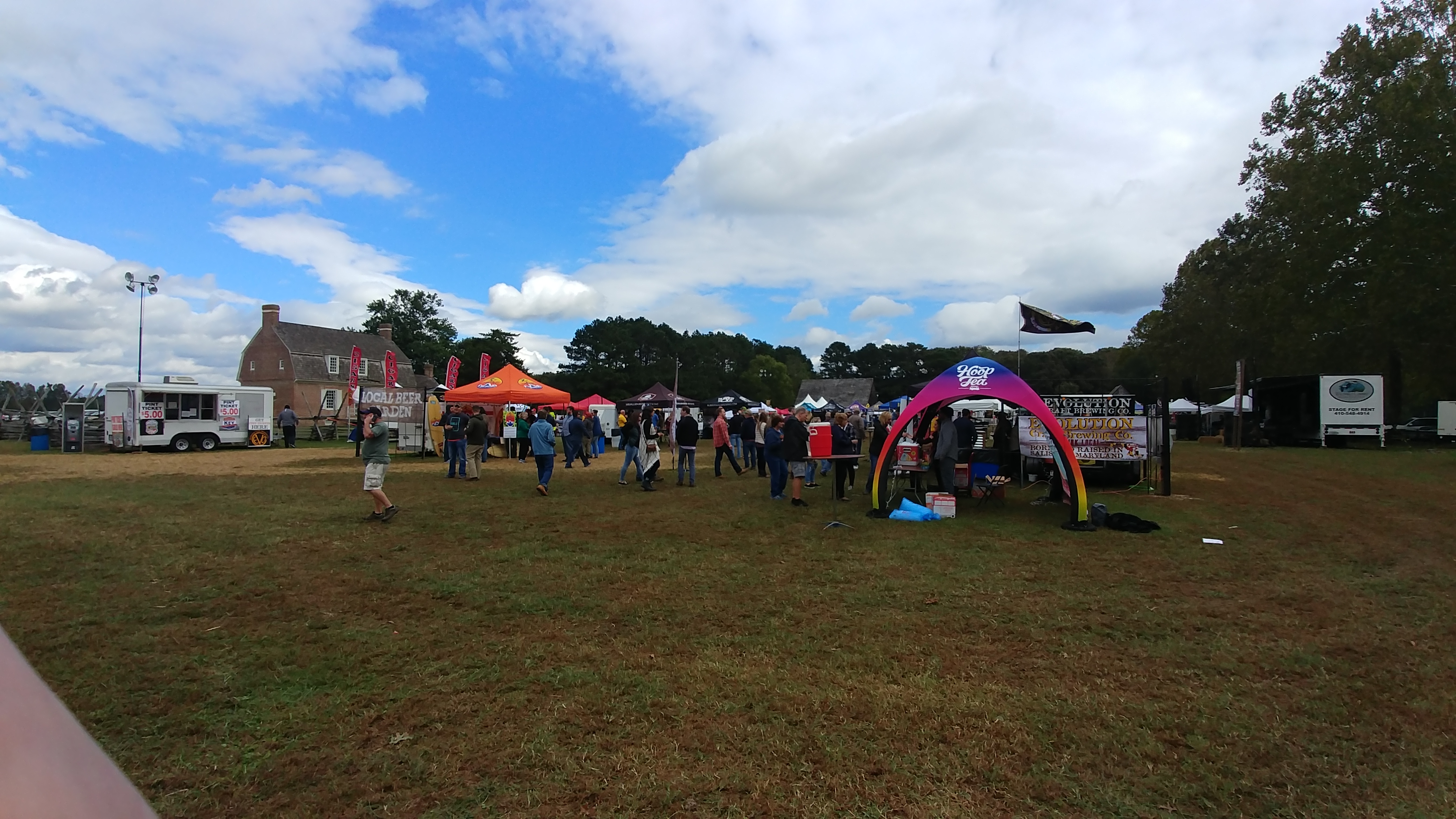
This is the local beer garden. It seemed to me that there were a larger proportion of local breweries vs. out-of-towners than before.
The beer garden from the “back” end.
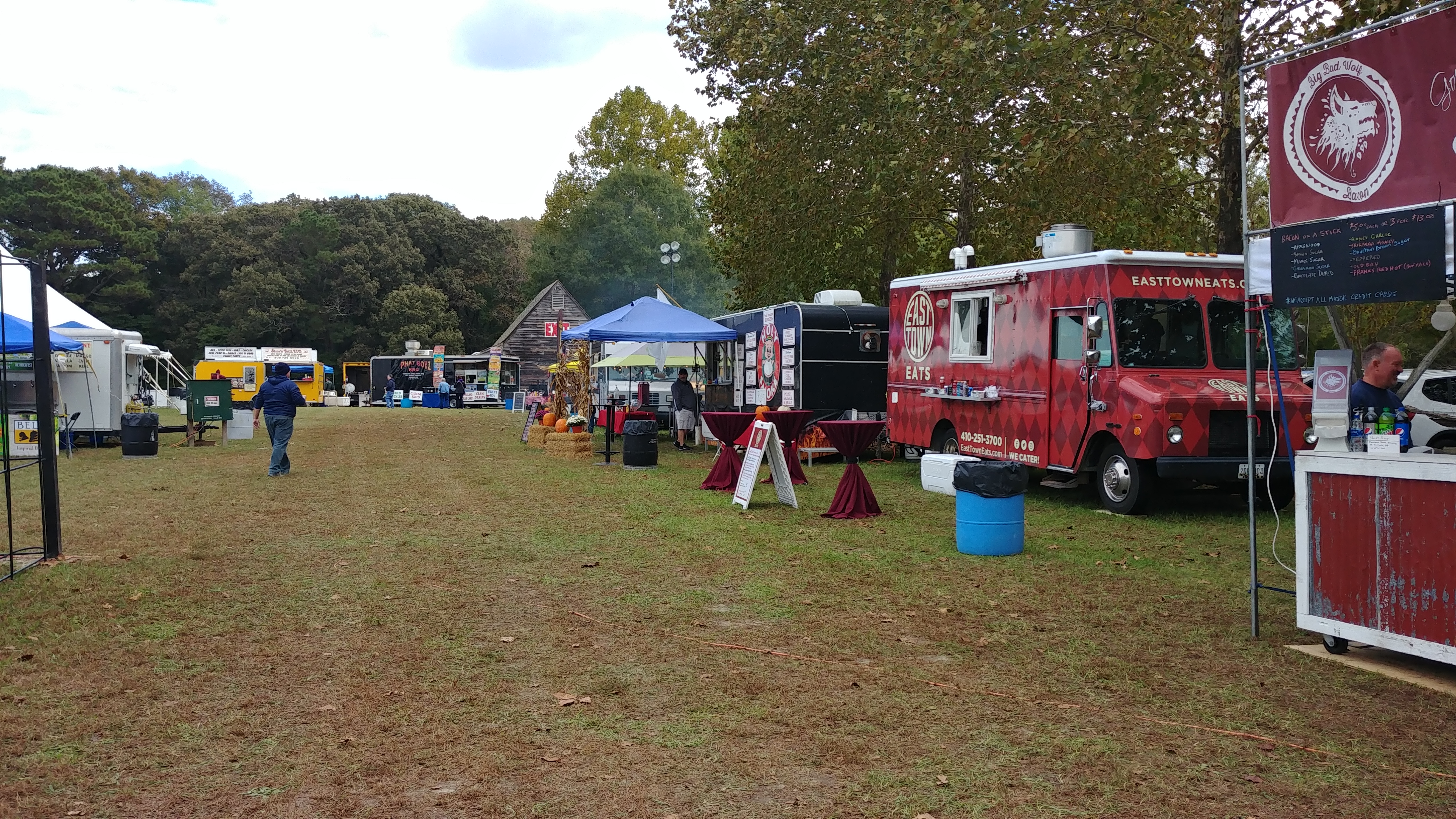
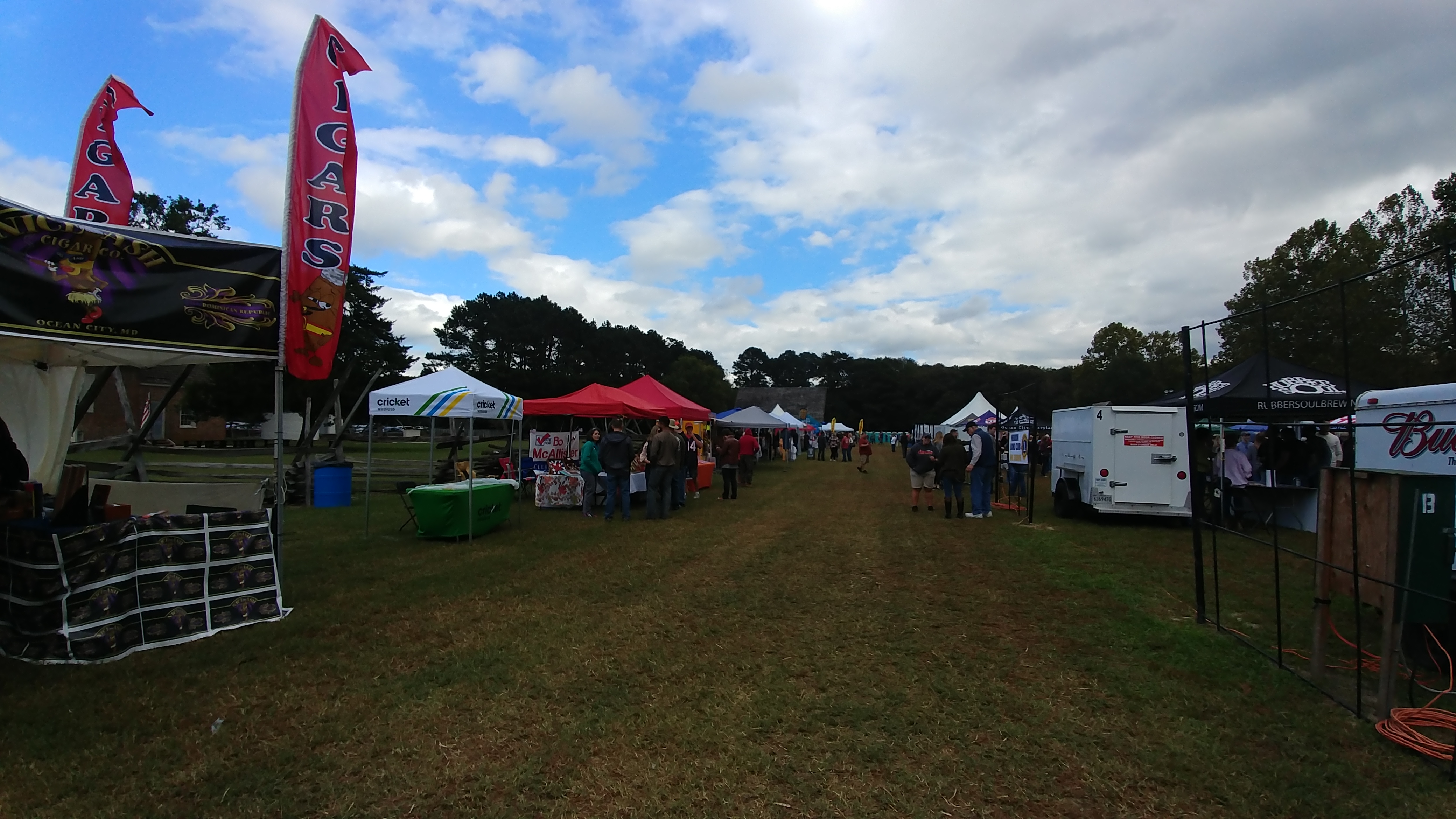
If there’s one thing the GBF was not hurting for, it was food. This didn’t catch every food vendor, either – there were a couple around the corner.
I had a really good brat with peppers and onions. My only suggestion would be to get real Polish kielbasa for the sandwich.
On Friday night, this was the karaoke barn. On Saturday college football ruled the day.
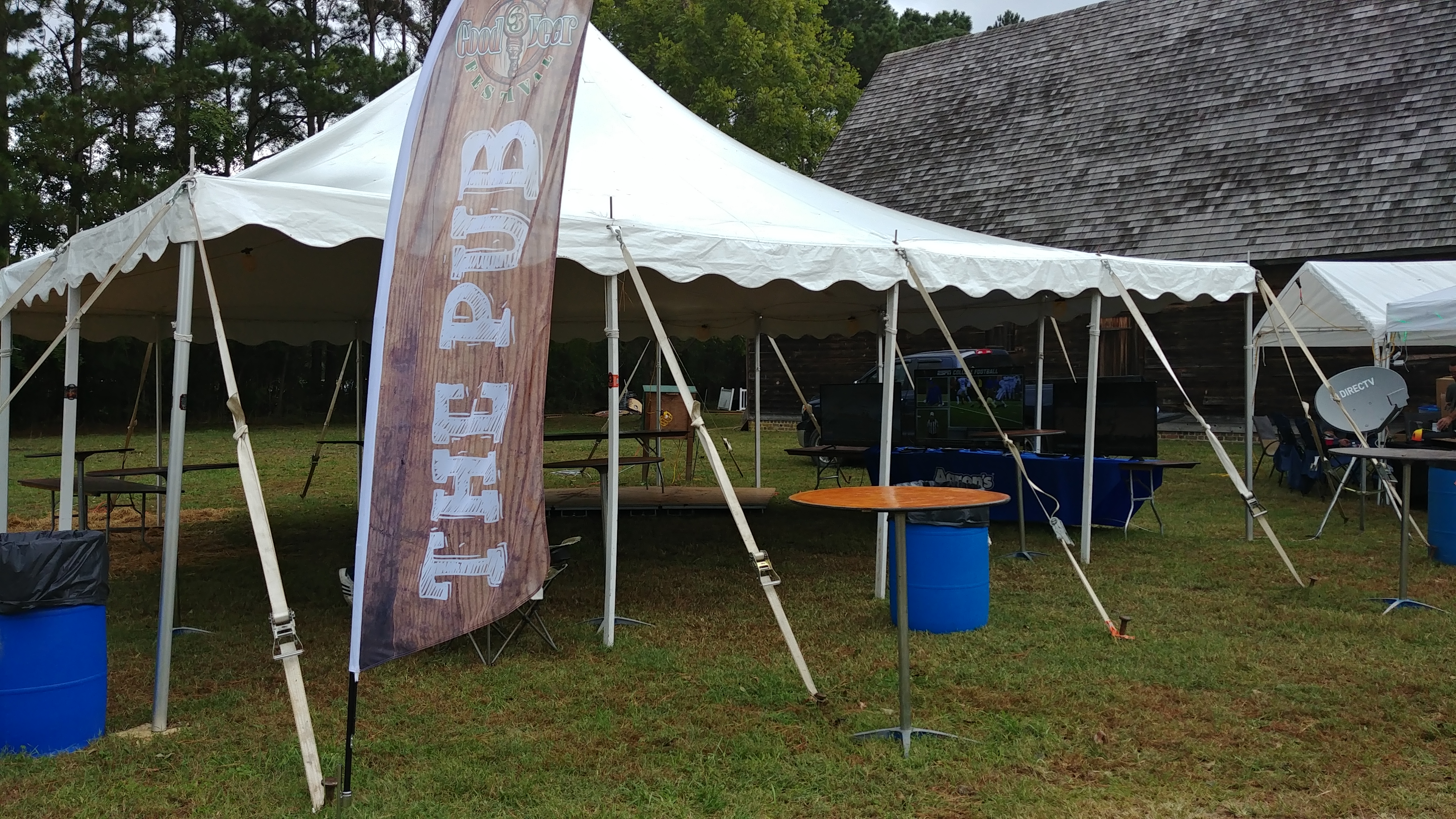
It used to be that they had couches and comfy furniture at The Pub. Maybe that’s why no one was in there.
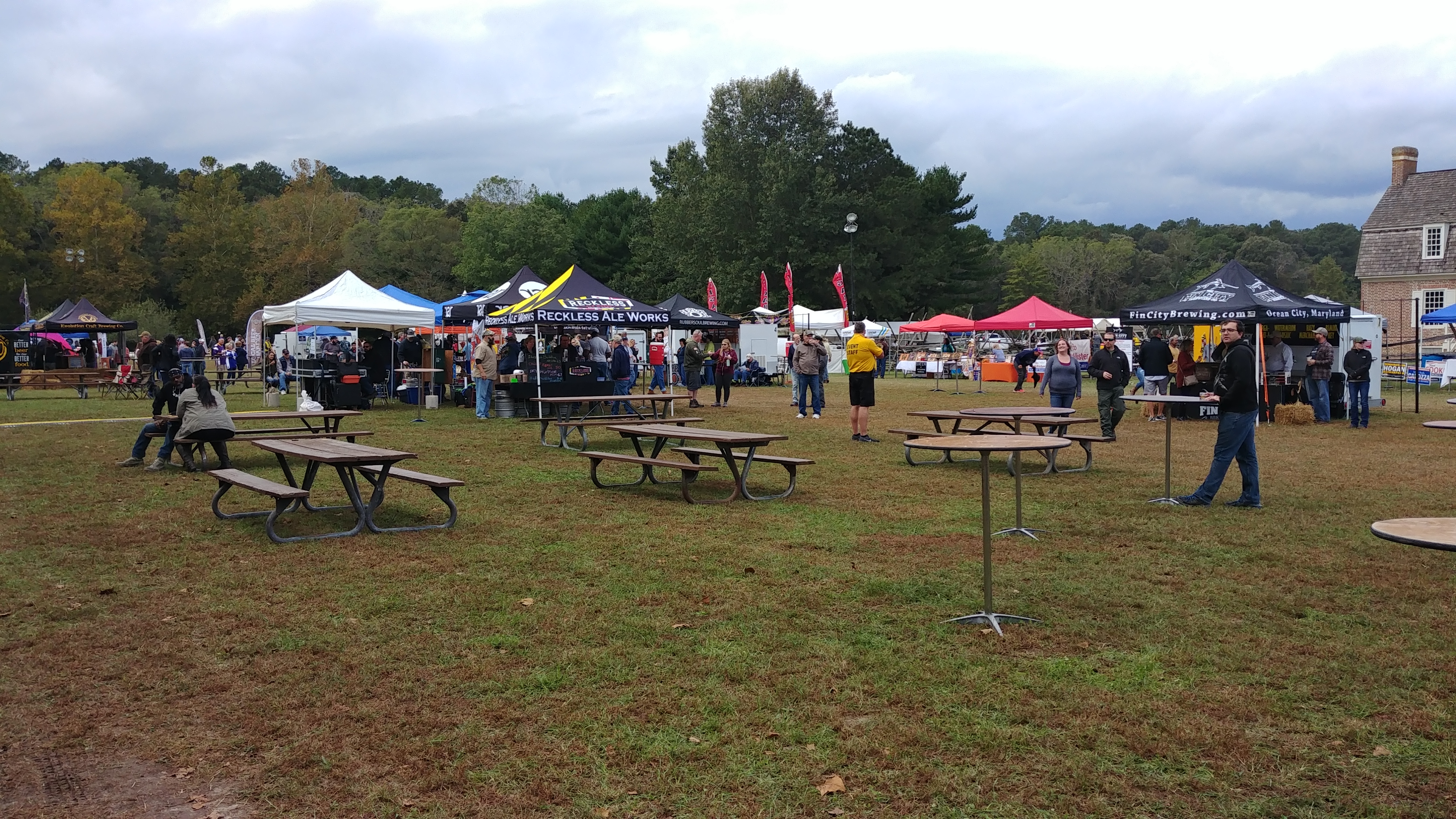
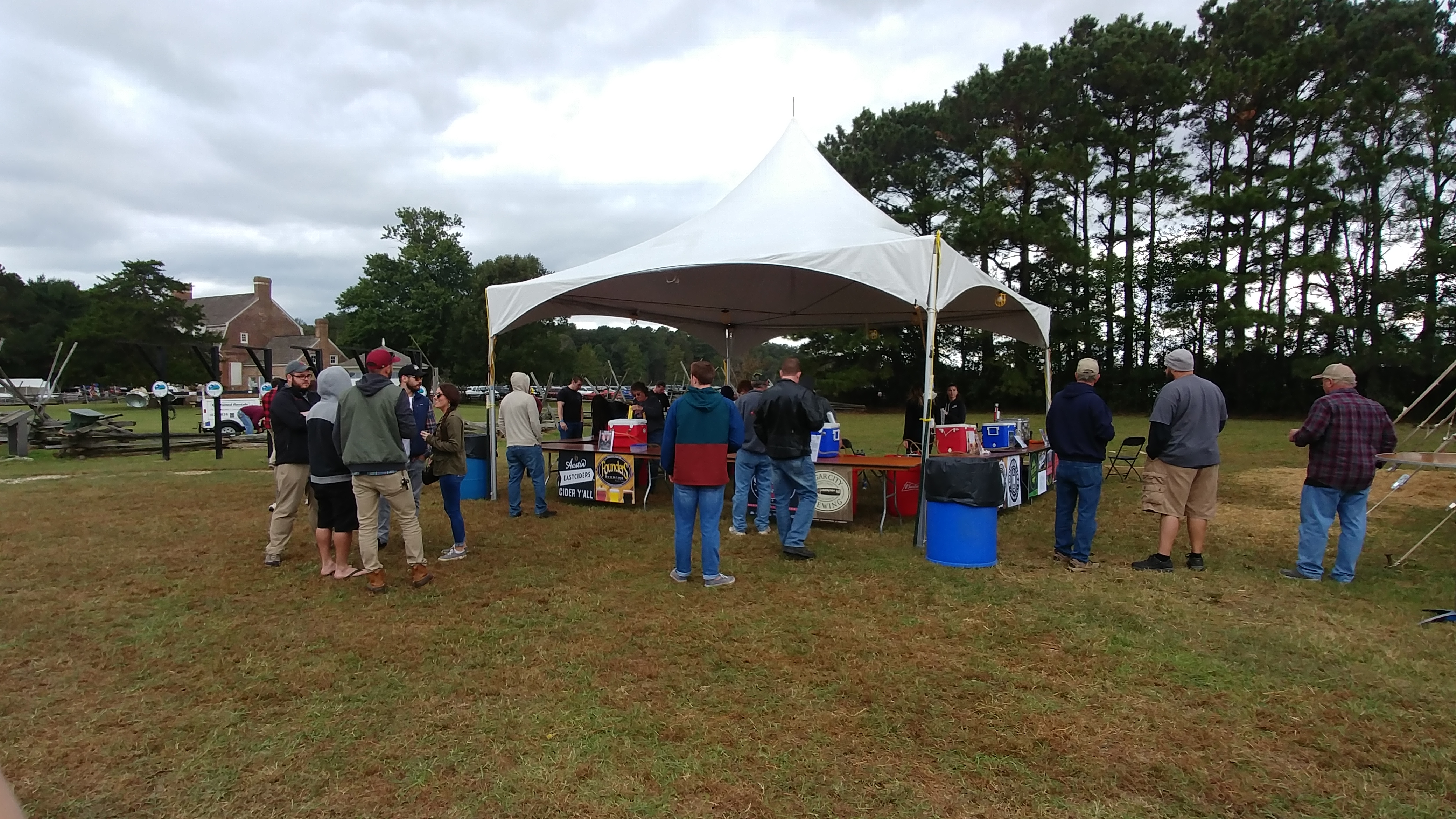
This was one of a few tents with the non-local breweries.
The first beer tent I stopped at, a half-hour in. I tried a couple, but missed out on the cider when I went back later. Bummer.
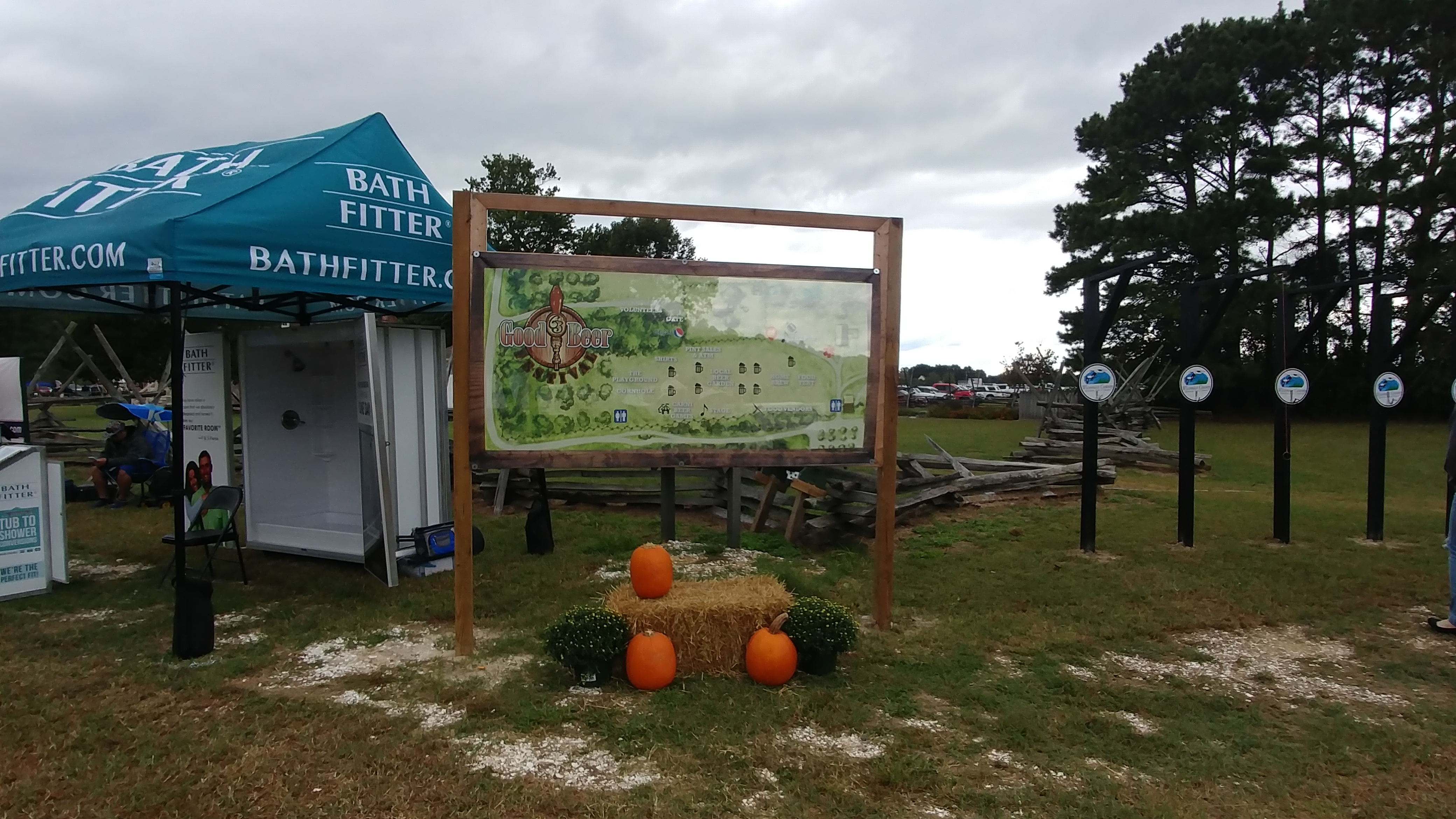
Not that I needed a map, but this was the substitute for the guides they used to give out.
It wasn’t Google, but it did the trick.
The problem with not having the guides (although most of us don’t carry a pen around, either) is that I had nothing but my phone on which to write down the ones I liked. As I’ll expand on later, though, they were few and far between.
Of course I stopped by to see my friend Shawn Jester, the leader of the local Republican club. It was his turn to be the hostest with the mostest.
I guess you can call this my old stomping grounds. It was nice to be on the outside, though.
Being a local election year, I was very surprised to not see them on the GBF video I saw from Friday night. Shawn explained that flooding at the warehouse where their items are kept put the kibosh on getting set up before the event, so they came early Saturday morning. Nor was the GOP weren’t the only vacancy, as there were a couple other open spots.
However, it’s worth noting that both Clerk of Court candidates were there: Bo McAllister was set up to the left of the GOP a few spots down and Chris Welsh to the right. It was good because I finally got to speak with Chris.
The aforementioned McAllister tent is third on the left, red with the orange tablecloth. An hour in and the crowds were still modest.
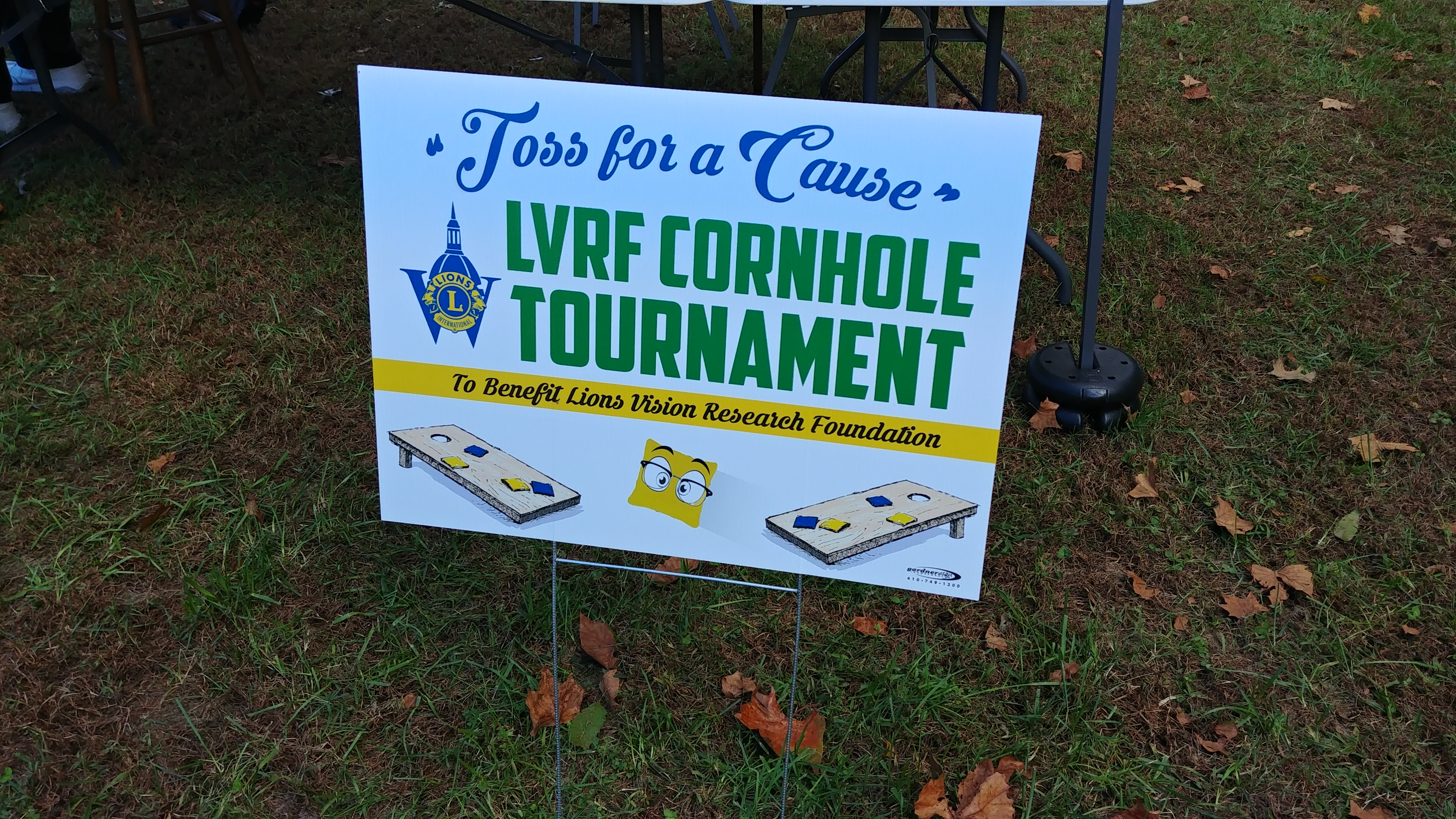
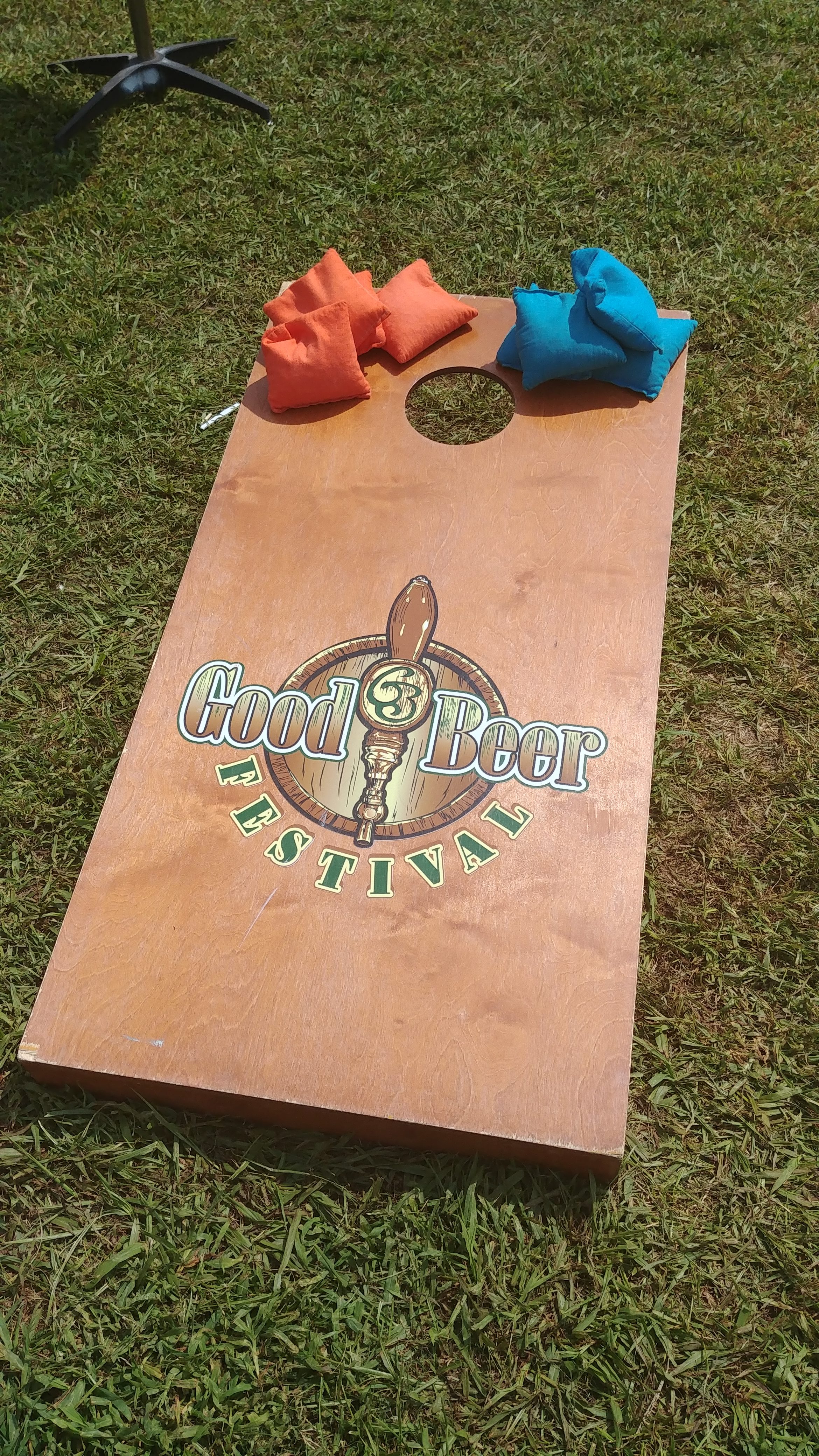
The Lions Club ran the cornhole tournament, which seemed to draw decent enough interest. There was usually someone playing as I walked by.
Not sure who won or how much the Lions Club made, but hopefully it was a successful run.
Finally, the sun came out and the crowds came out of nowhere to frequent the beer garden. This was taken about 2:30, two hours in.
Once the sun came out, so did the people.
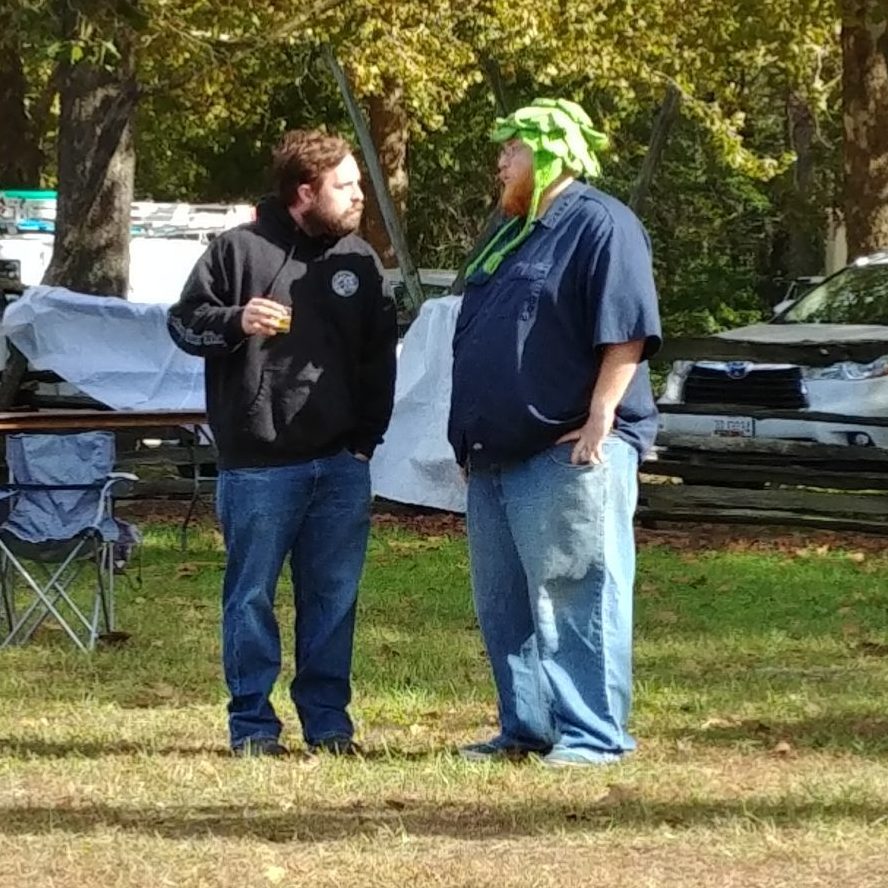
Among that larger crowd: someone with a hat like this comes every year.
This is always a fun look.
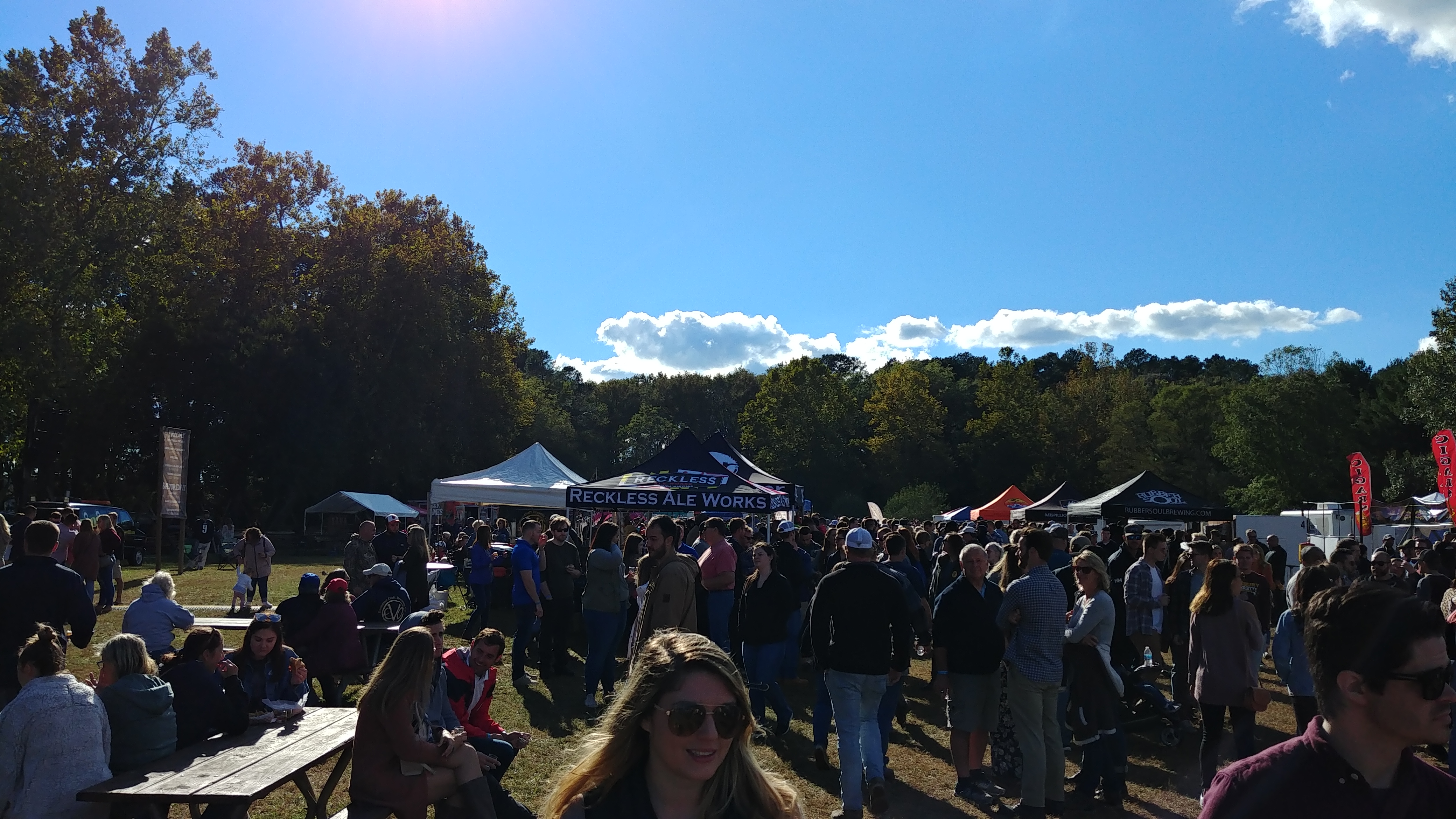
Remember that shot I took of the back of the beer garden? By 4:00 the place was hopping.
Where did all these people come from? Too bad the event was over in an hour or so.
Even the human foosball was finally happening.
Human foosball. That sounds like a way to work off those alcohol calories.
I had to leave about 4:00 when the event ended at 5:30 because of a family event. So here’s my parting shot, photography-wise.
Still going at 4 p.m.
Now that I’m through with the photos, it leaves room for a few thoughts.
I really can’t be a judge of how it went Friday night because I wasn’t there. But to me the issue with doing the event in this manner is that it discourages tourism – if you live across the bridge you would have to take off a half-day to attend and I don’t think all that many are willing to do so – particularly if Saturday looks bad weather-wise. I guess they were trying for a 3rd Friday vibe but I’m doubtful they succeeded. Nor did I think going to this sort of event after sunset was a smart play, particularly barely 24 hours after a torrential downpour from Tropical Storm Michael. (Notice the amount of straw in the photos.) Unfortunately, it meant I missed the better of the bands.
And speaking of that: I truly miss the two-stage setup. Sure, it left room for the games on one end but those were really underutilized. And they actually could have placed the main stage on the south end, kept the karaoke tent on the north end, and used that as the side stage. I guess as a cost-cutting move they hire fewer bands by having one stage.
In reading my older posts on the GBF, it’s apparent that either the number of breweries represented has declined somewhat or they are just not doing as many varieties. It was said there were 100 beers on tap, which may have been the case: but do you have to have half or more be IPAs? There are those of us who like the lagers, pilsners, blonde ales, and hefeweisens just as others like the stouts and dark brews. I felt a little underrepresented, although there were also a smaller number of pumpkin beers there, thank goodness. Of course, without a booklet guide it was hard to see where I wanted to go and what to try.
I also don’t know if you increased the vendor price but that seemed to be lacking, too. Granted, my experience was as a non-profit so our rules were a little different but the row of vendors seemed to be more anemic this time around. I also liked the previous practice of having the local beer garden more defined instead of just seemingly a random segment of tents that were clustered together.
I guess it’s time to stop beating around the bush with this piece: this year it felt like the GBF was the red-headed stepchild no one wants (not the craft brew of the same name.)
It seems like a whole lot of corners were cut this time around: for example, they always wanted the setup to be on Friday but having a Saturday-Sunday event meant two nights of security. Shift Sunday to Friday night and suddenly you only need one night of security, plus the lights that had to be there anyway could be taken down early Saturday night once the breweries were broke down.
Or make the Pub a karaoke tent and now you don’t need to rent a lot of seating. They’ve done one stage for a couple years, anyway, but by chopping time off each day of the event (it was a 5 1/2 hour window on Friday and 5 hour window on Saturday, instead of six both days) and cutting off the band time even further by the bands wrapping up a half-hour before the “official” end they’ve succeeded in cutting maybe 11 hours of live music down to eight. But you still have to have the sound set up so why cut the music?
When we lost Pork in the Park after a fairly successful run, we were told it was because the county wanted to concentrate on its other event held at Winterplace, the Wicomico County Fair. But the writing on the wall for Pork in the Park came a few years earlier after they mismanaged one year’s event into a cluster that angered a good number of vendors, then decided to double the admission price in the hopes a more well-known musical act may save the day. When neither worked, they downsized the event too much and never got the momentum back; meanwhile, our food tastes moved away from barbecue and on to other things. Now we have no such festivals when for a few years two had reasonable success.
I’m surprised to find that Maryland is one of the least successful states for craft beer – perhaps due to antiquated laws or just a population group that prefers other adult beverages. (By contrast, Delaware is a heavy-drinking state.) Another interesting fact: excluding Prohibition, the number of breweries in America hit its all-time low in 1978, when there were only 89. (Now just between Maryland and Delaware there are 94, a small segment of 6,372 American breweries listed in 2017.)
But at some point we will reach saturation. Remember how there were so many coffeehouses two decades ago? There is still a thirst for coffee, but the industry has consolidated: there are a few major players, particularly Starbucks and Dunkin’ Donuts, while regional and local shops such as Rise Up or Pemberton Coffeehouse remain as well. I suspect we are ready for a similar shakeout in breweries because tastes change and markets are fluid.
By the same token, where the Good Beer Festival was a rather unique event on its founding eight years ago, there are now beer festivals occurring in this region most weekends between spring and fall. Basically, I think the Good Beer Festival needs to become more of a destination: instead of dropping Sunday to add Friday night, go the opposite way and make it a whole weekend. Go back to multiple stages for music and catch those good up-and-coming regional acts like you did when you began. Perhaps try to get more beer-related vendors there, almost like a trade show. I think there can be a larger tent on the south end just for them so that aspect can be rain or shine.
By doing this and expanding the scope, you create an event that people interested in craft brewing regionally may want to spend the weekend at, sort of like how Pork in the Park used to attract BBQ teams from a wide area – except these folks won’t be camping outside cooking pigs, they’ll be using our lodging and eating at our other restaurants after hours – speaking of which, why not a 5:00 to 10:30 Friday, noon to 10:30 Saturday, noon to 5 Sunday event? Make it worthwhile.
Oh, and one more thing (and I can’t believe I’m saying this): they need to put a little fill line back on the cup. Maybe others need the full shot glass to taste, but I can get a good enough swallow with a half-shot to know whether I like it or not. People that stand at a tent and try six different brews have basically just consumed half a six-pack when it comes to alcohol (since craft beer is generally stronger.) I didn’t see too many unsteady people being held up by their friends yesterday but I didn’t stay until the end either.
The event this weekend came dangerously close to “meh…” for me, and if 40 people feel that way and stop showing up that’s $1,000 less the event brings in. As this is a fundraiser, one would think they would work on maximizing revenue by making it more attractive rather than get overly greedy for a subpar event or nickel-and-dime it to death like they did with Pork in the Park.
Oh, and I didn’t forget the music. There is a WLR upcoming from this, too.
Earlier this month I took a look at the financial situation of the various state candidates in Districts 37 and 38, so now I’m going to narrow the focus down to Wicomico County, which has a number of interesting contested races going on – although only a few have much money involved to speak of. No six-figure war chests here.
I’ll begin at the top with the County Executive race, where Bob Culver has an interesting split going on:
49 donations from individuals in county for $5,910
9 donations from individuals outside of county for $1,175
13 donations from businesses in area for $2,300
4 donations from businesses outside of area for $6,700
2 donations from PACs and other committees for $600
Average donation: $216.69
Cash on hand (bank account balance) – $15,398.33
Because of the 2 large donations from Comcast (considered a business outside the area) totaling $4,000, Bob’s numbers are skewed: 49.2% of his money came from inside the area, with a hefty 47.2% coming from outside the area and just 3.6% from PACs and other committees. Out of the 96.4% coming from individuals and businesses, 42.5% was out of individual pockets and 53.9% was from businesses – again, the Comcast donations make up almost 1/4 of Bob’s total take.
Now let’s look at the “independent” challenger Jack Heath:
68 donations from individuals in county for $14,825.05
10 donations from individuals outside of county for $1,950
8 donations from businesses in area for $1,771.76
No donations from businesses outside of area
No donations from PACs and other committees
Average donation: $215.66
Cash on hand (bank account balance) – $8,897.41
For Jack, 89.5% of his money came from inside the area and 10.5% from outside. Similarly, the heavy preponderance of contributions are from individuals: 90.4% compared to 9.6% from businesses. Heath has raised more money than Culver but his burn rate is faster, too.
Democratic County Executive candidate John Hamilton has filed only ALCEs since opening his campaign, meaning he has raised and/or spent less than $1,000. He’s the first of many candidates who can claim that route, as you’ll see moving forward.
Regarding the quotes around “independent” for Heath: that lack of movement from the elected Democrat has prompted at least one recently-elected member of their Central Committee (who’s also the president of the Wicomico Democratic Club) to resign from the DCC so he and the club could back Heath, while others on the Wicomico DCC (who presumably are club members, too) are more tacit in their support for Jack.
It’s much simpler when it comes to other county-wide races. I’ll hold off on the County Council and school board for the moment to look at the two single-victor races for State’s Attorney and Clerk of the Circuit Court. The two other countywide positions (Register of Wills Karen Lemon and Sheriff Mike Lewis) feature unopposed candidates who have regularly filed ALCEs – Lemon’s streak goes back to 2010.
The State’s Attorney race has the current appointee, Republican Jamie Dykes, running for a full term. Her campaign so far:
80 donations from individuals in county for $13,388.25
6 donations from an individual outside of county for $1,000
11 donations from businesses in area for $4,065.47
No donations from businesses outside of area
No donations from PACs and other committees
Average donation: $189.63
Cash on hand (bank account balance) – $6,087.33
Jamie received 94.6% of her money from inside the county and 5.4% from outside. Individuals also chipped in the most by far: 77.9% compared to 22.1% from businesses.
Conversely. Democrat Seth Mitchell, who previously ran for the post in 2010, has ceded the financial field to Dykes thus far: Mitchell has filed nothing but ALCEs in his run to date.
The fight has been joined on both sides for the Clerk of Court race, an open seat thanks to the retirement of longtime Clerk Mark Bowen.
For Republican Chris Welch:
47 donations from individuals in county for $4,255
10 donations from individuals outside of county for $1,030
7 donations from businesses in area for $1,566
2 donations from businesses outside of area for $408
No donations from PACs and other committees
Average donation: $109.98
Cash on hand (bank account balance) – $4,643.05 – with a $40 loan outstanding.
For Welch, 80.2% of his money came from within Wicomico County and 19.8% from outside; meanwhile, 72.8% of donations came from individuals and 27.2% from businesses – much of that business income was in-kind donations for a raffle Welch must have had.
Turning to Democrat James “Bo” McAllister, he has a very unusual setup:
25 donations from individuals in county for $2,865
48 donations from individuals outside of county for $7,367.11
4 donations from businesses in area for $600
1 donations from a business outside of area for $500
No donations from PACs and other committees
Average donation: $100.86
Cash on hand (bank account balance) – $3,268.97, but with loans for $10,190.07 outstanding.
Not only is McAllister heavily in debt, he really has one major benefactor: the Robins family in Ocean City. (Chris Robins is his treasurer.) Between standard donations and in-kind offering, the Robinses have contributed $6,333.91, or nearly 56% of everything taken in. It appears that most of Bo’s early campaigning came out of their pocket, but with a family member as treasurer that seems to be a little cozy.
Now that I have those countywide races out of the way, I’ll shift gears to County Council and begin with the two at-large seats.
As the lone incumbent Republican John Cannon is first up, but he hasn’t been very busy:
2 donations from individuals in county for $350
No donations from individuals outside of county
3 donations from businesses in area for $251.68 ($1.68 is interest on the bank account.)
No donations from a business outside of area
1 donation from a PAC for $2,000
Average donation: $433.61
Cash on hand (bank account balance) – $10,961.34
The huge Realtor PAC donation completely skewed Cannon’s take: 23.1% of his money came from within Wicomico County and 76.9% from the PAC; because of that bump just 13.5% of donations came from individuals and 9.7% from businesses. (The rounding doesn’t allow it to add up.)
Fellow Republican Julie Brewington is less well off:
8 donations from individuals in county for $1,920.49
1 donation from an individual outside of county for $300
No donations from businesses in area
No donations from businesses outside of area
No donation from PACs
Average donation: $246.72
Cash on hand (bank account balance) – $809.30, with a $1,000 loan outstanding.
For Julie, 86.5% of her donations came from individuals inside the county and 13.5% from outside, with all of it from individuals.
On the Democrat side, former County Council member Bill McCain has the financial advantage to return:
43 donations from individuals in county for $5,850
1 donation from an individual outside of county for $100
No donations from businesses in area
No donations from businesses outside of area
1 donation from a PAC for $2,000
Average donation: $176.67
Cash on hand (bank account balance) – $4,828.89
McCain has had 73.6% of the 74.8% of his take from individuals come from within Wicomico County – the other 25.2% is the donation from the Realtor PAC (the same group that gave to Cannon.)
Lastly is the second Democrat for the at-large County Council position, Jamaad Gould:
16 donations from individuals in county for $952
2 donations from individuals outside of county for $110
1 donation from a business in area for $10
No donations from businesses outside of area
No donation from a PAC
Average donation: $56.42
Cash on hand (bank account balance) – $325.85
Jamaad is the first of two sub-$100 average donation candidates, but the only countywide one. Percentage-wise, 89.7% of Gould’s donations come from inside Wicomico County and 99.1% come from individuals. It’s a very local-source campaign.
District races are rather low-key as well. In District 1, Ernest Davis had to survive a primary so he raised money earlier in the cycle.
27 donations from individuals in county for $1,085
1 donation from an individual outside of county for $20
1 donation from a business in area for $250
No donations from businesses outside of area
No donations from a PAC
Average donation: $46.72
Cash on hand (bank account balance) – $828.00
District 2 is contested: incumbent Republican Marc Kilmer is running for a second term. His totals were very simple:
2 donations from individuals in county for $450
No donations from individuals outside of county
No donations from a business in area
No donations from businesses outside of area
No donations from a PAC
Average donation: $225.00
Cash on hand (bank account balance) – $2,198.39
That’s one of the healthier on-hand totals around; however, Marc does have a Democrat opponent who is also fundraising in Alexander Scott:
3 donations from individuals in county for $550
No donations from individuals outside of county
2 donations from businesses in area for $800
No donations from businesses outside of area
No donations from a PAC
Average donation: $270.00
Cash on hand (bank account balance) – $550.00
Both donations from businesses were in-kind, which explains the even $550 balance on Scott’s first report – previously he had filed ALCEs and has reported no spending. (So where did the filing fee come from?) But it works out to 40.7% from individuals and 59.3% from businesses.
The District 3 race features incumbent Republican Larry Dodd, who reported just one donation of $1,000 (from the Realtors PAC) and has an outstanding loan of $100 against a balance of $1,784.91. Some of that will be eaten up by a pending fine to be paid to the state Board of Elections of $160 for late filing – the fourth time this cycle (and third this year) that his campaign has been late. After my experience with Kirkland Hall last time (see updated post here) this is a subject I’m going to get back to for a later post.
However, his Democratic opponent Michele Gregory has filed nothing but ALCEs.
Moving to District 4, which is one of the two open seats on County Council (one at-large is also open) we find Republican Suzanah Cain has these statistics:
24 donations from individuals in county for $1,496.16
11 donations from individuals outside of county for $625
No donations from businesses in area
1 donation from a business outside of area for $0.28 (a setup fee for an account)
2 donations from a PAC for $4,000
Average donation: $161.09
Cash on hand (bank account balance) – $703.01
Like her fellow Republican John Cannon, the huge Realtor PAC donation completely skews Cain’s take: 24.4% of her money came from within Wicomico County, 10.2% from outside the county, and 65.3% from the PAC. All but less that 0.1% of that non-PAC cash is from individuals.
For Democrat Josh Hastings, the story is a lot different:
68 donations from individuals in county for $4,940
27 donations from individuals outside of county for $2,425
1 donations from a business in area for $50
No donations from a business outside of area
1 donations from a PAC or other committee for $100
Average donation: $77.47
Cash on hand (bank account balance) – $1,512.38
Hastings had 66.4% of his donations come from within the county, 32.3% from outside, and 1.3% from the other committee. 98% was offered from individuals, with 1.3% from the one business.
Finally for County Council, you have the unopposed District 5 Republican Joe Holloway. He loaned his campaign $5,000 and still has $4,975 left after the $25 filing fee.
The other partisan office on the ballot is the Orphan’s Court. Not one of the four candidates have filed anything but an ALCE – as expected in a bottom-ballot race for which the Republicans have seldom filled the slots. (All three incumbents are Democrats; however, one lost in the primary.)
Now for the Board of Education. These non-partisan slots are being filled as follows:
At-large candidates: 2 from a group including Tyrone Cooper, Don Fitzgerald, Michael Murray, and Talana Watson
District 1: Michelle Bradley or Allen Brown
District 2: Gene Malone
District 3: David Goslee, Sr. or William Turner
District 4: David Plotts or Ann Suthowski
District 5: John Palmer
Out of that group Cooper, Murray, Malone, Turner, and Palmer reported no contributions. Malone loaned himself $100 so that’s his balance.
Fitzgerald reported $1,400 in contributions (all from the candidate and his treasurer) and has $212.12 on hand.
Watson reported $1,000 in contributions from 2 local businesses and loaned her campaign $1,000 with $909.51 available.
Bradley reported $150 in contributions, one $100 from an individual in the county and $50 from one outside. She still has the $150 left.
Brown reported $860 in contributions, all but 2 of the 13 from individuals within the county and accounting for $660 of the take. He has a balance of $25.
Goslee had the biggest stake among the district aspirants, receiving $1,650 from 4 local individuals – however, $1,100 was from his own personal funds. $586.80 is the largest war chest among the remaining district candidates.
Twelve people have given $706.96 to the Plotts campaign, which includes in-kind donations. (One who donated $25 was from outside the county.) His balance is $187.45.
Suthowski was the second-biggest beneficiary with $1,500 from 13 local individuals (including $400 of her own.) She has $376.46 to play with.
I sort of suspect the real money in the school board race is going to be revealed on the post-election report since the Wicomico County Education Association has yet to be heard from and they’ll certainly have a preferred slate.
That brings this look at finance to a close. But I have a little more research to do after seeing the Kirkland Hall and Larry Dodd debacles. Is it really that hard to do campaign finance reports on a timely basis?
So when I last left you, I promised to tell you about Blue Ribbon Drive. For those who don’t know the area too well, it’s the street that bisects Winterplace Park (where the WCF is held) from north to south. But over the weekend it was a pedestrian mall of sorts.
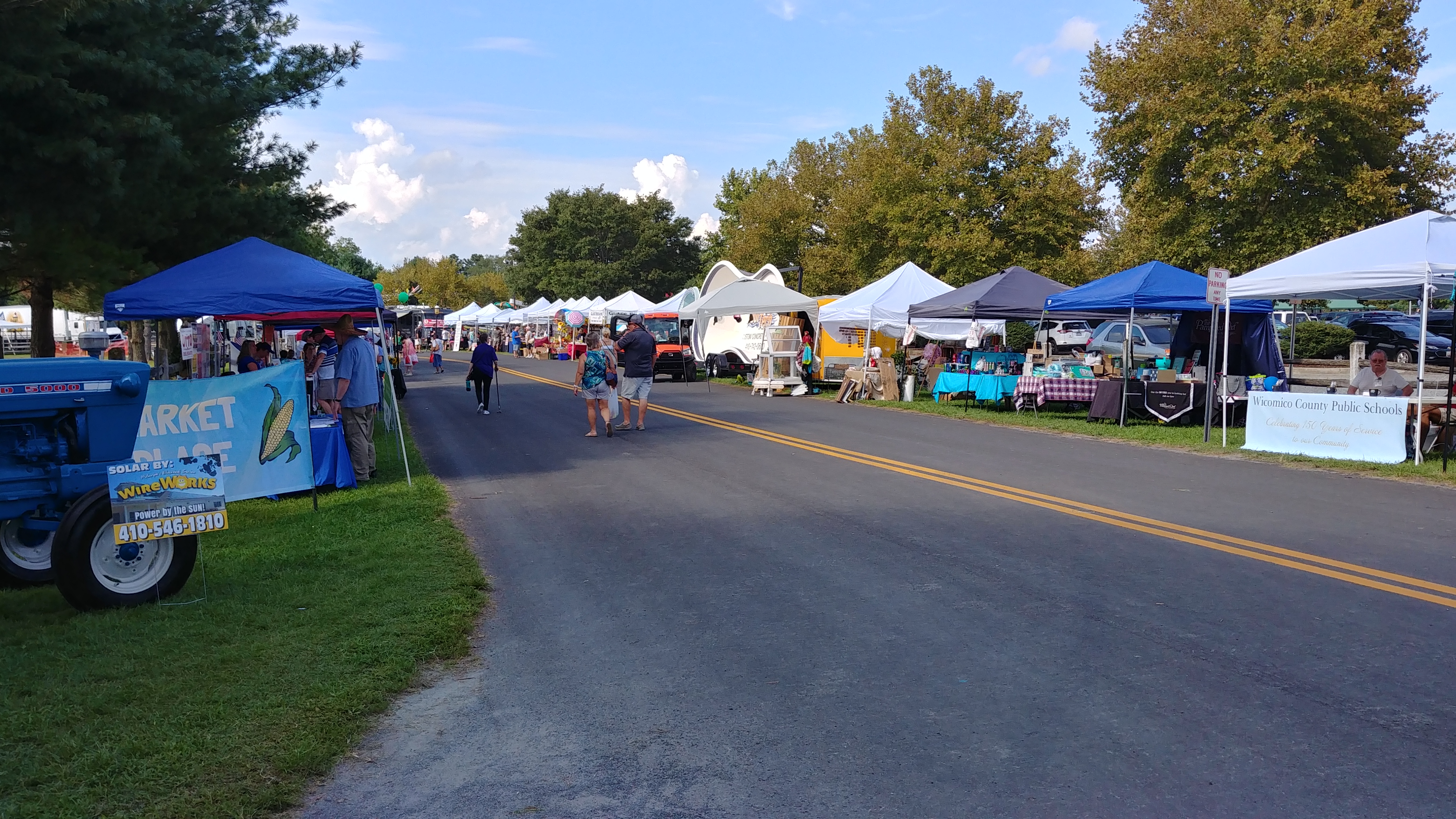
Looking north along Blue Ribbon Drive. It was a clever usage of the street so the path these vendors were on wouldn’t be muddy.
Now I’m looking south. One of my favorite vendors (insofar as tweaking the Left is concerned) is second one in – the Atlantic Tactical Firearms Trainers tent.
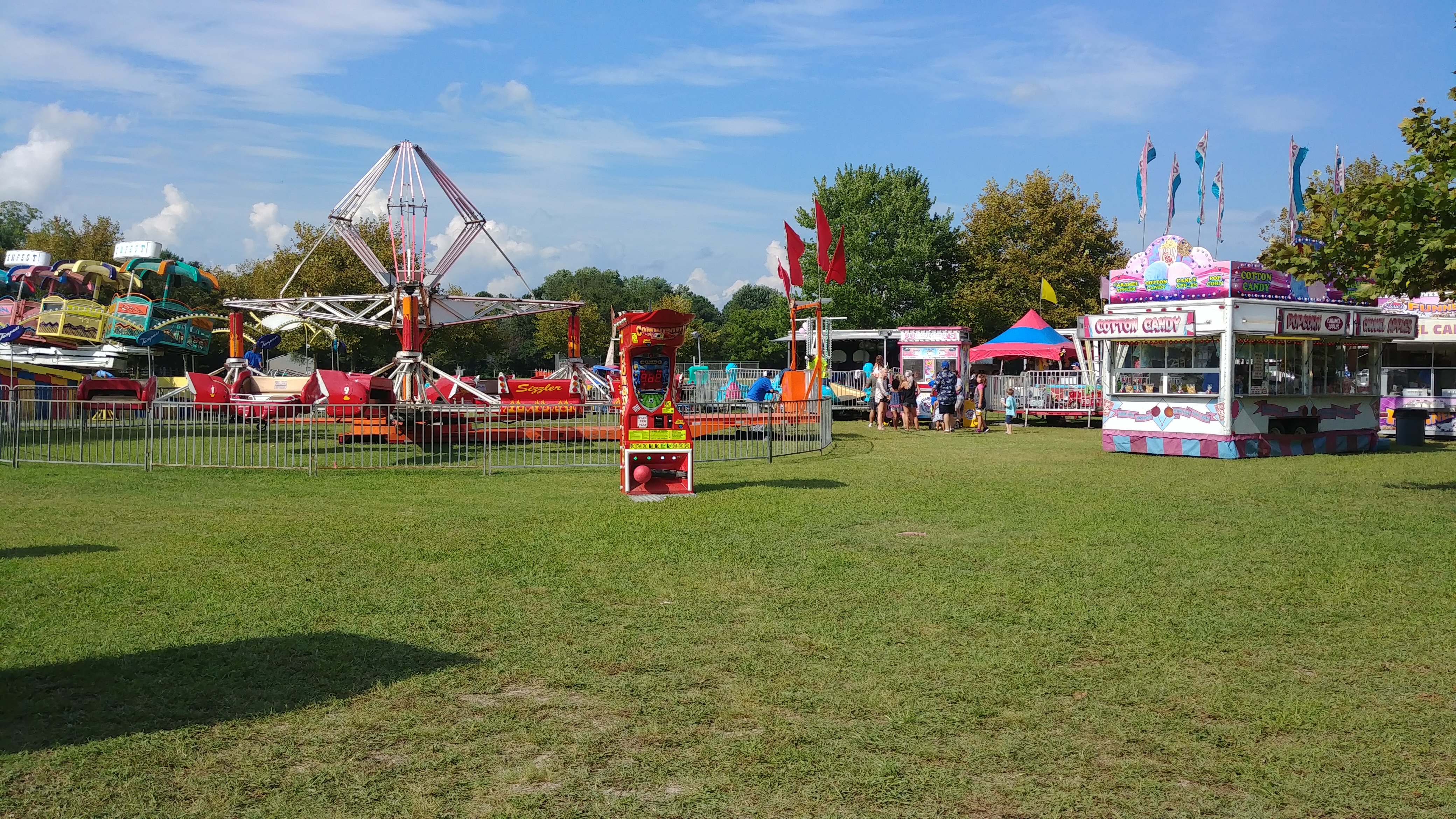
The only people who may have been disappointed with the setup were the people who ran the rides, but they were actually closer to the action this year even being across the street.
I don’t do rides, but I’m sure the kids wore them out.
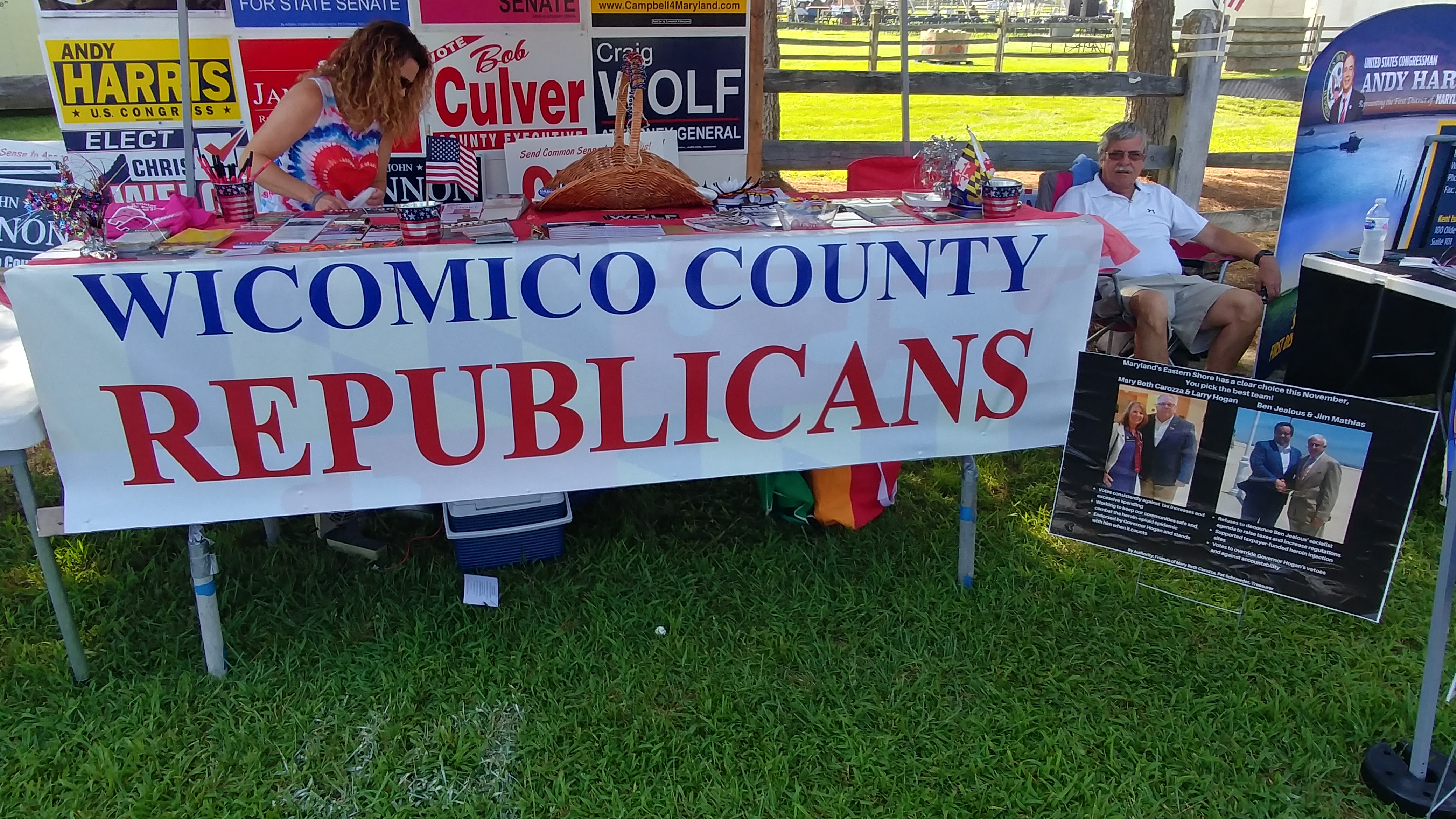
Nestled toward the south end of this road were my erstwhile colleagues at the Wicomico County Republican Party.
Ellen Bethel was one of many GOP volunteers – I saw Mary Beth Carozza there for the second time this weekend, after catching her coming in as we were heading out Friday evening too. That woman is everywhere. My old friend Bill Reddish, meanwhile, was manning Andy Harris’s space.
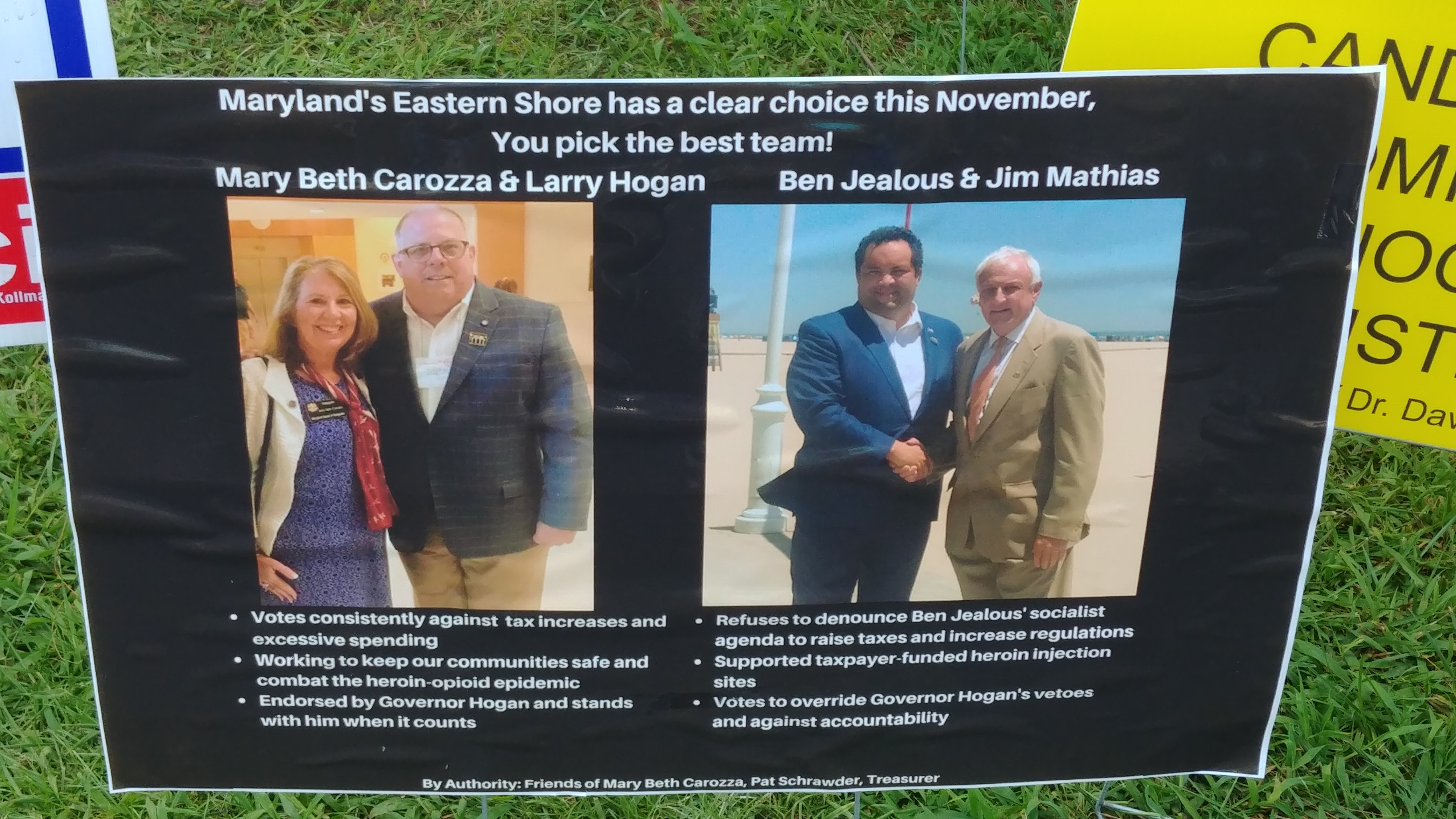
I heard there was a lot of angst on the Mathias side about this sign. Notice how he’s trying to get closer to Larry Hogan these days? Sorry, Jim, but your voting record is very Jealous-like. Birds of a feather and all that.
I noticed on social media that the Governor made his rounds Saturday before we arrived. This actually did us a little bit of a favor as it turned out. While I have another point to make in the meantime, don’t worry – I won’t forget to close that loop.
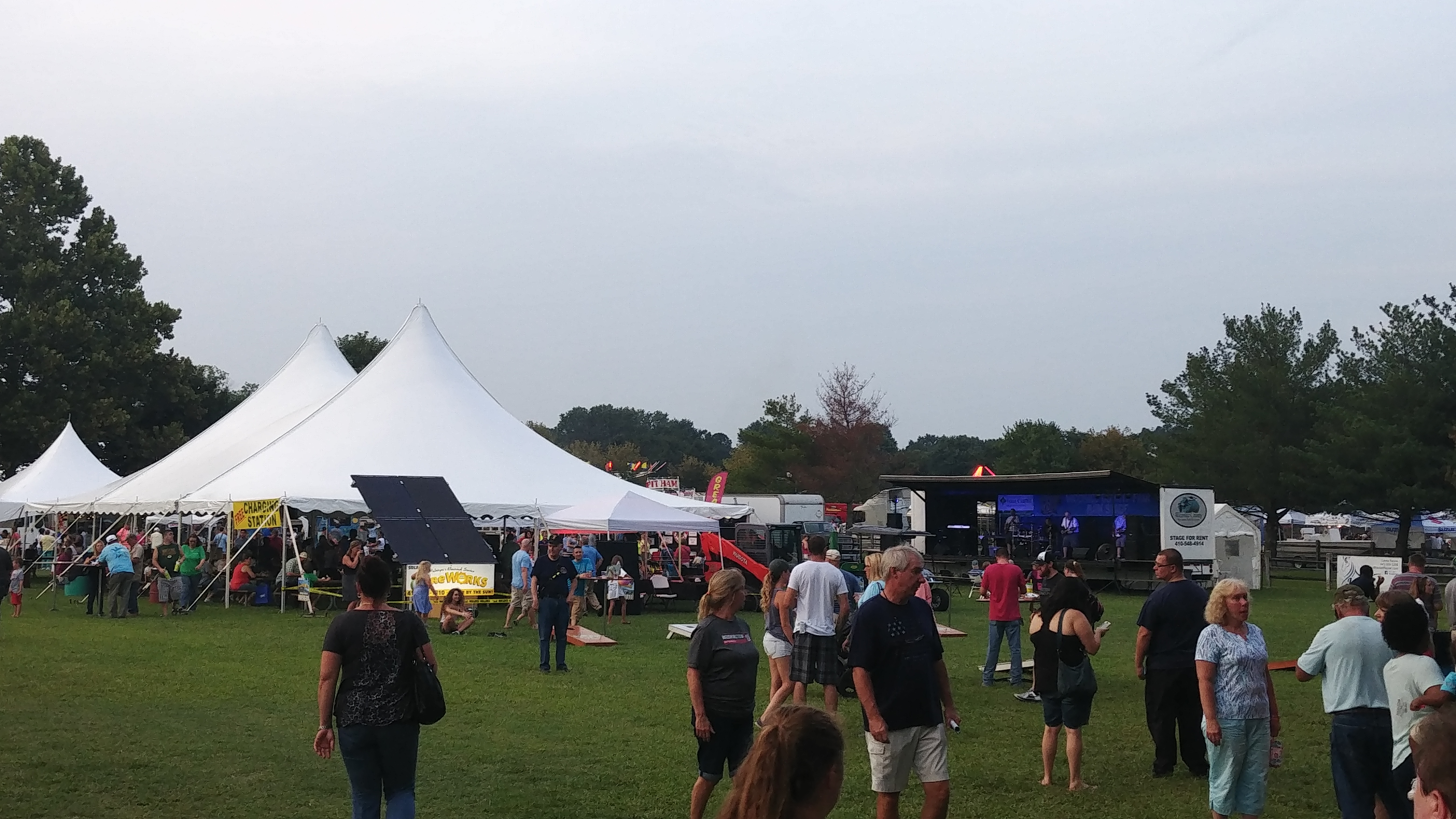
Moving the vendors and the rides left a nice space. I guess you could call it a beer garden but it served as food court and musical entertainment center.
I’m looking from the west end of the shady main lane toward the stage in this shot that was taken Friday evening.
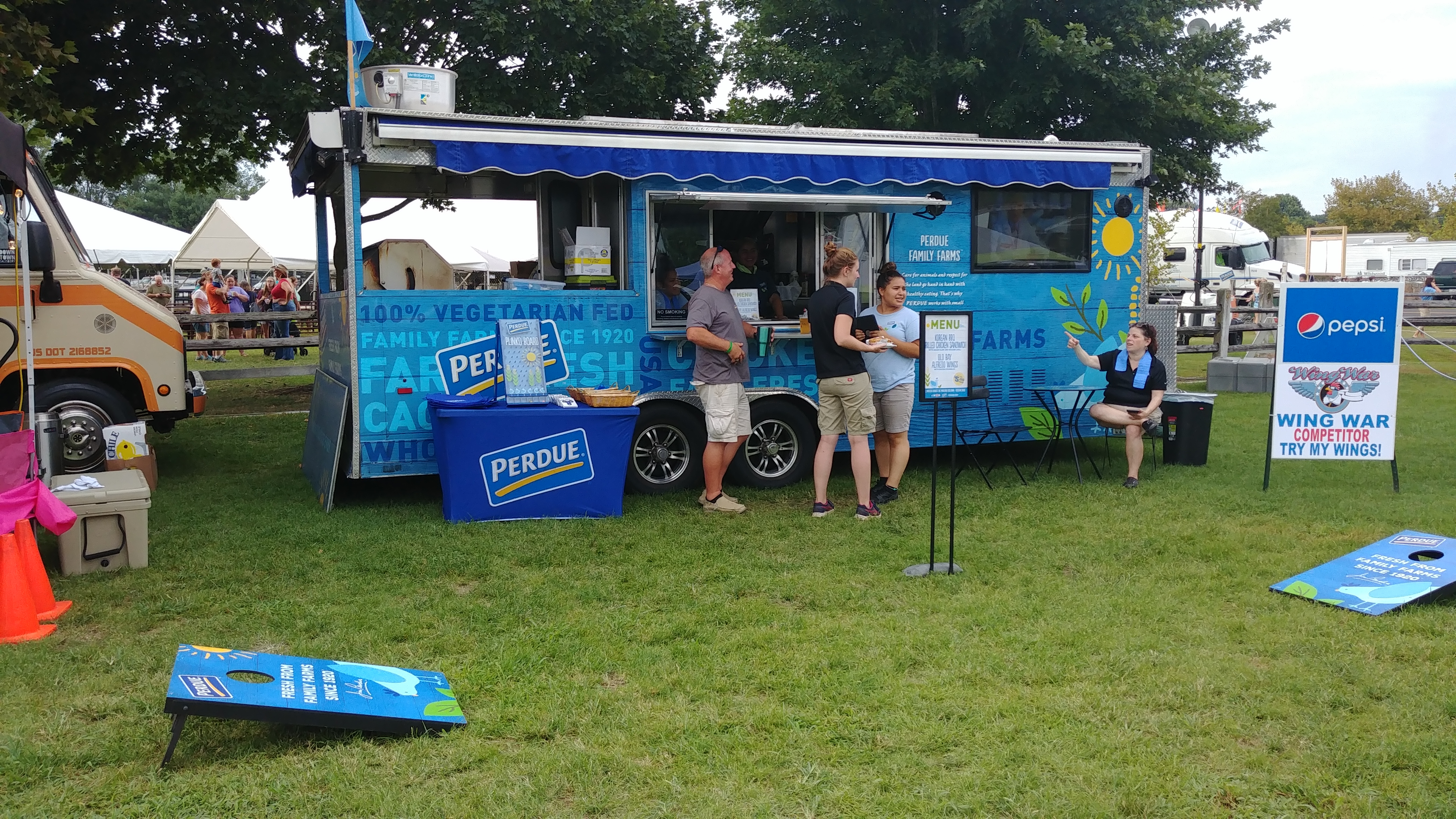
Perdue was all over this event, as you may expect. Unfortunately, a Korean BBQ chicken sandwich or Old Bay Alfredo wings didn’t sound too good to me. Hope that wasn’t their Wing War entry.
So it was an unusual place for this tent.
The Wicomico County tourism tent. I guess it was too big to just put along the road – or they wanted the captive audience?
Speaking of unusual, look closely at this equestrian photo.
I’m probably glad I didn’t catch this guy’s act. It’s called The Jump of Death with Sir Barchan of Renaissance Stables.
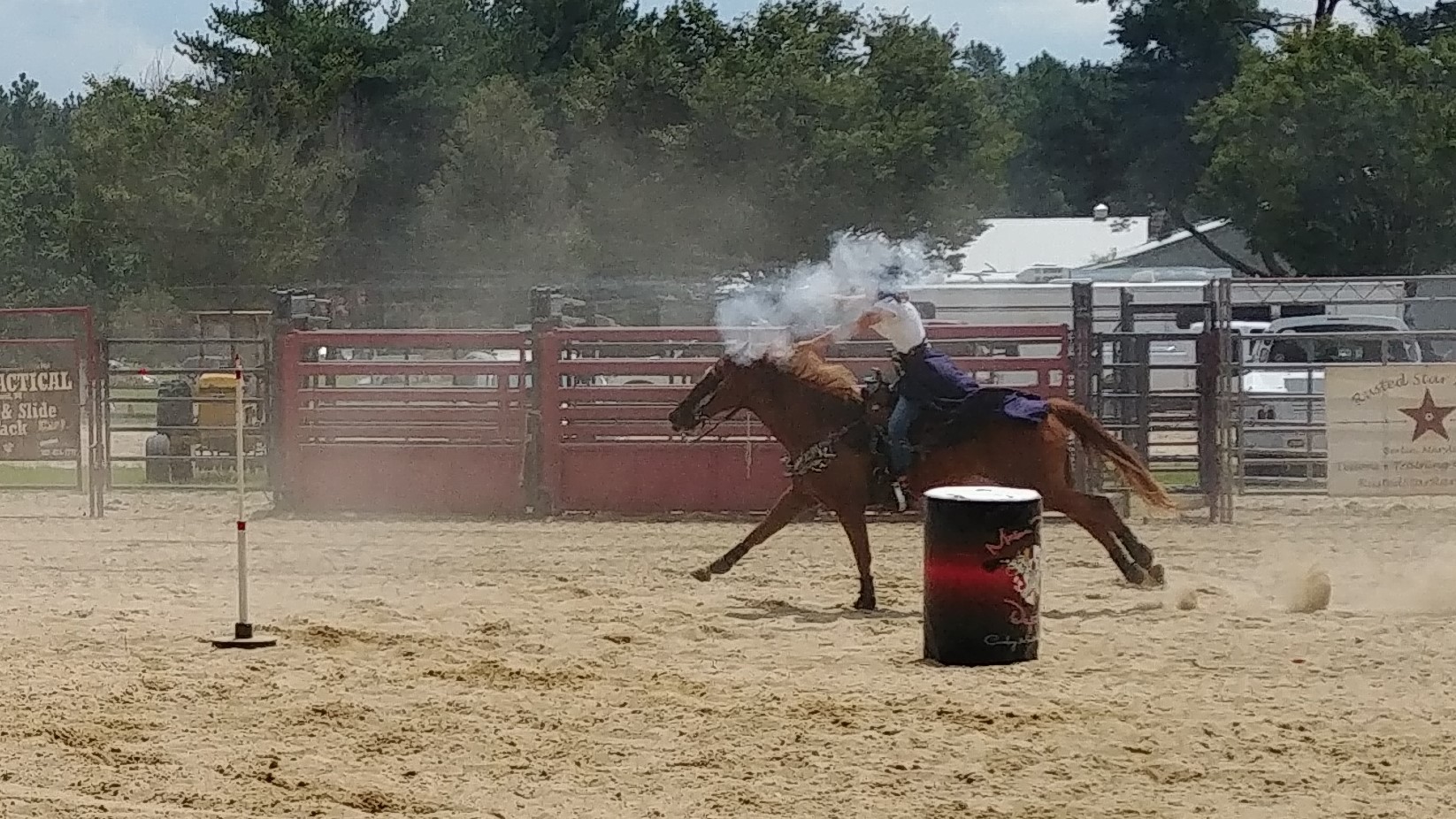
We spent a lot of time this weekend, though, watching my wife’s favorite equestrian event: the Mason Dixon Deputies mounted shooting.
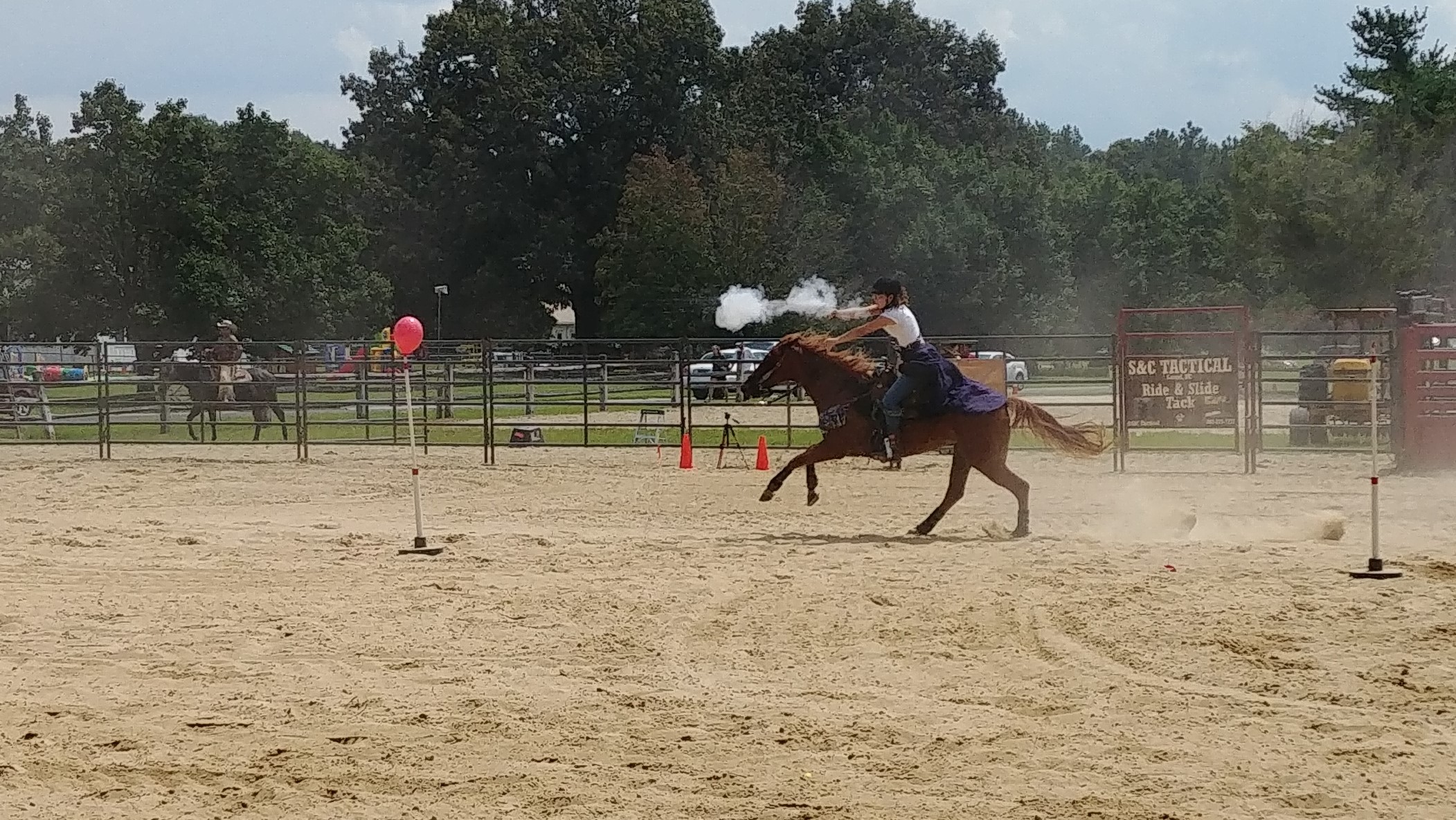
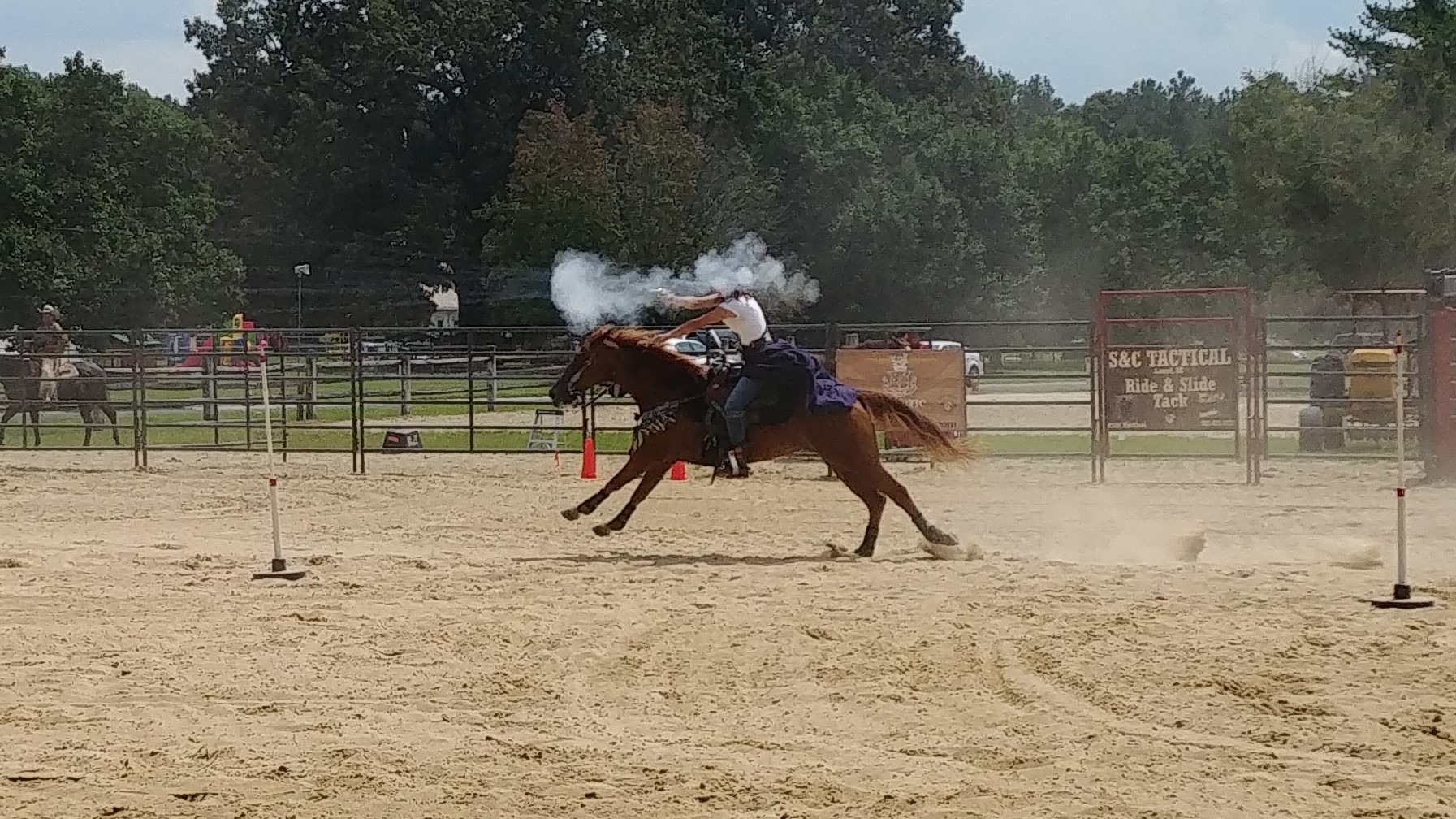
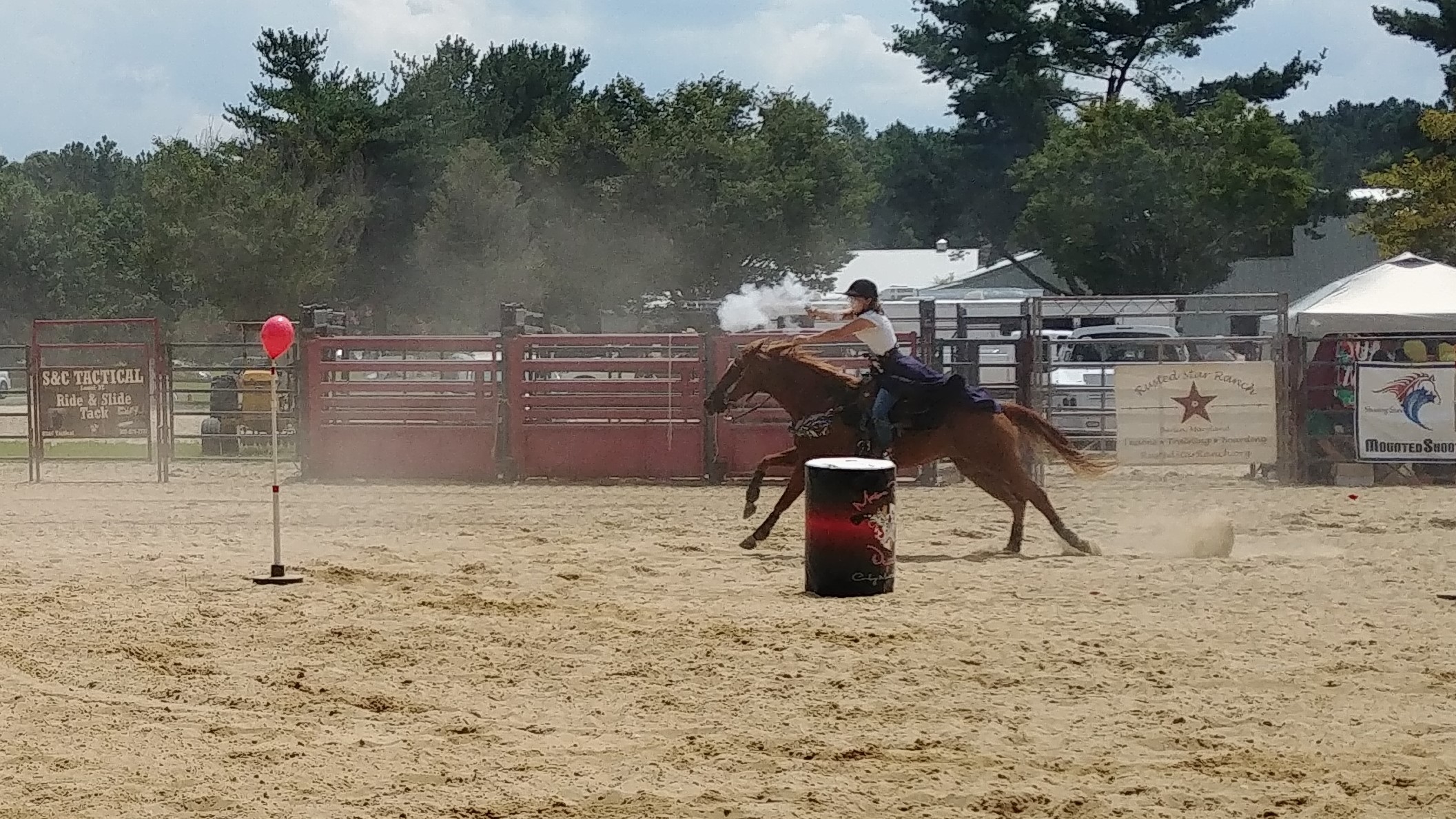
The perfect photo. I finally figured out how to get good motion shots using the “Burst” function on my cell phone camera. It made for some great action photos since old, slow me can’t outwit a 1/10 second snap if I hold halfway still.
Consider that the next two pairs of photos are 1/10 second apart and you’ll see the quick reactions this sport requires. (And how good it makes a schmuck photographer like me look. But I selected the shots and cropped them a wee bit.)
Now you see ’em, now you don’t. But you never hear the balloon pop over the sound of the revolver firing.
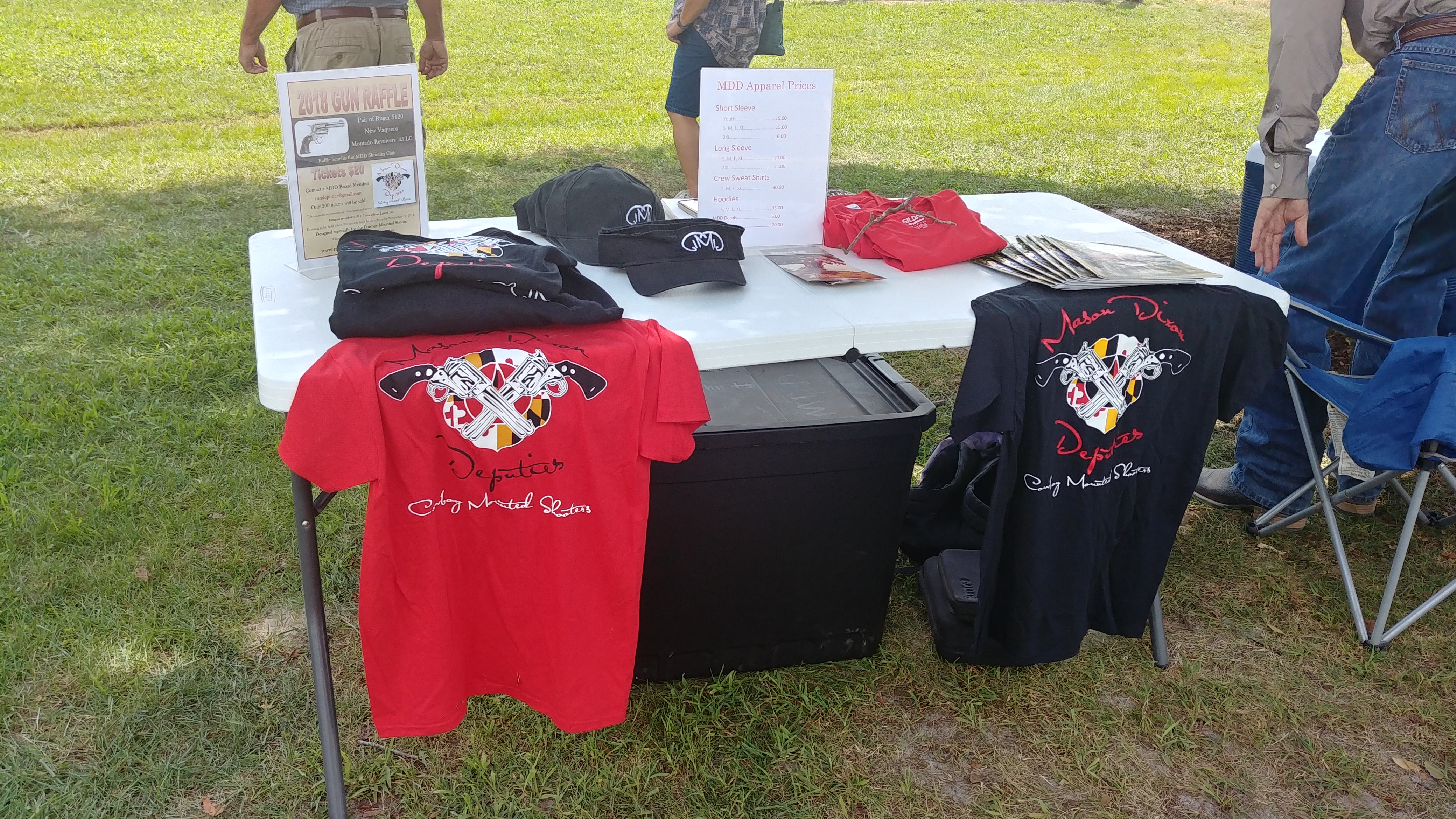
The red one on the left? My wife loved the late (yes, it was extra, she already got stuff) birthday present.
Now my wife and stepdaughter can coordinate – one has the red version and the other black.
It’s been a really good fit for the Wicomico County Fair since they brought the Mason Dixon Deputies in three years ago – the four-stage event takes up three to four hours. In this case they went Saturday evening and Sunday afternoon – the former, in particular, packed the bleachers so I’d say 300 to 400 were watching.
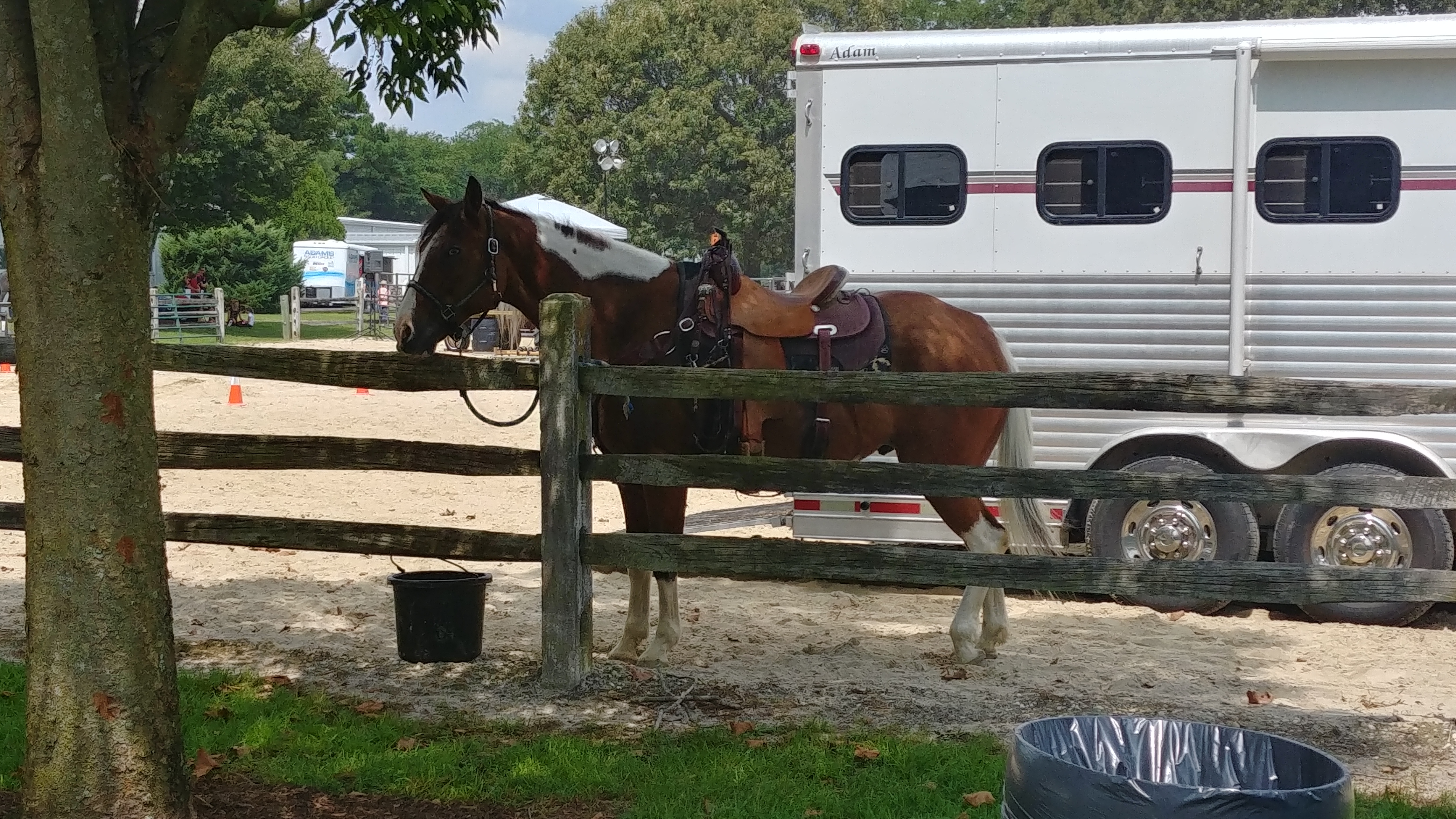
In between runs, the riders made sure their horses got plenty of water and (especially) shade.
The daytime hours were fit for neither man nor beast at times thanks to the humidity.
Oddly enough, their Saturday stages were supposed to begin at 2 p.m., but because Governor Hogan was here and loud gunfire would (understandably) put his security on edge, they didn’t start until after 3, just as we arrived. So Kim got to see pretty much everything before we left to see the Scrapple. (Normally they’re the Delmarva Shorebirds. Considering they won Saturday night as the Scrapple and are 0-2 since, maybe they should have kept the unis.)
Besides the Mason Dixon Deputies and checking our photo entries, there is one other thing at the fair which is a must-do for us.
My wife has known Pastor Oren Perdue for years, ever since her daughter began going to the Salisbury Baptist Temple summer camp (the one with the weekly rodeo) as a six-year-old. (This summer she finally aged out after thirteen summers.) So over the last three years we’ve played hooky from our church to listen to Perdue’s much more impromptu service.
Pastor Oren Perdue, founder and pastor emeritus of Salisbury Baptist Temple. For the last three years, he’s been delivering a church service at the WCF. Photo by Kimberley Corkran.
Definitely not the most formal church setting, and probably not a tent revival either. But we still had music. Photo by Kimberley Corkran.
If I had a bone to pick with this year’s fair – which was otherwise the best in the three years under the current format – it would be that either the church service needs to allowed to begin at 10 a.m. or the rest of the events go off at noon. I understand the desire for something like the Mason Dixon Deputies to want to get an earlier start and avoid the heat of the day for the sake of the horses, but that and a church service really don’t work and play well together.
But I think I have the 2018 Wicomico County Fair pretty well covered – Lord knows I spent enough time there to get the flavor of it.
They even had a reminder of the next item on the docket.
Next up in less than eight weeks…
Just hope the weather cooperates for that one. The GBF is my favorite local event, but the Fair gained a lot of ground this time around.
After a one-year hiatus and a whole host of changes, I’m bringing back my coverage of the Memorial Day weekend occurrences.
Last year’s Memorial Day celebration, to me, wasn’t much to write about. It’s not that the ceremony was any different, but to be honest I wasn’t in the mood for taking photos or recording the events. Couple that with the demise of another Memorial Day weekend staple event I enjoyed, the Concert for a Random Soldier, and I suppose I saw no point.
While the CRS is still lamented and missed, this Memorial Day weekend was special nonetheless because Kim’s daughter graduated from high school on Saturday, so we celebrated that fact with friends and family. Yet I didn’t forget to recall those who made the ultimate sacrifice at the Civic Center this morning.
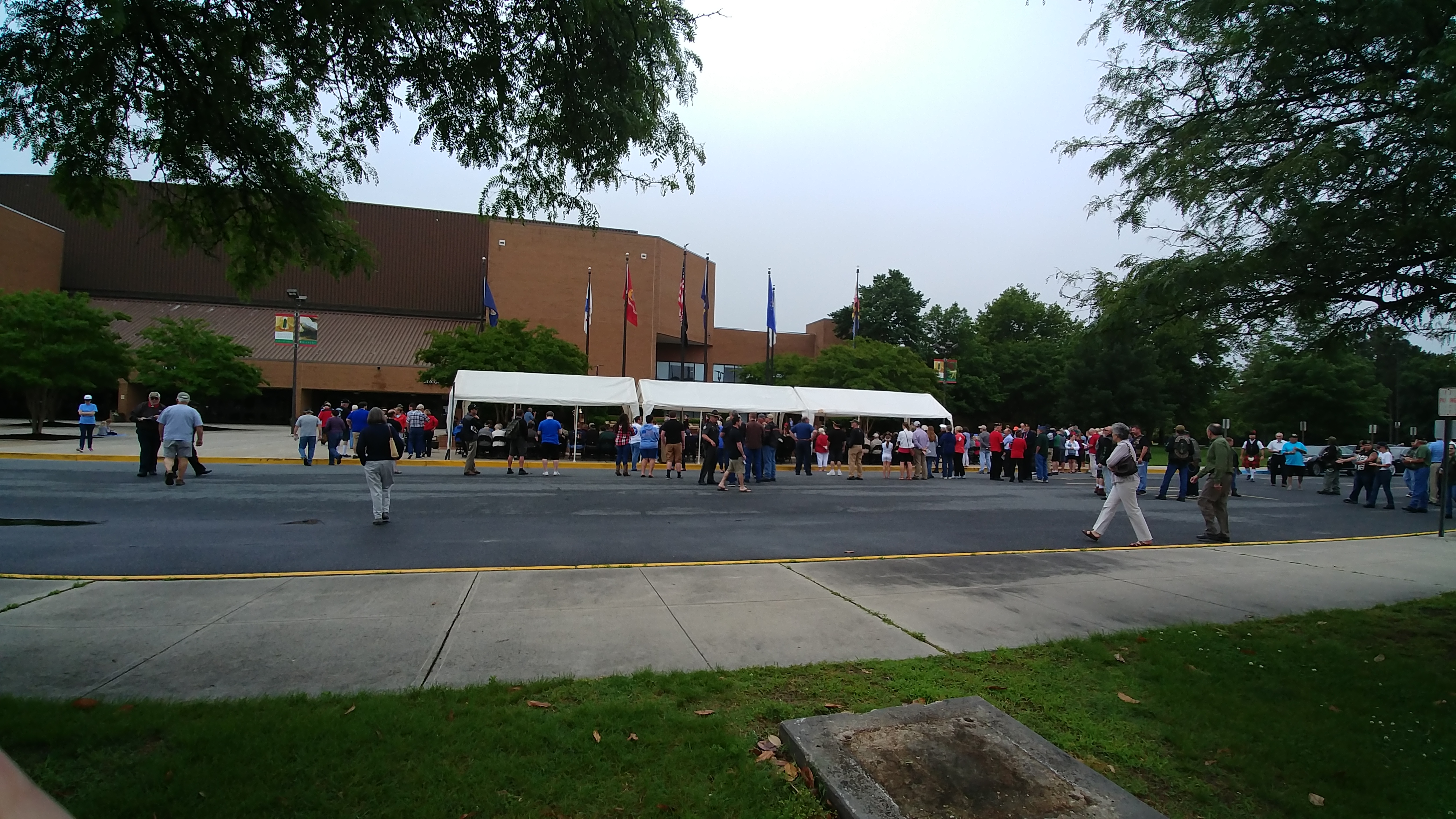
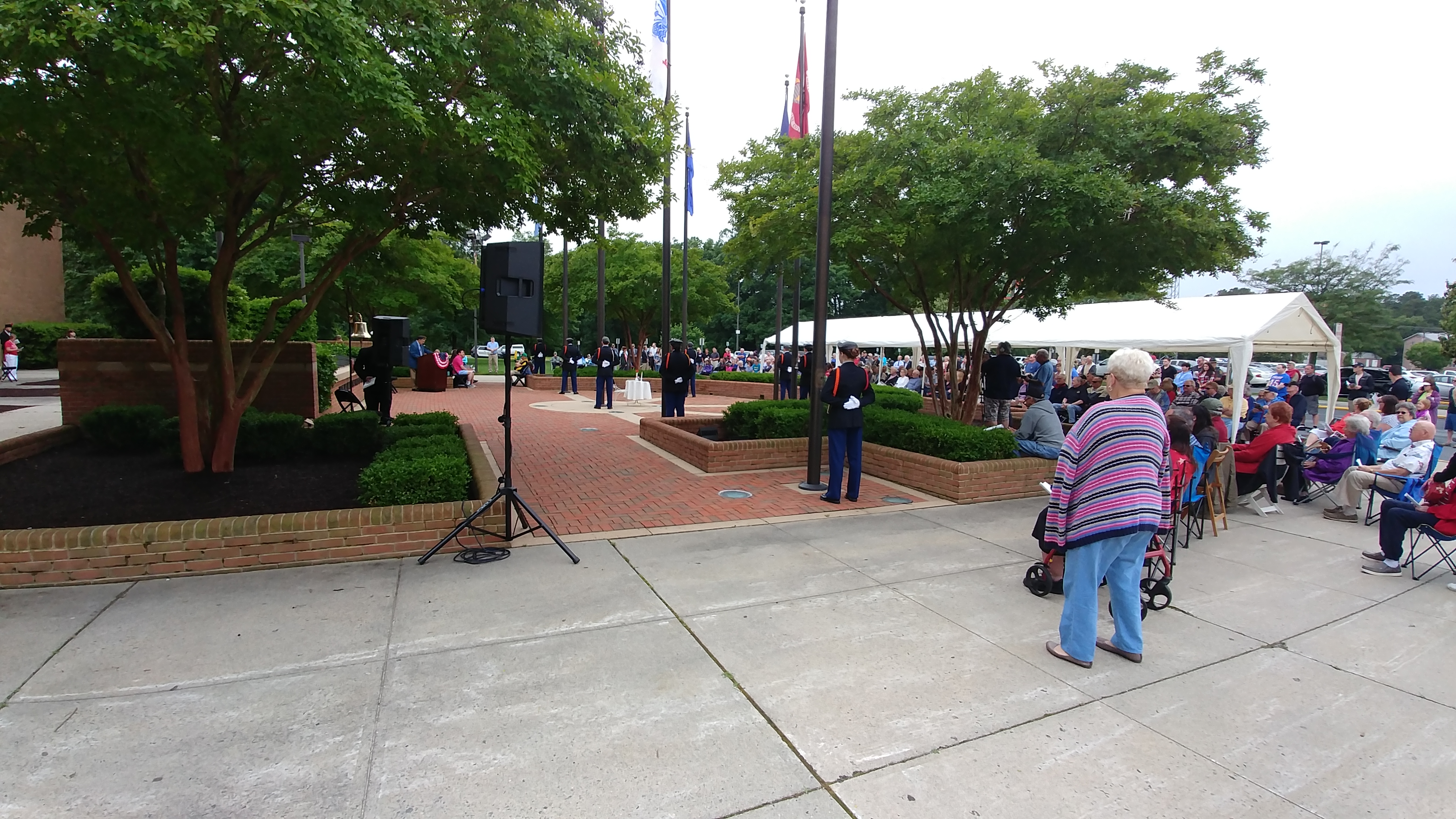
The usual crowd of those who remembered made it a point this morning to be at the Wicomico Youth and Civic Center.
More and more of those looking on needed a seat. With the exception of those in Operations Iraqi Freedom and Enduring Freedom, our veterans are from conflicts that occurred over a quarter-century ago.
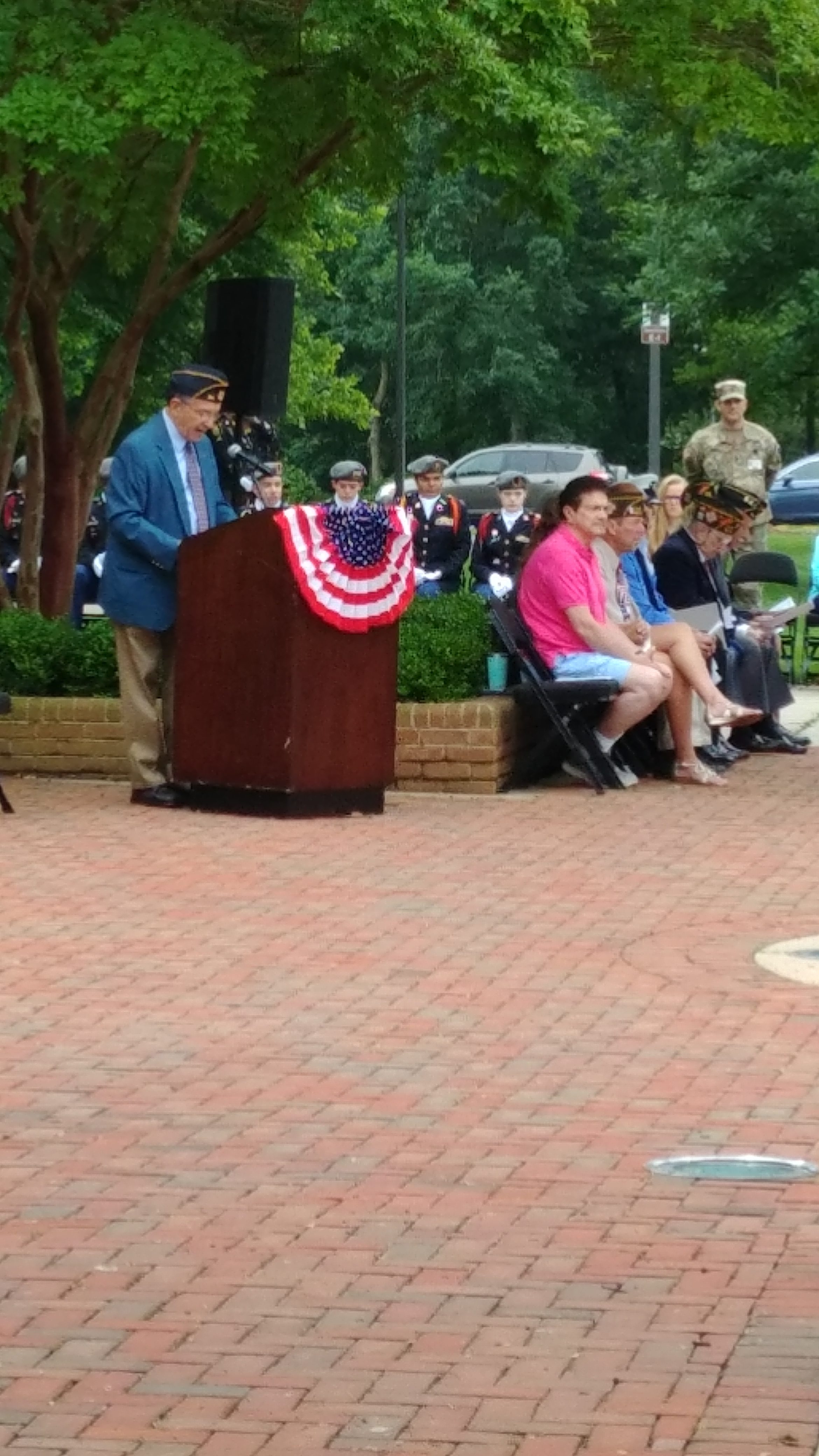
I’ve seen the program several times before, so I pretty much have the order of ceremonies down. Longtime MC Tony Sarbanes is still at his task.
Former County Councilman Tony Sarbanes, an Army veteran, continues in his post as host.
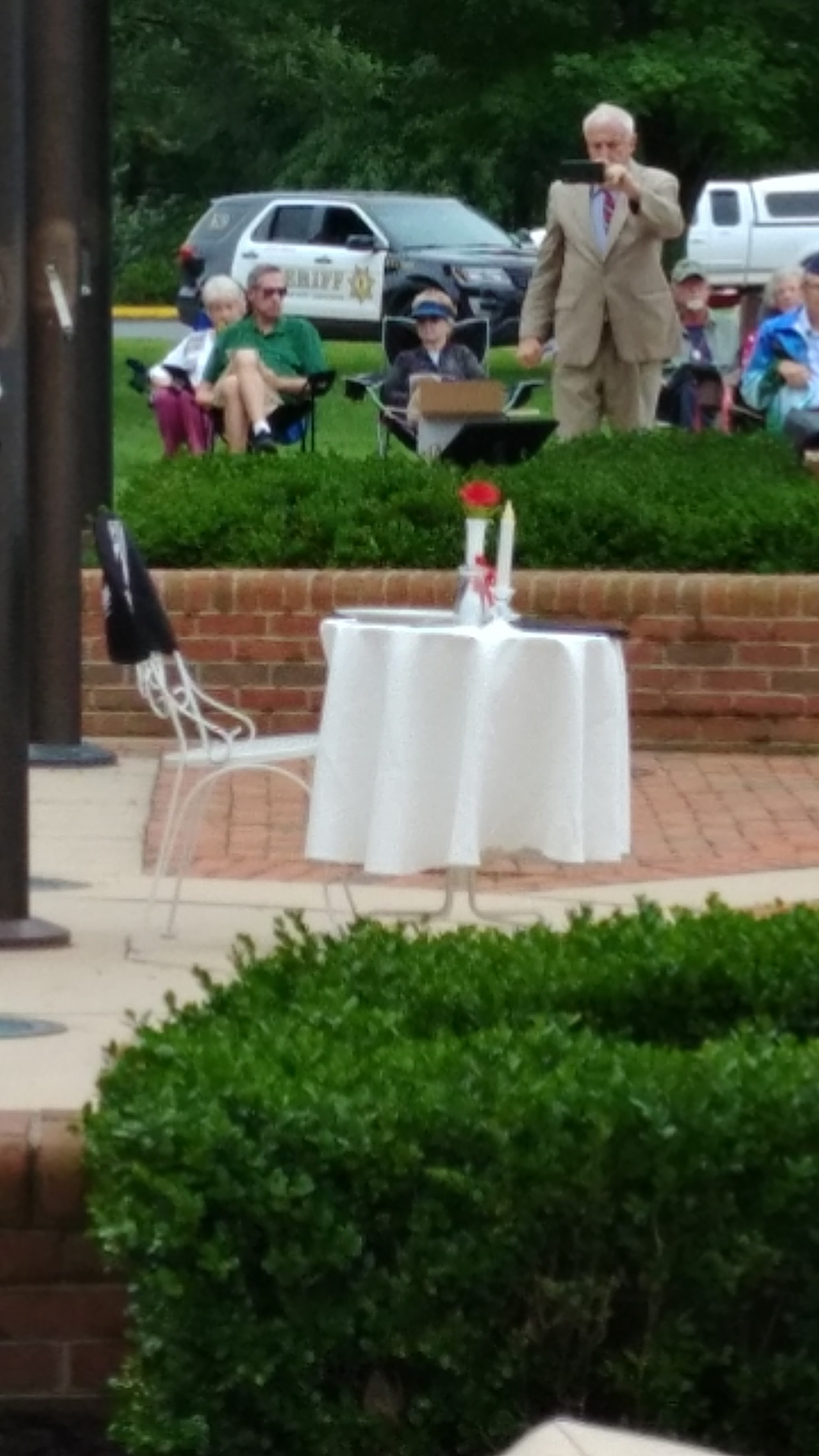
We recognize the Gold Star mothers, the veterans who are attending, the committee that annually puts the event together, and elected officials. In recent years, however, the purpose of this table is explained as well.
This is known as America’s White Table. One deviation from the custom (likely because of the chair selected and the POW-MIA flag) is that the chair is supposed to be tilted inward.
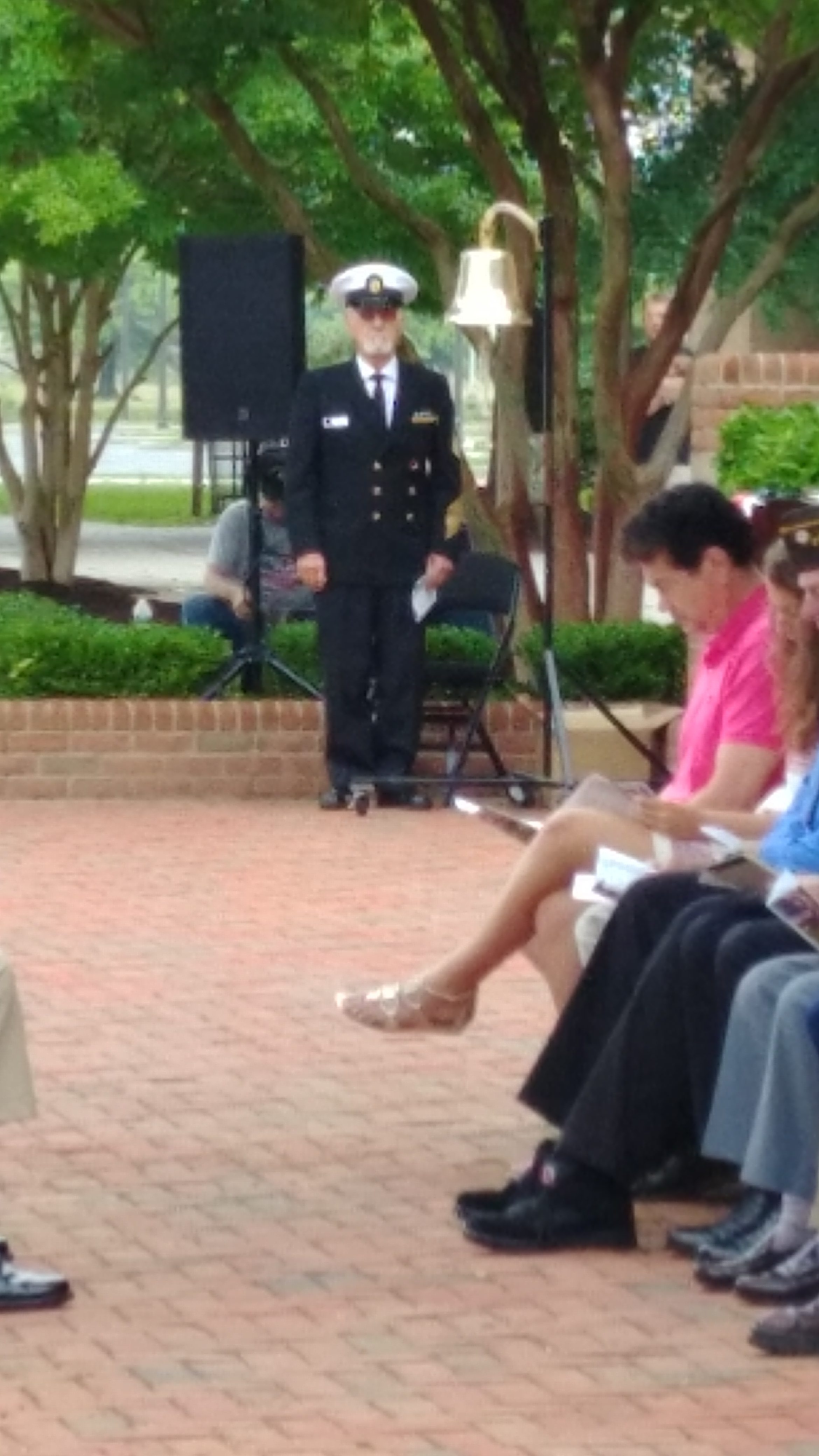
After the reciting of branch prayers, and before reading the list of names for each war, which varies from the two local residents lost in Operation Enduring Freedom to the 109 who perished in World War II, this bell is tolled two times, in succession – four rings for each. Since the annual event began in 2002, there have been seven names added to the list, the most recent being SGM Wardell B. Turner three years ago.
SCPO Dave Suiter, USN-Ret. has been tolling this Red Knights Memorial Bell for a number of years now.
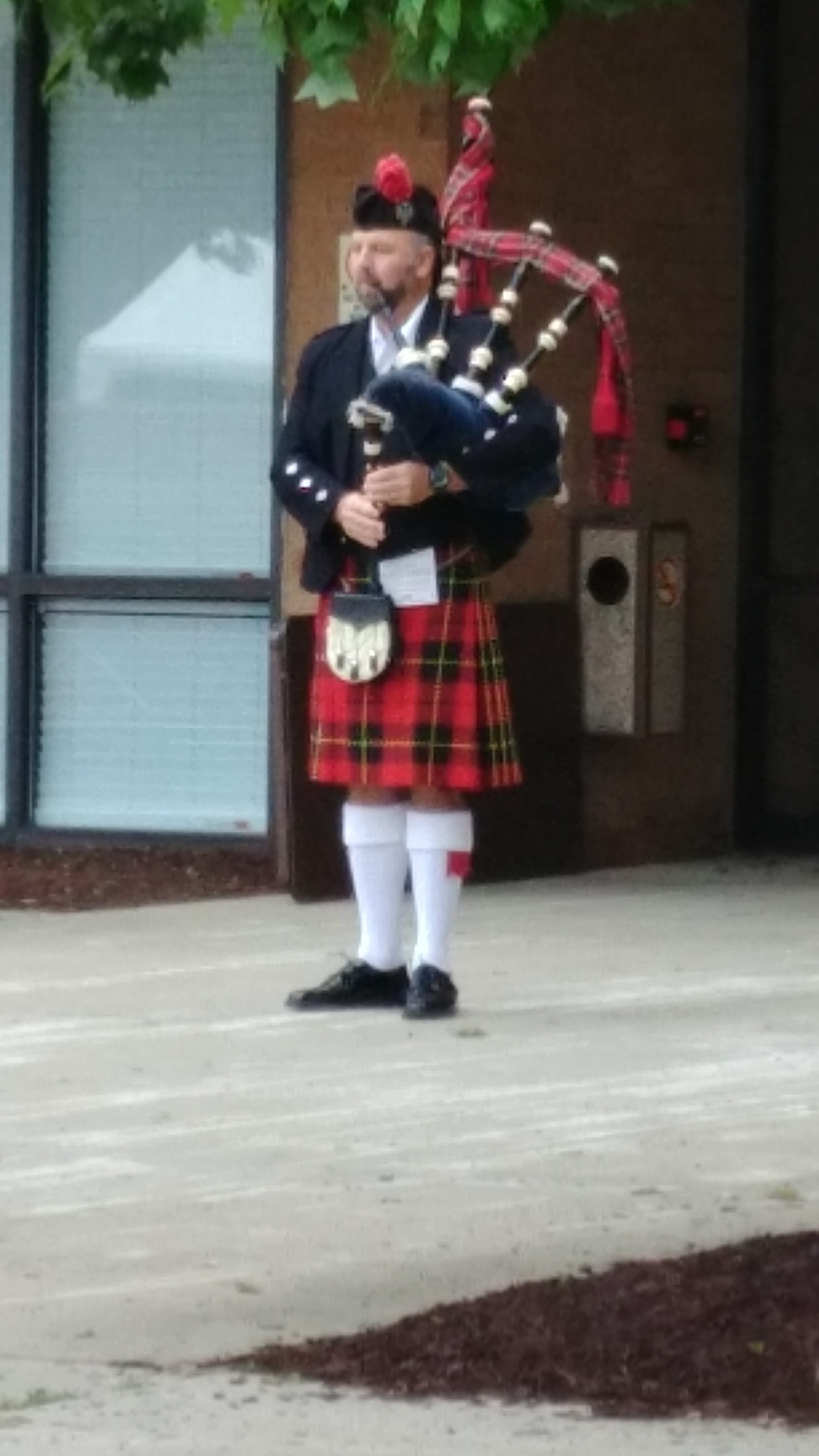
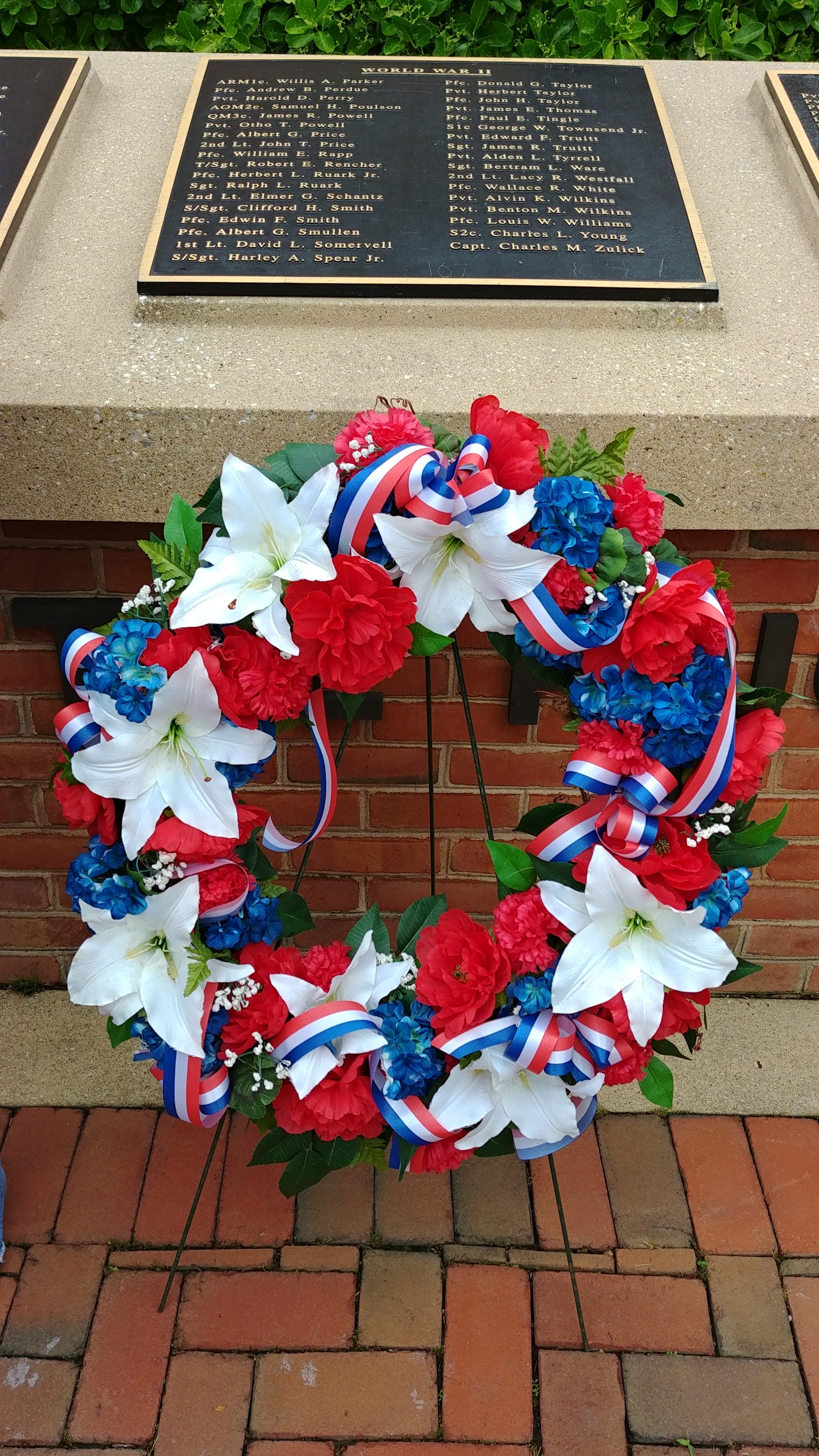
We conclude, as always, with the playing of Amazing Grace, laying of a ceremonial wreath, a volley of arms, and Taps. Just try not to get misty-eyed.
Hearing Amazing Grace performed by Matthew Wallace is always a moving portion of the program.
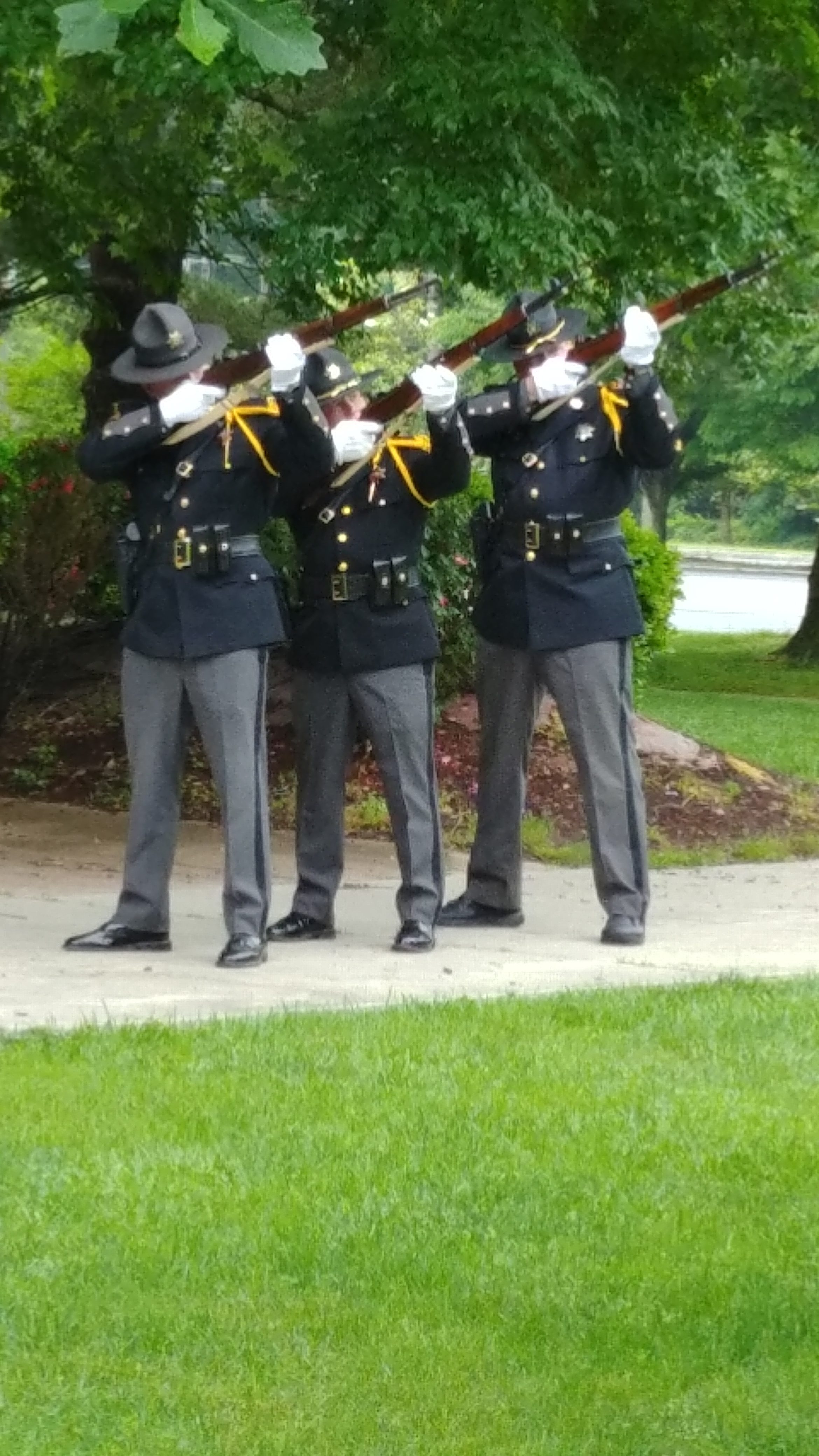
A unit from the Wicomico County Sheriff’s Department gives a nine-gun salute – three rounds of three shots fired.
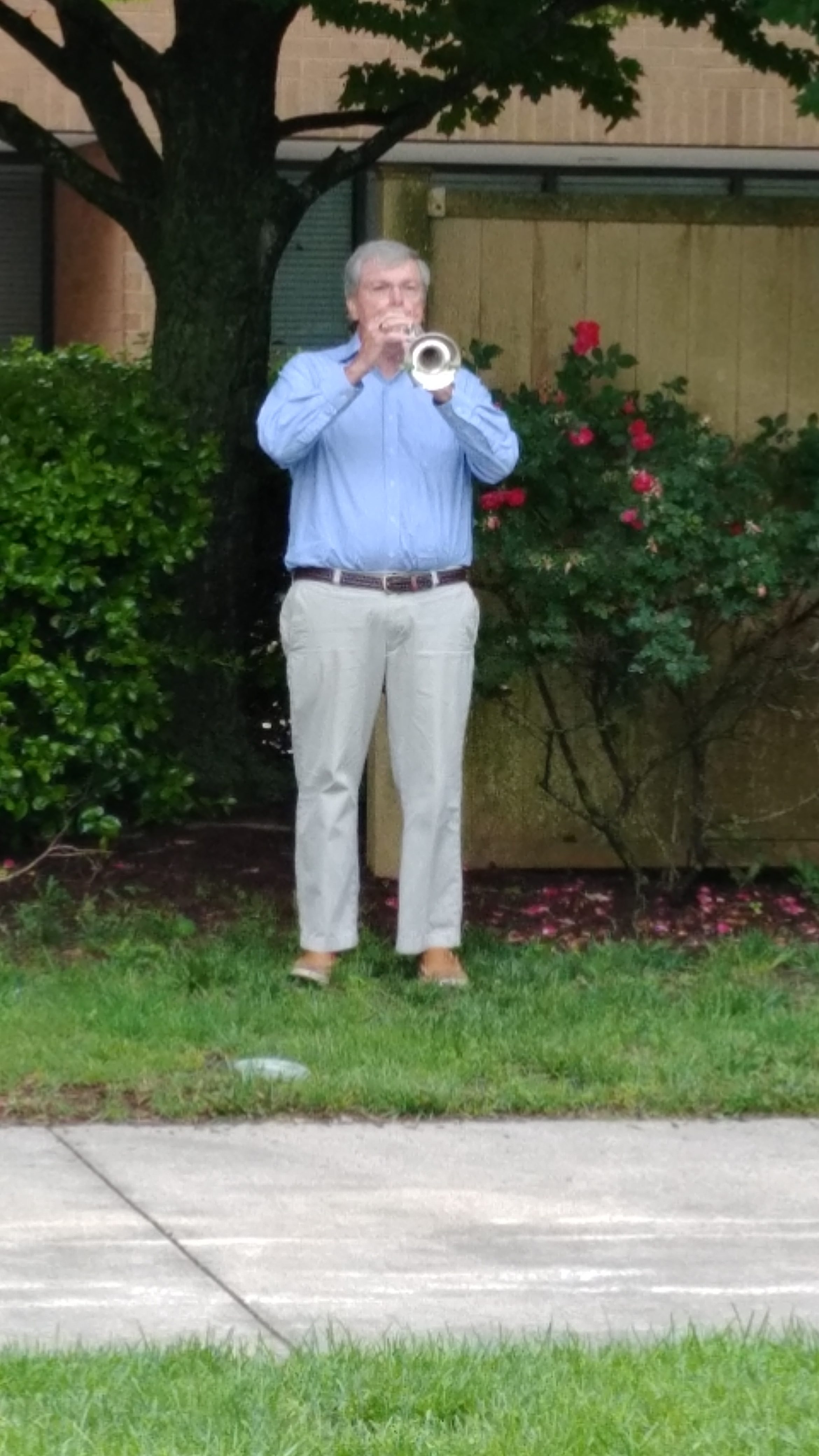
Tom Hehman emerged from his seat to the side to play Taps.
As an aside, we also had Taps played in our church service Sunday. John Jochum, who is the member of our church who played it for us, has also performed at this event in the past.
The wreath that is laid to remember our fallen. Doing the honor of placing it was Silver Star and Bronze Star recipient William James Byrd, Sr. SFC RET MPC U.S. Army.
The location for the ceremony is a permanently dedicated section in front of our Wicomico County Youth and Civic Center. While it is a fine location for our county, it is far from the most unique location for such a memorial.
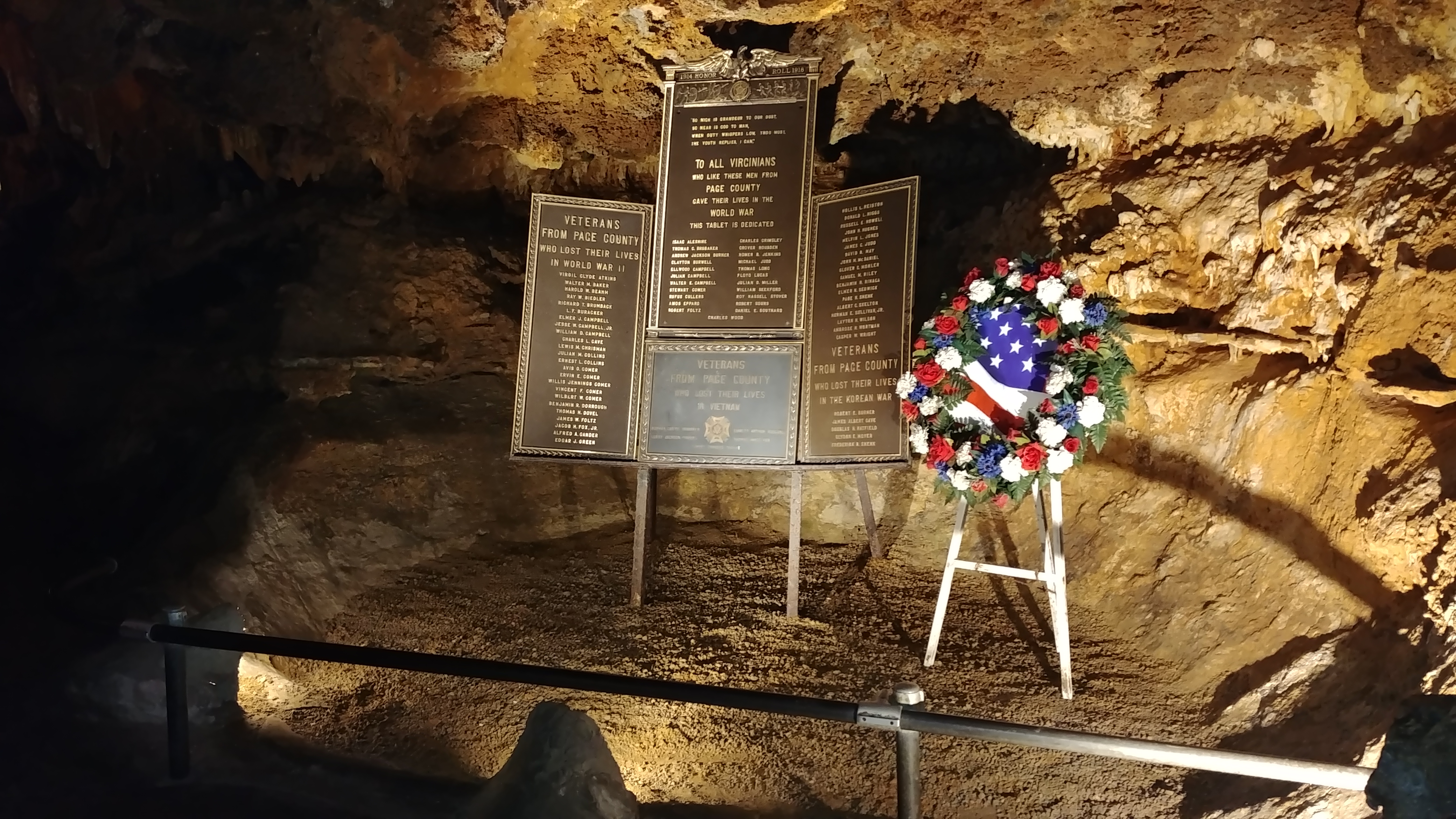
Last weekend my wife and I took a mini-vacation to the Shenandoah Valley, with a stop at the Luray Caverns. Near the end of our tour, we were informed about a most unusual feature – the Page County Veterans Memorial, which, like Wicomico County’s, honors their fallen from World War I onward. Our guide explained that, in a county of 28,000 people, the local veterans’ organizations felt there was no better place for a memorial to be seen than at an attraction that draws over a half-million annually. So there it stands.
The Page County Veterans Memorial in Luray Caverns, Virginia.
Aside number two: while the Luray Caverns are nice, I highly recommend visiting the Luray Valley Museum across the road. I could have spent another hour there looking at the pioneer-era to Civil War displays inside the museum.
Finally, I would be remiss if I didn’t remind my readers that today, Memorial Day, is a day set aside to honor those who perished in battle. Yes, we should express our thanks to veterans as we see them, but that particular ceremony is appropriate for Veteran’s Day in November.
Is it just me or is the 2018 primary season just not that exciting?
The reasons it could be just me are both an accident of geography and the fact that something is missing. Since we moved again last year, I’ve returned to County Council District 5. If you are a voter there of either principal party, you have very little to choose from on a district level: we have one Republican running for County Council (incumbent Joe Holloway, seeking a fourth term) and one person for school board (incumbent John Palmer, who we Republicans appointed a few years back. Bear in mind school board is non-partisan.) The poor Democrats in my district don’t even have a candidate.
In fact, unless you live in County Council District 1 and are a Democrat, there’s no need for a primary to whittle the field for County Council. Both parties found the requisite two candidates for the at-large seats, and all district incumbents who chose to run (John Hall of District 4 did not) except Ernie Davis in District 1 are unopposed for their spots. The Democrat primary in District 1 decides the seat, since no Republicans ran there.
That District 1 race will be interesting as it features three familiar names. Marvin Ames ran for the seat last time around and was third in a three-person field. More than likely that will be his fate yet again as he takes on the incumbent Davis and the former Salisbury City Council member Shanie Shields, whose district there overlaps to a great extent with the County Council District 1 boundaries.
Council Districts 1 and 4 have the best school board races as well, as there are three contenders for that position. To be perfectly honest, I don’t know if there’s a primary runoff for the position to whittle three candidates down to two or if it’s left to voters in November. I think the latter course of action is more prudent, particularly since more unaffiliated voters would be involved in a non-partisan race. There are four vying for the two at-large spots, which would reflect the County Council at-large race – so it’s likely that’s how a primary would proceed. Having an elected school board is a new process, so there’s no experience to back it up.
I mentioned earlier that something’s missing: well, that would be me. The ballot looks strange without my name on it for the first time in twelve years. But they found – for the third cycle in a row – thirteen Republicans to run for nine spots on their Central Committee, and the Democrats (who are showing their segregationist roots) feature the same number but split among five women and eight men for four spots apiece. (If you are keeping score, Republicans have four women in their thirteen-candidate field, the most in recent history. When I was first elected in 2006, we had none.)
I can’t speak for the Democrats, but the GOP Central Committee is assured of some significant turnover. Only four of the nine elected four years ago are seeking another term, as is appointed incumbent Nate Sansom – a.k.a. the guy who I recommended for the job when I left. If just one of them loses the WCRCC will be a majority of “new” people, although most have been involved with the party for several years beforehand. It also means I’ll cast multiple votes for the position for the first time – nothing against my peers, but in a race such as that you better believe I bullet-voted just for myself. This time I may cast a half-dozen or more as a sort of referendum on job performance.
Now I haven’t even discussed some of the bigger, statewide races. That boring primary in my County Council district extends to those who happen to reside in the state District 38B end of it, where Carl Anderton will be elected by acclamation. Those Democrats still have nothing to do in the adjacent District 38C (which overlaps into that Council district) because none ran there – my Republican fellows, on the other hand, have a great four-person race to attend to. On the other side of the county, District 37B Republican voters have a four-person race they get to whittle down to two, and Democrats in District 37A pit the incumbent Sheree Sample-Hughes against fellow Democrat Charles Cephas. (There’s also a Republican in the race for the first time in eight years.) Meanwhile, on a State Senate level, the fields are already set.
For all their bluster, Republicans who were upset with Larry Hogan as governor couldn’t put their money where their mouth was and find a primary opponent (like Brian Murphy in 2010 against Bob Ehrlich.) At least there are GOP candidates for the other two statewide slots, so neither Peter Franchot nor Brian Frosh get a free pass.
As for Democrats in the governor’s race, having a governor who governs from the center means they are positioning themselves just as far-Bernie Sanders-left as they can go. I don’t think there’s a conservative atom in their collective bodies, although to be fair I don’t know all of their positions. If they have any conservative ideas, they hide them well.
It’s also interesting how many Democrats signed up for the “I’m the insurance policy in case Ben Cardin crumples over from a coronary” part of the ballot. (Based on name recognition, the winner in that case could be Chelsea Manning, the artist formerly known as Bradley.) There are eleven Republicans in that race as well although none of them have thrilled me yet to put my support behind them like a Jim Rutledge, Dan Bongino, or Richard Douglas did. And considering none of these eleven had a current FEC account, voting for one may be an exercise in futility – in their defense, though, the FEC only reports quarterly so this doesn’t yet reflect 2018 results.
So pardon me if I have to suppress a collective yawn for this election, particularly given the tendency for both parties to govern in a manner that’s reminiscent of two teenagers fighting over who’s going to go out and wreck Dad’s car. They may not know the result at the time, but that’s what’s going to happen if they win.
Over the summer in Salisbury, there has been a controversy over a plaque in front of the courthouse that honors a native of what would become Wicomico County after his death. Brigadier General John Henry Winder was a West Point graduate and veteran of the Mexican-American War, but he also played a role in the War Between the States as a military prison commander in the Confederate army, and that trivial fact has enraged a certain segment of the community.
The plaque itself dates from the mid-1960s, as it was placed by a commission created to mark the centennial of the Civil War. Its original location along U.S. 13 made it a target for wayward drivers, so it was relocated in 1983 to its present location on the front yard of the old county courthouse, facing south along East Main Street. (The old courthouse itself fronts North Division Street, so the plaque is sort of off to the side. In truth, visitors to the courthouse seldom see the monument as it’s on the back side of the more recent addition to the county’s halls of justice, where most enter.)
Last week an incident at the courthouse reignited the uproar, as two men were charged with malicious destruction of property after chalking up the building and walks leading up to it with various slogans and phrases indicating their displeasure with the monument’s presence.
With that background in mind, know that I decided to drop by an event on Friday that I’ve been meaning to check out but hadn’t. The final edition of “Fridays at Five” for the year was this past Friday and even though I had a family function later that evening I decided to go scan the scene. As parties go, it was comparatively modest: a beer truck and team of two DJs surrounded by a host of games to amuse the partygoers. But there were also a couple of buckets of chalk there and I think these gentlemen weren’t through with their messaging.
Yes, these guys were just the life of the party, all right.
And not only were they being blowhards about a dead subject – the plaque’s not going anywhere fast unless another criminal act is perpetrated – but they’re not too bright, either. “Buget”? (He tried to fit a “d” in after it was pointed out to him.)
While he’s pretty close on the number, there’s a reason it’s so high: sequestration. It didn’t seem like anything else on the budget was subject to it, but something that’s Constitutionally mandated was. And the FY18 defense budget had bipartisan support.
Since the chalk was going to be used anyway, I had my own little message, set off to the side.
Because I’m not a professional chalker, this is what it says: “Let history be history, work to a better future.”
I say just leave the Winder plaque where it is, because it’s not hurting anyone and nary a complaint had been made about it for 33 years until a certain president was elected. Now if they want to commemorate other things that occurred there, let them go through the proper channels (since I believe these are state-sponsored monuments) and see if there can be monuments to the lynchings or slave trading that may have taken place in downtown Salisbury.
With so many more important issues and problems in our community, worrying about a plaque seems a waste of time. Notice I’ve been relatively quiet about the whole NFL kneeling for the National Anthem thing because there are more important things in life for me to obsess over – if NFL players want to cut their collective economic throats, people can do other things on Sunday. I don’t really worry about football season until the World Series is over, anyway.
And with the news of the Las Vegas massacre, it’s a reminder that we have serious issues which demand that we hug our loved ones a little tighter and not be as offended with things we don’t wish to read.