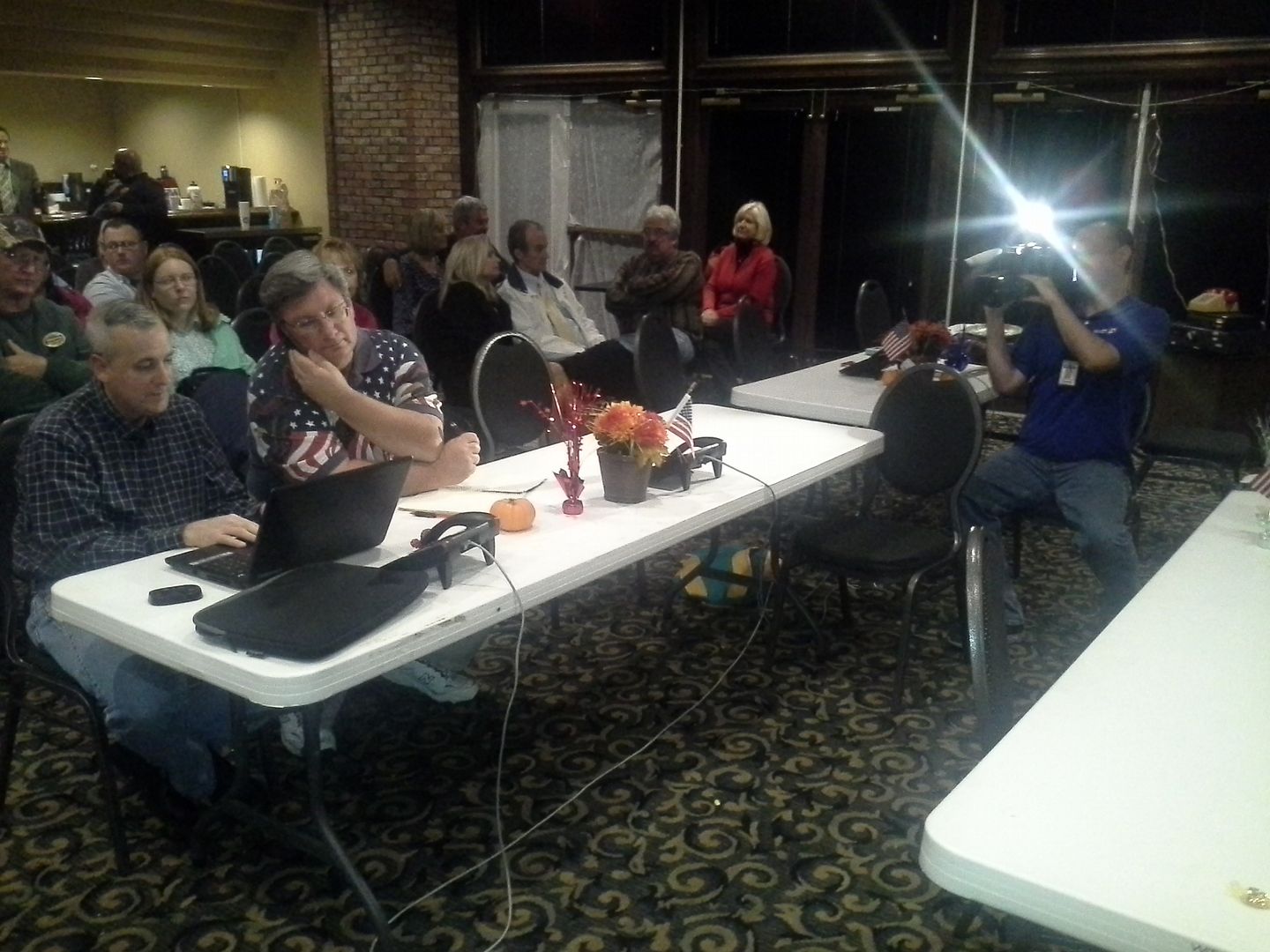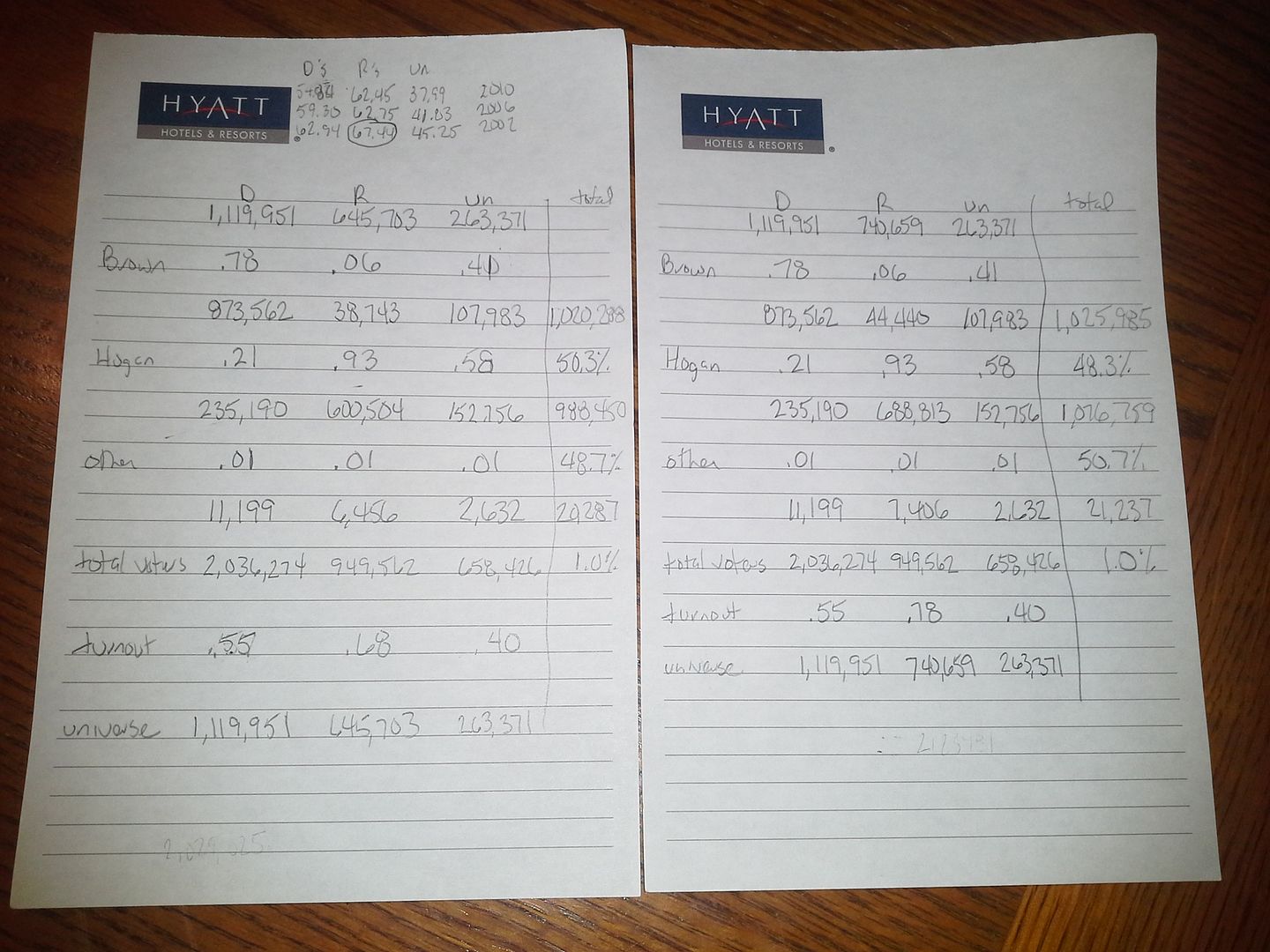
Aren’t we thrilled?

May 17, 2013 · Posted in Campaign 2014, Delmarva items, Maryland Politics, Politics · Comment 

You know, it’s hard to come home after a nice evening and discuss bad news, but there it was on the table: Martin O’Malley finished the damage of the “90 days of terror” by signing the last of the approved bills from this year’s “very productive” General Assembly session. If it were any more productive we’d be a banana republic.

Of all the bills signed, though, it appears that just two will be subjects of a petition drive to referendum: the death penalty repeal and the gun law. The death penalty repeal is “officially” sanctioned by mdpetitions.com  while the gun law is being challenged by another group, with the petition there at freestatepetitions.com.

Regardless who begins the effort, though, the rules are the same: by June 30 there needs to be valid signatures equal to 3% of the number of those who voted in the 2010 gubernatorial election (just under 56,000) with 1/3 of those required by May 31 – the end of this month. Both drives got sort of a late start.

Unfortunately, having seen the 2012 petition drives all defeated at the ballot box, the question is whether there is enough interest in seeing another potential wipeout at the 2014 election. Granted, the demographics of the vote may be more favorable to those who would like to overturn these issues but so far both petitions seem to be having tough sledding. Moreover, failure to get enough signatures for either or both petitions will probably embolden Democrats to pass even more egregious legislation – it’s bad enough we can’t petition appropriations bills and may have an even higher hurdle to overcome in the future.

There’s also the argument about the gun bill being brought to referendum because it’s placing our God-given rights to a vote. One thing a referendum would do though is delay the enactment of the bill, so there is a point to consider.

Still, it was a sad day for the formerly Free State yesterday, and I hope in 18 months we will wipe the smiles off their faces after the people take back their state.

That’s a sentiment shared by Maryland’s GOP, as Chair Diana Waterman admitted the following:

Cracking down on crime is clearly not part of Martin O’Malley’s presidential resume. Together with the Democrats in Annapolis, O’Malley has shamefully politicized the tragedy in Newtown, Connecticut in order to advance his radical agenda and political aspirations. This legislation will do nothing to curb the effects of gun violence in Maryland, but instead only makes it even more difficult for law-abiding citizens to exercise their Second Amendment rights.

While other Governors like Bob McDonnell of Virginia and Tom Corbett of Pennsylvania and their legislatures are working to reform state government, Martin O’Malley, Mike Miller, Mike Busch, and the Democrat legislators in Annapolis have wasted the people’s time and money by imposing higher taxes, promoting government dependency, and assaulting the Second Amendment.

Elections have consequences. Whether it was an uninspiring top of the ticket, underperformance in filling out the ballot card, or not being effective in promoting a conservative message to the state’s voters, the 2010 election which should have been a slam dunk in t least restoring the GOP to a player in Maryland politics was, instead, a lost opportunity. In part, this led to the demise of our 2012 initiatives to roll back the welcome mat to illegal aliens and to maintain the common meaning of marriage.

Instead, we pretty much have to try again in 2014 to reinvent the wheel. Granted, there is potential at the top of the ticket for a young and dynamic presence, but the true test will be whether we can contest every race this time around. Hopefully the regressive nature of the O’Malley regime and the prominence he’s already given Anthony Brown as a hand-picked successor – and, in turn, Brown’s defense of the O’Malley record – will give the MDGOP something to build upon. A referendum drive or two won’t hurt the cause.

Share

Scandal fatigue?

This William Warren cartoon seems to sum it up, doesn’t it? Between Benghazi, the IRS TEA Party targeting, the AP phones being tapped, the FOIA preferences at the EPA, questions on campaign finance in both 2008 and 2012, the Enroll America protection racket – the list can go on and on and on if you revert back to earlier activities like Operation Fast and Furious, Solyndra, or the handling of the Deepwater Horizon accident. And I’m not counting what goes on in Maryland, like the inmates taking over the prisons or having a governor who’s more concerned about presidential prospects than running the state. I suppose if power is the ultimate aphrodisiac then that must be why Democrats are pro-abortion; otherwise they would have a dozen or so children running around, by nearly as many mothers.

Now I’m certain the minuscule number of progressives and leftists who dare to read here would beg to differ and can probably point out all the scandals, conflicts of interest, and foibles of the Bush years, but really, guys, come on – what happened to the most transparent administration ever? I suppose in a perverse sort of way finding out about all these scandals is a type of transparency – too bad we were stonewalled every step of the way in finding out.

But are the American people and their notoriously short attention spans in danger of scandal fatigue in May of 2013, 18 months before the midterm elections? Sometimes the pre-emptive strike is the best thing in the long run, and there’s little chance of the rabidly partisan Democrats in the Senate turning on their leader and convicting him in the unlikely event we ever get to an impeachment trial. Moreover, Barack Obama doesn’t exactly strike me as a fall-on-the-sword kind of guy, so don’t bet on him resigning to save the country the agony of an impeachment trial like Richard Nixon did. Democrats know well what sort of electoral fate may await – the Republicans who placed country over party were “rewarded” by losing 48 House seats and 3 Senate seats in the 1974 elections, which were held just three months after Nixon left in disgrace.

Meanwhile, focusing on the scandals of the past will blind us to the issues of the present. Even if the GOP gains control of the Senate in 2014 – a likely possibility even without scandals as the sixth year of a presidency is traditionally unkind to the president’s party – the nation will simply revert back to the inverse of the situation we had back in 2007-2008, where a Republican president was crippled by a Democratic Congressional majority in both houses. Much of the damage was done in the two years the Democrats held absolute control of government, as the massive entitlement program dubbed Obamacare came into being and Barack Obama’s re-election means at least some of it will be in place by 2014. Once established, we haven’t killed an entitlement program yet. And there’s still the aspect of governing by executive order: “Stroke of the pen, law of the land. Kinda cool.”

Perhaps the one silver lining in all of this is the emergence of the new media as a force for uncovering these and other issues with the government in Washington. No longer do we have a small group of periodicals, newspapers, and television networks determining what is news and what remains on the cutting room floor. Certainly, there is a huge majority of the American public still in an celebrity gossip-induced slumber, but slowly people are beginning to see the light and it only takes an irate, tireless minority to effect real change.

In the meantime, though, there is plenty to write about for those obsessed with Obama scandals. That really is a shame because it makes it more difficult to argue with the other side on why their ideas are such a failure – I can hear it now: “Well, if you Republicans wouldn’t have made the Obama years such a partisan witch hunt he may have succeeded with his good ideas.”

But I suppose it comes back to the old saying about absolute power corrupting absolutely, doesn’t it? Do you see why the nation’s founders wanted a limited government yet?

Share

If you’re in for the penny, you’re in for the pound

A week or so back I referred to one of Delegate Michael McDermott’s summaries of the 2013 General Assembly session, and he’s come back with another installment today. In this one, he laments the economic effects of those “few pennies” we’ll be paying every day to the state in additional taxes and fees by reminding us that businesses will be paying them, too. McDermott concludes that:

As the government draws more money out of the economy through these new taxes and fees, taxpayers (and) consumers find themselves with fewer discretionary dollars. This always results in fewer dollars being put back into our local economy and every point of commerce suffers. When business slows, expansion is put on hold. When business suffers loss, people lose jobs.

All this seems to be basic common sense which is lost on those who inhabit the Maryland General Assembly and vote with the majority party. It somehow never seems to seep into their consciousness that business aren’t going to pay maybe $100 a year for the so-called “rain tax” or the promised no more than $2 a month for “green” energy, nor will the effects of ever-increasing gasoline taxes be minimal for them.

The problem they have is twofold:  the Maryland economy is dynamic and the geography is static. From my house I can be in Delaware in 15 minutes and Virginia in about 40. It’s worth pointing out that just four of Maryland’s 23 counties aren’t on a state border (Anne Arundel, Calvert, Howard, and Talbot as well as Baltimore City) while several border two states and Washington County touches three. Certainly it’s not like larger states where traveling to a different jurisdiction to take advantage of their business climate involves the expenditure of several hours and a half-tank of gas.

So Maryland has to compete on a playing field which is far from level, and savvy consumers know just where to go to get the best deal. It’s no wonder that neighboring states have large shopping meccas close by Maryland’s borders.

Now this isn’t all bad news for Marylanders, as some cross state lines to work just as some who live in neighboring states make up Maryland’s too-slowly growing workforce. But as critics like McDermott and Larry Hogan of Change Maryland point out, we can do better.

And don’t think Mike isn’t seeing the political reality. Note this passage in his report:

I am not sure where the disconnect lies with legislators who see nothing wrong with this tax and spend approach at governing, but I am quite sure the public is fully able to connect the dots. I was recently at a meeting of local business owners and entrepreneurs when a senator told them that what they could “conceive…the government would help them achieve.”  Sadly this was repeated so there was little doubt where he was coming from in his thoughts regarding the purpose and scope of government.

It wouldn’t surprise me if the Senator in question isn’t the person McDermott will be facing next year.

Share

David Craig setting up announcement tour

Updated below.

It’s been perhaps the worst-kept secret in Maryland politics for over a year, but it appears as though David Craig will make his 2014 plans official on June 3 as he embarks on a real statewide tour, or at least one more geographically encompassing than Democrat Lt. Gov. Anthony Brown’s puny effort last week when he announced his gubernatorial plans.

Within the last couple hours, the first day of the Craig tour was laid out on Facebook: a 9 a.m. announcement from his front yard in Havre de Grace, followed by an 11:30 a.m. appearance at the Dundalk American Legion Post 38 and a 7 p.m. happy hour reception at Bulls and Bears in Hagerstown. I have it on good authority there will be a Salisbury stop on day 2 of the Craig tour, June 4, although details are probably still being finalized. On that front, I was also told by that same local Craig volunteer this would be a three-day tour, so it’s possible the local Eastern Shore event could instead be June 5.

Craig would officially enter a fairly crowded field as the Republican nomination is opened up for the first time since 2002, the year Bob Ehrlich first won his nomination over two perennial candidates. Arguably this could be the strongest gubernatorial field ever for the Maryland GOP, as the shadow of Bob Ehrlich and his three-election run as the established Republican standard-bearer allowed a number of good candidates to establish a solid local foothold while clamoring to get their chance at the brass ring.

At this point only one GOP candidate has officially filed, and Brian Vaeth – who finished dead last out of 10 would-be U.S. Senate candidates last year with 1.9% of the primary vote – probably won’t present much of a challenge to the remainder of the eventual field. While Blaine Young has been campaigning mainly to party insiders for the last several months and Ron George formally announced his plans last month, we are still awaiting official word from Charles Lollar and Dan Bongino. With the caveat that both are internet-based surveys and are not scientific, Craig has held his own in two recent preference polls on conservative websites with Bongino and Lollar, while Young lags behind. Meanwhile, Ron George performed respectably in the latest Red Maryland poll cited.

Obviously this will be a developing story, and Craig’s entry may break the dam for others to make their intentions clear. It’s likely June will also be the month Charles Lollar makes his draft campaign official while Dan Bongino has no set deadline in mind.

In Dan’s case, though, there is also the chance he could choose to bypass 2014 to concentrate on a 2016 Senate run for what could be an open seat given Barbara Mikulski’s advancing age (she would turn 80 in the summer of 2016) and declining health. In that case, much would depend on whether the GOP wrests control of the Senate (and their Appropriations Committee. which she chairs) from the Democrats. Obviously this is true of the others as well, but Bongino is the only one of the five with statewide campaign experience.

Then again, the other four will catch up on that front should they go through the primary of 2014. Look for more on the Craig front in the coming days.

Update 5/14: It appears the Eastern Shore will be served either in the evening on June 4 or on the 5th, as thus far June 4 sends Craig to an 8 a.m. breakfast in Silver Spring, the Calvert County Courthouse at noon, and the Annapolis City Dock at 3 p.m.

Update 2 5/14: Salisbury’s stop will be at the Government Center at 9 a.m. on Wednesday, June 5th.

Share

O’Malley’s top 40

Recently Change Maryland had to do a mea culpa, because they found out they were incorrect.

Just weeks after putting out the word about Martin O’Malley and his 37 tax increases since taking office, the good-government advocacy group had to let people know they were just a little bit off – in the wrong way:

Previously, Change Maryland released a report that updated tax and fee increases following the 2013 session, which brought the total to 37 increases that remove $3.1 billion annually over and above the existing tax burden.  These latest reports adds new fees for gun purchases, enacted in 2013, and two newly-discovered measures buried in omnibus legislation and not subject to normal legislative procedures.

So now we are up to a nice, round 40 tax and fee increases under the O’Malley regime. Aren’t we special?

Since I began with Change Maryland, I may as well continue with what their leader, Larry Hogan, had to say:

Nobody expected the total impact to be this staggering, not even me. Struggling Maryland families and small businesses simply cannot afford another four years of an O’Malley-Brown tax and spend binge.

Hogan continued by lamenting the ongoing nature of the problem:

This is not just an argument about big government. It’s about a government that is on auto-pilot to grow exponentially, beyond anything any of us have ever seen in our lifetimes and that comes directly at the expense of the private sector economy that we desperately need to diversify our employment base.

Undoubtedly, the question for the O’Malley/Brown team – and they are a team, since our lieutenant governor is the favored choice of Martin O’Malley – is whether Anthony Brown will try and run up the score some more. Would triple digits be possible over a 16-year reign of the O’Malley/Brown team? In a speech in Chestertown, Hogan used the occasion to blast the heir apparent, who’s announced his intention to snag the state’s top spot next year, from the stump.

(Side note: the odds are against Brown, as on three occasions since the office of lieutenant governor was re-created in 1970 the officeholder failed to win the office him/herself. Blair Lee III lost the 1978 Democratic primary, as did Melvin Steinberg in 1994. Kathleen Kennedy Townsend won her nomination, but lost to Republican Bob Ehrlich in 2002.)

Yet the more Hogan chooses to point out the foibles of the O’Malley/Brown team, the less of a chance there is he will enter the race himself. In a lot of ways, Larry has chosen to be this state’s version of Sarah Palin as he could potentially be a kingmaker as the leader of a bipartisan group closing in on 40,000 followers. If each can influence five voters, you have yourself a GOP primary winner in a year where it appears we will have two or three relatively strong candidates.

And then there’s always O’Malley’s own legacy and his dreams of running for President in 2016. Certainly he would find it a feather in his cap to get his LG elected as successor and cement his legacy. Being the media whore he is, I wouldn’t be all that surprised to see Martin O’Malley take the tack suggested in this piece by Pete “DaTechGuy” Ingemi as MOM has to overcome the legacy of one Hillary Rodham Clinton. “I can see a certain Maryland governor doing this,” indeed.

Share

Observations on observations

Perhaps the pro-liberty crowd is still a little restless in Maryland.

Today I got an e-mail from “the Susquehanna Conservative,” a.k.a. Scott DeLong of Harford County. Let me toss out a couple caveats before I begin with my analysis of his remarks: one, he was a Collins Bailey supporter for Chair as I was,  and two, Scott is part of the Campaign for Liberty group, which probably makes point number one unsurprising since that was Bailey’s base of support. This rather lengthy e-mail mainly speaks to Scott’s thoughts about our recent convention, although he opines on some other topics as well.

Upon his arrival, he noticed the same thing I did: a handful of Waterman signs but many passionate Bailey supporters out sign waving. Of course, he also highlighted the Maryland Liberty PAC hospitality room to a much greater extent than I did, because I went to several others in my travels that evening. I didn’t realize, for example, that Delegate Michael Smigiel spoke to the group and the information Smigiel related about the SB281 gun bill was quite enlightening. I truly appreciated the overview and wonder if anyone recorded all of the speakers there for future reference.

And since I’m sure I have the attention of the pro-liberty crowd – and hopefully the MDGOP leadership as well – I’d like to offer a suggestion. I’ve alluded to this before, but honestly I’m not sure I have done so in this particular forum: why not move the Maryland Liberty PAC suite out of Friday night, when the focus is more on socializing and schmoozing, to Saturday morning? As DeLong explained later, not all of the Saturday morning fare was well-attended, and to me it would be like a miniature MDCAN conference before our convention business began. Perhaps we could integrate a continental breakfast into it, but in either case I bet it would draw more than seven people.

So only a small portion of Scott’s reflections focused on Friday night. The next part, though, I found interesting. To quote Scott, “It was the Establishment versus 2 grassroots candidates,” but by the very next paragraph he darkly alludes that “The Establishment was going to pull out all the stops to make sure their candidate, Waterman, would win” by “Thugging The Vote.”

Personally I found what I heard to be happening reprehensible, then again, this is politics and “politics ain’t beanbag.” While we had a proxy unsure of the direction to go, having heard conflicting information about following the wishes of the person being substituted for versus following their own desire, I was hearing some of the same stories being related by DeLong in his account.

So let me back up the scenario a little bit. In previous discussions, Dave Parker (our county Chair) and I agreed that our county’s vote could easily (and likely would) split three ways. I actually was mildly surprised by the split as one person I thought of as a Waterman supporter picked Bailey and one other did the reverse. In the end, we were about as split as any county was – but our Chair was perfectly fine with that, and allowed us to make up our own mind.

Contrast that to the browbeating some county chairs gave to their charges, particularly those in the Waterman camp. It was disappointing, but frankly not too surprising. They weren’t going to repeat the same mistakes they made when they thought Audrey Scott had the National Committeewoman’s seat in the bag last spring. Granted, the three votes DeLong alludes to would not have changed the end result – unless it was the tip of the iceberg, and we may never really know that.

But after Scott goes through the voting process, he points out some of the goings-on between ballots for the Chair position:

The chain of events after the first round of balloting for Chairman was interesting.

The Kline and Bailey camps appeared to be genuinely cordial to one another.

It was reported that during that pow-wow that when Kline was deciding what to do that Bailey told him that if he thought he should stay in for one more round, he should.

That’s just Collins being Collins.

However, if one of their goals was to get a grassroots chair and get Pope off the RNC Rules Committee, then the Kline team really needed to be able to see the writing on the wall.

The only thing that would be accomplished with Kline remaining in the race would be the election of Diana Waterman as Chairman since she was 11 votes away and it would be virtually impossible for Kline to get enough to get close.

The Bailey team was prepared to endorse Kline had the outcome been reversed.

The supporters of these two groups clearly had more in common with each other than with Waterman and Pope.

Had either become the Chairman the other groups would have certainly had a seat at the table and would have had their ideas and input considered, and if found workable, implemented.

The Kline guys seemed like a decent bunch, but they clearly need to get better at reading the tea leaves.

Now that last statement will probably earn Scott DeLong the everlasting enmity of the Red Maryland crew, for whom I am an erstwhile contributor (as they like to point out.) One result of this particular election, though, is that it may create a change in the bylaws or the adoption in the future of a special rule where the lowest-ranked candidate is automatically evicted from the ballot. Again, we will never know if a Kline withdrawal and endorsement of Bailey would have been enough to push Collins over the top given how close Diana was in the first place, but as things turned out Bailey supporters got the next best result.

From here, Scott implores us in the pro-liberty movement to “unite for common goals” and launches into a discussion about national party affairs. I believe DeLong is correct that National Committeeman Louis Pope will be extremely resistant to change, and given some of his statements regarding the “Liberty Pack” (as he calls it) it doesn’t appear he will be of much use to the purpose of revisiting the RNC rules.

Yet some of the ideas in the “Growth and Opportunity Project” that DeLong doesn’t like are ones I happen to be in favor of. Personally. I would like to see multi-state primaries – but I don’t want the calendar front-loaded because I would prefer the primaries occur in the timeframe of May through early July, with the conventions remaining in September. With such a compressed schedule, there would be plenty of time for a grassroots candidate to gather support beforehand, not to mention “as much debate and discussion as possible.” (By the way, we should tell the cable networks that either we pick the debate moderators or they can pound sand.) On the other hand, the idea of all caucuses intrigues me as well – perhaps we can have a cutoff number of Republicans in a state (say, just for an example, one million) between a state which can caucus and a state which must hold a primary. (And yes, I think the primaries should be closed. Don Murphy hasn’t convinced me yet.)

DeLong returns to the convention narrative to talk about the reports from Senate Minority Leader E.J. Pipkin and now-former House Minority Leader Tony O’Donnell as well as the “usual parliamentary chaos.” I have to agree with Scott on that one.

There have been far too many conventions where we simply ran out of time before important business could be concluded, and to me that’s inexcusable. In one case, I had a pending bylaw change on the short end of the time stick; this time, there was the Tari Moore resolution which was tabled last fall. It always seems like we have some sort of high-priced dinner afterward that no one really wants to attend because they’re dragged out from 24 nearly non-stop stressful hours with very little sleep and – for many – a long drive home. (Next spring in Rocky Gap will be a classic example of that for those on my end of the state, just as Ocean City conventions were difficult on those who came from out west.) I understand we weren’t expecting a Chair election when this spring gathering was scheduled, but why put people through this?

Another place where I part ways with DeLong is over the Tari Moore resolution. If you want to be critical of her budget and other decisions she’s made since becoming Cecil County Executive, that’s one thing and I can accept that. But unless and until she files to run for re-election as an unaffiliated candidate, I think she deserves the benefit of the doubt that she will revert back to her Republican registration so I wouldn’t support such a resolution coming off the table.

To me, Scott is beginning to let the perfect be the enemy of the good and not looking at the 80% rule. Certainly I can pore over anyone’s voting record and find at least a few flaws, but until a better alternative comes along the idea is to try and steer them right.

Yet I think we could have had a better alternative than Nic Kipke for Minority Leader; unfortunately none stepped up to the plate. DeLong correctly points out some of the many flaws in Nic’s voting record but also savages Tony O’Donnell for his mistake of supporting Thomas Perez for a federal position several years ago.

I think Scott’s letter is shorter than my analysis, but in the end he does point out that:

I hope that some of the issues I’ve highlighted in this e-mail provide you with a starting point.

So I made it such. It’s better to get this discussion underway now so we can get through it in plenty of time for 2014, since it’s not like the Democrats aren’t dealing with their own problems.

Share

Divided parties

Over the last few weeks the media has reveled in the divisions which became apparent in the Maryland Republican Party, first in the party chairman race which was only decided on the second ballot and later with an upheaval in House of Delegates leadership which I’m told succeeded by a two-vote margin – Nic Kipke actually only won a plurality of the 43 House members (but a slim majority of those present.)

But there is new leadership in both entities and folks seem satisfied with the final result, at least insofar as the Maryland GOP leadership is concerned because the runner-up in the race for Chair won the consolation prize of 1st Vice-Chair. Incidentally, for the first time in my memory, both Diana Waterman and Collins Bailey will be sworn in at an event outside the convention setting as they will jointly be sworn in May 13 in Annapolis. (Key question: will bloggers be invited to the “media appreciation lunch” afterward? I guess my invite was lost in the mail.)

So the GOP is more or less united and ready to do battle. But what of the Democrats? Well, they seem to have hit a little snag, which was mentioned in more detail at my Politics in Stereo counterpart on the left, Maryland Juice.

On Friday the Montgomery County Democratic Central Committee hosts their annual Spring Ball, which, like a Lincoln or Reagan Day Dinner for local Republicans, serves as a key fundraiser and a chance for party faithful to hear from a number of local elected officials and a keynote speaker. But their event is threatened as a fundraiser because a number of prominent Democrats are boycotting the event. Why?

I’ll pass along the explanation from the Washington DC Metro Council of the AFL-CIO:

Senator Ben Cardin (D-MD), Maryland Lt. Governor Anthony Brown and the Montgomery County Young Democrats are among those who have announced that they’re honoring a boycott of the Montgomery County Democratic Central Committee’s May 11 Spring Ball. The metro Washington-area labor movement is boycotting – and picketing – the Montgomery County Democratic Central Committee’s Spring Ball because the Committee took a position in favor of the 2012 Question B referendum, which took away the police union’s right to bargain the effects of management decisions.

But I nearly spit up my drink when I read this line, from UFCW 1994 president Gino Renne:

Labor will not tolerate being treated as an ATM and foot soldiers for a party which is often indifferent – and sometimes openly hostile – to working families in Montgomery County.

As the Republicans often seem to ask the pro-liberty movement, where else are you guys going to go? Trust me, they will have this ironed out in plenty of time to give extorted union dues and “representation fees” to those Democrats in Montgomery County and elsewhere in the state. The point will be made at this event, but like any other “family business” they’ll come to an understanding and things will be quietly made whole at a later time when the heat is off.

I find it quite amusing, though, that members and candidates from the party which regularly chastises Republicans for signing an Americans for Tax Reform pledge to not raise taxes or kowtowing to the National Rifle Association on gun issues scurry like cockroaches once it’s learned they would have to cross a picket line to attend a party event. It would be interesting to see how many people brave the picket line (if one occurs; perhaps the threat was enough to make the point) and attend the Spring Ball. I’ve seen Big Labor when it feels slighted, so the question might be whether there will be more people inside the Bethesda North Marriott Hotel or picketing outside.

Share

One man’s observations

Just because I didn’t feature them as prominently as I had last year didn’t mean I wasn’t interested in what Delegate Mike McDermott had to say about the recently-concluded General Assembly session. Granted, once the gauntlet was thrown away last November by an electorate more interested in glitz and glamour than seriously pondering our state’s future we figured the path was clear for Martin O’Malley to create his legacy for 2016. And if you think Democrats in Maryland don’t have those sorts of dreams of reflected glory from electing the first President from Maryland in the state’s long history, think again. Sure, there are a few who are allowed to stray from the party line in the interest of political self-preservation, but when the chips are down they will come through.

This was particularly true when it came to the idea of making the state as hostile as possible to small businesses, as McDermott points out:

Our Corporate Tax rates remain the highest in the region and our layers of government process insure that we continue to be slow to respond and costly for business start ups.

McDermott uses the obvious examples of offshore wind, the submission of our state to the effects of Obamacare, the increased gasoline tax, and the adoption of last year’s “rain tax” as examples of how our state is lagging further and further behind our neighbors. Yet aside from the outrage we exhibit in our little corner of the state, we seem to be having little if any impact on the direction Annapolis is taking.

Unfortunately for us, the majority Democrats – and some of the more centrist, “go along to get along” Republicans – are a reflection of the areas in which they live; areas which seem to be succeeding despite themselves thanks to the heavy influence of Washington, D.C. on our state. In the city of my birth, Toledo, we had a saying that if Detroit sneezed we would catch the cold because we were so overly dependent on one industry for our economic livelihood – even moreso than the Motor City. Here in Maryland the I-95 corridor, as I call it, plays the same role Detroit did for Toledo by calling its tune. My contention is we would be in the same dire straits as a state like Rhode Island or Nevada if it weren’t for having thousands of workers on the federal payroll living within our borders.

Indeed, Maryland is a state where government checks aren’t just for the poorest among us but also feed a growing number of well-to-do families. Consider the fact that Maryland has been a state in the top 5 of per-capita income for all but one year since 1990 – in 2008 we were 6th. States which have outranked us have generally done so on the strength of the New York or Boston metro areas and a lack of poorer rural regions. (Note that Washington, D.C. would be far and away #1 if it were ranked, though.) It’s also worth pondering, though, that a state is now close on Maryland’s heels and threatening its position in the top five – thanks to the strength of a booming energy industry, North Dakota has surged upward 21 spots in just five years.

Yet rural Maryland lags well behind their I-95 corridor counterparts. There are areas of our state which fare just as poorly as those states in the Deep South do, and they don’t receive the economic benefits of having federal government employees on every block. Unfortunately, the policies which discourage private investment in the state hurt rural areas more than urban ones, for there are some businesses with enough economies of scale – and desire to be closer to those high-income families in Montgomery and Howard counties – which can either grin and bear the increased costs or can otherwise pass them along to end users.

And while the idea of job creation was one of the issues in the recent election here in Salisbury, the reality is that we will have to succeed here despite the state’s best efforts to stymie our development in favor of agricultural preservation. It doesn’t matter to those in Annapolis and across the bay because they already have theirs, so if it’s to their advantage to keep us as a rural backwater which has to be kept in line every so often when it gets uppity, so be it. They’ll just punish us a little more until we learn our place again.

So what is the solution? Obviously we need to convince Maryland voters to stop voting against their best interests and instead promote the benefits of limited government and liberty. Granted, there are many thousands of Maryland voters who won’t get that hint because a limited government also would limit their government-backed paycheck but as I have said before the world needs ditchdiggers too. Enhance private industry and the best and brightest will find work – if we play our cards right, it could happen here in Maryland.

Share

A pervasive problem

Well, this is an interesting followup to a story I posted the other day – you know, the one where I asked whether those correctional officers indicted last month as part of the Black Guerrilla Family (BGF) prison scandal had gang ties from the outside:

Is BGF also prevalent outside the walls of the prison, too? Were any of these women gang wannabes in their youth, and recruited by the gangs from the inside?

Chair Mark Uncapher of the Montgomery County Republican Party obviously has a long memory, as he wrote in his latest party newsletter about a previous scandal uncovered in 2009 by the Baltimore City Paper.

This is a rerun of a very bad horror movie that continues to replay throughout the O’Malley administration.

Rewind the movie back to 2007, O’Malley’s first year in office. Patrick Byer is awaiting trial on a murder charge in the Baltimore Detention Center. Like many of the inmates in that facility, Byers has access to a contraband mobile phone, which he uses to negotiate a murder for $2,500 of the principal witness against him. Just 8 days before the beginning of Byer’s trial, Carl Lackl Jr. is gunned in front of his house in a crime witnessed by his daughter.

What’s perhaps more amazing is that Antonia Allison, who was cited in that City Paper story as being one of the correctional officers alleged to have gang ties, is also under indictment in the newest scandal. One would have thought the slightest hint of gang activity would have gotten her out of the correctional system, at least as a guard. But she remained and is one of the 13 correctional officers newly accused.

Understandably, the prison population isn’t adding any value to society and very, very few people aspire in their life’s wish to be prison correctional officers. Moreover, the percentage of correctional officers who are tied to gangs is probably fairly low (although it likely varies from facility to facility) but it’s obviously enough to shift the balance of power in the Baltimore City facility. For those highest up in the gang’s food chain, jail wasn’t punishment at all but simply a place to do business with decor which left something to be desired.

This isn’t going to add to Martin O’Malley’s Maryland legacy, although it may be an interesting thing to bring up for Lieutenant Governor (and 2014 gubernatorial candidate) Anthony Brown and perhaps Attorney General (and also prospective candidate) Doug Gansler. But as the meme points out, Martin O’Malley has set his sights on a higher office since about the time the results of the 2010 election became official. Priorities for him seemed to shift from the actual idea of governor a relatively small state to burnishing his resume. Running prisons? That’s boring, and they probably can’t vote anyway – let’s pander to the gays, green energy crowd, and illegal immigrants!

(Obviously the hat tip for that comes from Change Maryland. Boy, this state really does need a change.)

And one has to wonder as well about the state’s other prisons. Looking at crime in Salisbury, which is a known resting stop for families who have loved ones locked away in the Eastern Correctional Institution outside Princess Anne – conveniently about as far away from the I-95 corridor as you can get in this state but not too close to Ocean City to scare away the tourists – one has to ponder to what degree this is a problem in ECI. Like Baltimore City, Somerset County is one of the state’s poorest areas so jobs, particularly for those without a great deal of education, are scarce. Granted, the fact that ECI is in a rural setting alleviates some of the issues found at the Baltimore City facility but being inside is still being inside.

But now that environment affects us outside the prison walls. That’s the problem with ineffective leadership, and it’s something which will need to be addressed in 2014 when the state next votes.

Share

Down on the GOP farm, Salisbury University CRs joining gun debate

They say the party needs to have a farm system; well, the Salisbury University College Republicans certainly are being an active participant in the political process. Next Friday night may be a watershed event for the university.

Download (PDF, 308KB)

Aside from the substitution of Charles Lollar for Andy Harris, this could be a rehash of the Mike Lewis townhall meeting held in March. (Another way of looking at it – add Mike McDermott and you have our Wicomico County Lincoln Day dinner lineup, which also focused on the Second Amendment.)

Admittedly, it’s a little unusual to have such an event on Friday night – particularly on the weekend before finals – so it’s obvious this year’s crop of College Republicans wants to go out with a bang, and yes the pun was intended. SU College Republican president Nicholas Pappas added this note:

I am just a college student, and I can only reach out to college students on campus because my resources are very limited. This Town Hall event is important because there are many new laws being pushed through…and everyone on the Eastern Shore should know about the new laws.

He was looking to promote the event, and I’m looking to help the SU College Republicans be part of the next generation of conservative leadership, so it was a good match. I also believe that Lewis and McDermott have spoken previously to the CRs so they’re familiar guests, with the added attraction of a potential nominee for governor.

Share

Leadership turnover in Maryland House

Of course, it’s not with the Democrats.

This was supposed to happen several weeks ago during session, but cooler heads prevailed and pushed the vote back to last night. All it did, though, was delay the inevitable and this time Delegate Nic Kipke won. Instead of Delegate Michael Smigiel as second-in-command, though, the new Minority Whip will be Delegate Kathy Szeliga. They replace the old leadership team of Delegates Tony O’Donnell and Jeannie Haddaway-Riccio, which had held their respective Minority Leader and Minority Whip positions since 2007 and 2011, respectively.

And like Delegate Ron George’s announcement last night, it seems like the center is striking back. With O’Donnell being fairly conservative in philosophy – at least as evidenced by his voting record – Kipke leaves a lot of room for improvement; in fact, for as much grief as I gave Delegate George for his choices, Kipke’s have been even worse every year since I started the mAP in 2007, and for many of the same reasons. Yet when I hear Mike Busch saying “Tony did a good job of providing the loyal opposition,” I wonder if the change wasn’t needed.

On that note, Kipke is pledging to work with center-right groups like Americans for Prosperity, Change Maryland, and the central committees to “coordinate the GOP’s push for support.” We won’t find out if this bears fruit, though, until next January.

At that point Nic may have to be the circus master as Delegates eyeing new districts or higher office add their political calculations to the already volatile mix of session business.

Share

Joining a crowded field

Honestly, this one came out of left field for me, but several published reports indicate Anne Arundel County Delegate Ron George will formally announce his intent in June to run for governor in 2014, abandoning re-election to his House of Delegates seat in the effort.

It’s interesting to me that, in a state where I’m continually told by conventional wisdom that the Democratic primary will determine the next governor, so many Republicans are considering the race. Most of my readers already know the field by heart, but just as a reminder it most likely includes (in alphabetical order) 2012 U.S. Senate candidate Dan Bongino, Harford County Executive David Craig, 2010 Congressional candidate and AFP Maryland leader Charles Lollar, and Frederick County Commission president Blaine Young. I’m becoming less and less convinced that early 2010 gubernatorial hopeful and Change Maryland leader Larry Hogan will make a run; in fact it wouldn’t shock me if at least two others of those mentioned above begged off the race.

There’s no question that George will be trying to make history as just the second governor in modern times to ascend from the House of Delegates to Government House, and the first to be elected – Gov. Marvin Mandel came into office in 1969 as the successor to Gov. Spiro Agnew, who became Vice-President under Richard Nixon. Mandel was elected by the legislature, as the office of Lieutenant Governor wasn’t created until 1970 in the wake of Agnew’s departure.

George hinted that his focus would be on economic issues, being quoted in the Capital as promising:

My plan is to really build a new Maryland – one that has true economic growth, not government-created jobs that don’t last long.

But is that the whole package? From a conservative’s standpoint, George is great on certain issues. But on the monoblogue Accountability Project, George only has a lifetime score of 73 and that puts him in the bottom third of Republican Delegates – one caveat being Republicans from that area tend to score a little lower as they cater to a more moderate district.

Evidence of that is easy to find, since his 2010 election website is still up. It includes accolades from well-known state Republicans Bob Ehrlich and Ellen Sauerbrey and praise from Reagan Attorney General Ed Meese, but also has a section devoted to “Democrats and Independents for Ron George,” including this from member Gil Renaut:

In the current “hyperpartisan” climate, he stands out as a delegate who can and does work across party lines for the public good.

But this site also poses a question which should give those up in arms about Agenda 21 and other environmental opportunism pause:

Did you know that Ron also supported and voted for The Clean Air Act, The Clean Cars Bill, The Chesapeake Bay Trust Fund, The Living Shoreline Protection Act, the Green and Growing Task Force, Performance Standards and Accountability that help Smart Growth, the Smart Green and Growing Commission, the Standing Bill and many, many more?

(snip)

That is how Ron George was nicknamed the Green Elephant.

Aside from the nickname, I can pretty much guarantee I knew this, hence his fairly low score on the monoblogue Accountability Project. I recall, however, that this bid to curtail illegal immigration was one of his bills I wrote testimony on some years back.

So while he has some appeal to the center of the political spectrum and those people who equate “it’s for the Bay” with “it’s for the children”, is that enough to propel him to the GOP nomination? After all, in a statewide election the question generally is why vote for Democrat-lite when you can get the real thing?

And on a more political level, why not announce before the state Republican convention when all the activists are there to be catered to? Yes, we had a messy race for Chair but the distraction may have been helpful.

George is staking out a position alongside David Craig, as both are apparently trying to portray the pragmatic centrists as opposed to the more fiscally conservative Blaine Young, the brash outsider in Dan Bongino, and the more socially conservative Charles Lollar. The latter three seem to be seeking the hearts and minds of the pro-liberty wing of the Maryland GOP, so maybe George’s entrance is good news for them.

Much, however, depends on what other surprises await as the 2014 campaign slowly comes into focus.

Share

Next Page »

  • Support my advertisers!

  • Only the competition hates him.
  • Kindle

  • May 2013
    S M T W T F S
    « Apr    
     1234
    567891011
    12131415161718
    19202122232425
    262728293031  
  • Advertise with monoblogue and you’ll reach a lot of people!

    Freedom fighters and TEA partiers in Maryland and beyond are discovering monoblogue!

    Click on the photo for details.

  • I haven't. Have you?
  • Part of the Politics in Stereo network.
  • Link to Maryland Democratic Party

    In the interest of being fair and balanced, I provide this service to readers. But before you click on the picture below, just remember their message:

  • Featured Advertiser

  • Categories

  • Locals flock to monoblogue

    More and more locals come here for 'News and views from Maryland's Eastern Shore.'

    Click on the photo for details on advertising opportunities.

  • Archives