The great thing about the 2022 Maryland Republican primary is that it drove Brian Griffiths out of the party – ironically, he’s leaving six years to the day that I resigned from the Wicomico County Republican Central Committee. That’s sort of funny because his reasoning was very similar to mine but he did it six years later because Dan Cox, a Trump-endorsed candidate for governor, and Michael Peroutka, who once ran for President as the nominee of my Constitution Party, both won Republican primaries. (Peroutka is running for Attorney General with the tagline, “Liberty forever, mandates never.”) In both cases, it was over Donald Trump.
Where Griffiths and I differed was that I was fed up with Larry Hogan well prior to the 2018 election. (Hogan careened rapidly downhill in the two years from 2016 to 2018 to the point I voted for the Libertarian.) When it came down to Hogan vs. Trump, he went the other way. For all Donald Trump’s flaws, at least he didn’t sell out good candidates in 2018 like Larry did; then again Hogan already had practice in selling out Eastern Shore farmers and Western Marylanders invested in the opportunity to create jobs in the energy industry by allowing fracking. And that reverse Midas touch Larry had back in 2018 really came out in this one since I’m sure he wasn’t interested in backing either Cox or Shalleck. Well, he can go vote for his dad again.
But the point of surveying what could be called the wreckage to some is to ask the question: where are all the “party over everything” people now? Are they going to be like Griffiths and take their ball and go home? Had I still been in Maryland, I may have been inclined to vote for Dan Cox and if I had I would have finally had a winner in a contested gubernatorial primary – truth be told, though, as an outsider who didn’t have a vote anyway I would probably have been okay with Kelly Schulz or Jim Shalleck winning their respective primaries. But the heads exploding in certain segments of the Maryland GOP are a spectacle to behold.
I lost with Brian Murphy in 2010 and with David Craig in 2014, although the “insurgent” in that 2014 primary would likely have been Charles Lollar. Yet those who backed the more conservative aspirants in those elections were always told by the “party over everything” crowd that staying home on Election Day was a vote for Martin O’Malley, Anthony Brown, or whoever. So guess what, Audrey Scott types – now you have Dan Cox or you have Wes Moore, so suck it up, buttercup. We had to.
In 2016, I thought for sure Donald Trump was going to lose, but after looking at it through the lens of history I found I misread the electorate. If you look at Wes Moore’s policies and consider them a state-level rehashing of what’s failing a few miles west down U.S. 50, that’s how you win the election.
I will give the Maryland GOP credit for one thing though: they only spotted the Democrats five Senate seats; unfortunately, they also gave away over thirty House seats so next year’s House of Delegates will probably look depressingly like about a 100-41 split, while the Senate should end up around 33-14 as usual. I think Maryland needs to go in a deep depression along the south end of its I-95 corridor as the federal government is rightsized to take care of that problem with its state government – either that or just burn down the Maryland GOP entirely by giving the DC statehood people the vote they demand by retroceding most of DC to Maryland as it should be, but all that is for another election to resolve.
Since Delaware doesn’t have a U.S. Senate race on tap this time around, I haven’t been paying much attention to that aspect of the political world. But then I saw a name that, like a blast from the past, caused me to notice Maryland’s U.S. Senate race. Unfortunately, it’s sort of for the wrong reasons.
As is often the case in Democrat-dominated Maryland, the federal races are dotted with a collection of crackpots and perennial candidates. Some of them on the Democrat side are probably on the ballot with the thinking that, hey, maybe if the guy dies after the filing deadline but before the primary I could get into Congress. That makes a wee bit of sense when you think about it, but I’m not sure why there are those same type of candidates on the GOP side since they haven’t won a statewide federal race in over thirty years.
I have learned over the years that most of these guys who are on the federal ballot are running on a shoestring, and as such have no FEC account. That sort of bankroll may have worked for New Jersey’s Edward Durr in a small State Senate district, but that ain’t happening statewide – especially when the incumbent has a mid-seven figure war chest he probably won’t even have to tap. Thus, there’s not much you can argue about the chances of George Davis, Nnabu Eze (who ran before in 2018), or John Thormann, as none of them have an active FEC account at this time – and it’s getting a little late to start one.
And those who do? Hoo boy….
This piece is an introduction to Jon McGreevey, also spelled McGreevy, who apparently also goes by the name Ryan Dark White. All that was getting into tl:dr territory, so make up your own mind since he has defenders, too. Whatever he goes by, McGreevey has an FEC account with no reported receipts, disbursements, or cash on hand.
(Remember, the incumbent has, in order for the last reporting period, $5,363,914 in receipts, $1,910,932 in disbursements, and $3,932,023 cash on hand.)
And then you have John Berman, who comes from the Rocky De La Fuente school of running for Senate in several states at the same time – he’s running in Ohio and Wisconsin so Maryland must be a betting hedge. However, Berman has not actually filed in Maryland (but has the empty FEC account just in case.)
So, compared to all that, fellow GOP Senate hopeful James Tarantin sounds relatively sane. Naive – which may be a good thing – but sane. And his message is simple: “I wish to be a public servant because I want to Heal America.” He also has an FEC account and – surprise, surprise – there’s a little bit of money in it. Maybe enough for a good State Senate race, but you have to start somewhere. And that’s the state of play for the Republican Party in Maryland, which is why I saw the name Diana Waterman come across my e-mail. And this is what she said. (The e-mail has lots of ellipsis.)
Marylanders are looking for elected officials who can understand what they encounter in their day to day lives…someone who has struggled to make ends meet but through hard work has been successful….someone who understands and values the importance of family and the role of family in creating a responsible and caring future generation…and someone who will work hard every day to try to make a better world for all Marylanders. James Tarantin is that person.
James believes that it is time to retire career politicians and put our government back in the hands of the people.
He truly wants to be the voice of the people so that he can help them to fulfill their dreams.
I know James will work tirelessly to represent all Marylanders in DC.
Diana Waterman, former MDGOP state party chair and former MFRW president.
I can vouch for the first statement, since I don’t think he’s run for anything before. So why not run in a statewide election? After all, someone has to get that 35% of the vote a Republican with no money will automatically get in Maryland.
There is one other unique thing about that Senate race: insofar as I know, there is no “Trump-lite” candidate out there like there is in the governor’s race (Dan Cox.) So the Maryland Republicans can hash it out among themselves and see if they can somehow find lightning in a bottle.
The problem with this cycle in Maryland is that all the other statewide offices come up this year as part of the state’s rather unique four-year election cycle, so no one can run from the cover of holding office this time around. In order to run for the Senate you would have to give up what’s likely a rather safe seat and place in the minority. In presidential years you may see a popular GOP officeholder or two stick their neck out to run for federal office, but not in a state office year. Add to that the feeling that the state GOP was hoping in their heart of hearts that Larry Hogan would take a shot at the seat and it explains the shallowness of the field. If Hogan somehow decided to jump in tomorrow with a late entry, ninety percent of Tarantin’s endorsers would withdraw their statements to back Larry – we all know it.
And this goes back to the shallowness of the GOP bench in Maryland. While Larry Hogan managed to win two terms as governor, arguably the state party is worse off than it was when he began in 2015. That weakness is manifesting itself in a race like the Senate contest.
Because they’re my ideological cousins – and have occasionally received my vote – I keep track of what the Libertarian parties of Delaware and Maryland are up to through social media. Every once in awhile I think about changing my registration over to their party, but like a bad case of the stomach flu that feeling passes rather quickly once I remember where they stand on issues like abortion and marriage. If they were inverse on economic and social issues they would probably be Kennedy-Humphrey Democrats of a bygone era.
That being said, though, I want to point out a couple things the current Delaware LP chair, Will McVay, noted on social media. Let’s set this up with a very descriptive opening set of paragraphs:
There’s a man. He’s a registered Libertarian. He was born in 1948, making him 73 or very close to it. I only know his name because I just now read it off of the voter file, but for the sake of his privacy we’ll call him DB. He’s been a registered Libertarian in the State of Delaware since 1972. Wikipedia only acknowledges our affiliate being founded in 1975 so this man registered Libertarian before Libertarian was even really a thing here. I do not know him from meetings. I do not know him from conventions. He’s voted in every general election going back to at least 2004, but we have never met.
I could ask some of the few people who have been involved here longer than even I have, and maybe one of them might recognize DB, but there are others just like him who registered Libertarian in 1976, 1978, 1979, and 1980. These people have been registered Libertarian in Delaware since before I lived in Delaware. Since before I was even born. They don’t come to county meetings though. They don’t come to conventions. They don’t come to bogus “special meetings” commanded by the LNC in violation of their bylaws and ours to involve themselves in the petty drama that seems to be the focus of far too much of our time lately.
They registered Libertarian 40 years ago or more, they protect our ballot access, and I’ll bet you they are consistently voting for us in elections when one of us is on the ballot.
But they have better things to do than to take two hours out of their month and 6 hours out of their year to involve themselves in the governance of our party and it is frankly an insult to expect them to.
Will McVay, Delaware Libertarian Party Chair, December 5, 2021.
Most of you know my background: I was active for over a decade in the Maryland Republican Party, and I’m sure we’ve had hundreds, maybe thousands, of DB’s in the GOP all around Maryland and Delaware. Having been a minority party in these states for decades, the long-timers sort of knew what they were getting into when they signed up, and so did I.
However, I was one of those who did take a few hours out of my month and an overnight trip twice a year to involve myself in the governance of our party, and I assure you the sausage-making was as gruesome as advertised as we argued around and around about bylaw changes that may have threatened someone’s fiefdom. (In my case, that was the Rule 11 controversy when Heather Olsen and I decided the state party should ask the rank-and-file before advantaging one candidate over another in a contested primary.) All those business meetings did little or nothing to elect Republicans, but the parties of the previous evening may have had a little benefit in creating the conditions for further collaboration. That and they were fun.
Having never experienced a Libertarian convention, I can’t comment on their sausage-making but it appears they have more than their share of controversy, particularly based on their election results. Don’t worry, though – I have a few Democrat friends in high places, too, and they suffer from the same malady. Maybe that’s why it’s only the few who sign up for the grief.
Anyway, there was one other passage from Will that I really wanted to hone in on because, frankly, I think it needs something of a rebuttal.
If we are truly a political party and not a social club, then the metrics of our success are not how many people show up to our meetings or how much engagement we can get on a social media post by provoking people to argue with some edgy hot take that alienates more people than it converts or energizes. The metrics of our success are people joining our party. People voting for our candidates. Of course we want people to get involved, volunteer, contribute, run, and do all the other things, but those self selected passionate few are not our customers, in the marketing sense. They are our employees and our investors. The people who don’t show up and do all of those things but still register with us and stick around voting for us for 40+ years are our customers. DB is our customer.
The “Patriots of (sic) Delaware” and before them the 9-12 groups and Tea Party groups also showed up and volunteered and did all the things. The result has been an absolute tanking of DEGOP vote totals since Christine O’Donnell knocked out Mike Castle in a primary and now the Republicans do not hold a single statewide office and can’t even block bills requiring a 2/3rds vote in the Delaware Senate. They have been catering to the people who show up instead of the people who don’t and it’s destroying them.
Will McVay, Delaware Libertarian Party Chair, December 5, 2021.
By this assumption, I am now a customer of the Constitution Party since that’s how I’m registered at the moment. For practical purposes, though, we’ll say I’m a Republican since my ballot (in contested races) only included the duopoly, a Libertarian, and a member of IPoD and in all but one of the cases last time I pulled the trigger for the GOP.
There are two main points I would like to make here. In a lot of cases, the TEA Party and 9/12 groups brought people who were political agnostics into the fray and pulled back those who had wandered away, disillusioned with the direction the country was going. (I think I have a sort of “showed up” idea on this one.) In fact (and this may be of interest to Will) the TEA Party started out with a heavy libertarian influence until they exited because its Venn diagram collided with Christian conservatives who saw the TEA Party as an extension of the Founders’ Judeo-Christian beliefs – and there were far more of them. That was the point where the TEA Party may have jumped the shark but certainly it was much more mainstream by then.
But anyway, those people who were the TEA Party and the 9/12 also became the volunteers for the GOP side, but all that meant in Delaware (and almost everywhere else) was that the battle was joined because for years the Democrats and Big Labor had all those things, plus plenty of money. Trust me, I lived that one too because Toledo is a heavy union town and I’ve been a Republican working a polling place, spending time with the union thugs, for much of my voting life. That was way before the TEA Party.
As for the second part of Will’s assertion, I think it’s something of a chicken-and-egg analogy. Certainly Mike Castle was one Republican who could win consistently in Delaware, but you have to go back decades to find a time when the parties were truly competitive. Based on voter registration totals, it can be argued that the O’Donnell-Castle primary may have turned off GOP voters because their share of the registration totals have since declined. But I found this is part of a long-term trend, and it was such an interesting study to me that I decided to cut this part here and make this thought piece a loosely organized two-part series rather than spend another thousand words on a post rapidly veering toward tl:dr territory.
I saw an interesting e-mail and release cross my desk the other day, reminding me of my halcyon days in the Maryland Republican Party. But before I get to that, allow me to explain my extended absence.
Back about two weeks ago, the company which handles my website as part of a shared server had a major problem with said server, which knocked me offline by itself for a couple days. Once the server was restored, however, there was an issue with the database – which is why you may have seen a lot of oddball text where my header photo would go and all of my links and posts were no longer categorized – the links were in an alphabetical jumble. It was really bad on the back end where I do my handiwork.
So finally I got tech support to fix that issue, only to find out I had yet another database error which occurred after I added a plugin which allowed me to back up this website to a remote place. That was what you may have seen yesterday evening when I noticed I couldn’t access my site. I finally repaired the database on my own – I found the instructions on a WordPress help side and lo and behold, it actually worked! So I also took the moment to upgrade to the latest version (now we are up to WordPress 5.4) and update the other plugins and themes. Hopefully I can keep this thing afloat for awhile longer.
Now that I have begged your indulgence and you (hopefully) stuck with me, allow me to speak my little piece.
I know I’m trying to focus on Delaware, but I have a lot of Maryland friends and a few days ago I received word that Nicolee Ambrose, who has been Maryland’s RNC National Committeewoman for the past eight years (elected in a convention that may have been one of my all-time favorites for the drama and successes, but one which – alas! – the post’s photos haven’t yet been restored which destroys my narrative) is trying for term number three. That’s not a surprise, as she seems to enjoy the job.
In fact, the surprise came from a blog for which I’m an “erstwhile” contributor, Red Maryland. This deeply slanted piece came from Brian Griffiths, who has no love lost for Ambrose, and announced that former party Chair Diana Waterman has decided to seek the position. It’s rather funny to me because politics makes strange bedfellows – Griffiths’ dislike of Ambrose led him to support “party over everything” matron Audrey Scott during that fateful 2012 convention. He may have one more vote than I do on the matter, though.
Truth be told, I think Nicolee has done a reasonably good job, but the argument that eight years is long enough in office is a compelling one, too. Unfortunately, I think the idea is that of getting new blood into the office, not using the position to be a cushy golden parachute because life gets boring when you’re not the leader. (I think that was Audrey Scott’s intent.) I’m not going to lose any sleep over it should Diana prevail, but I don’t see it as a vast improvement.
At the time she was elected, Nicolee was exciting and new while Audrey Scott represented the old guard that seemed to be happy with the Republicans being a perpetual (and not very principled) minority party in Maryland, save for the more rural parts of the state. (In that respect it reminds me of the current Delaware GOP.) I’m not going to paint Diana Waterman with that same brush I used for Audrey Scott, but what I will say is that she’s not exactly going to take things in a new direction, either. Diana reminds me a lot of Larry Hogan, and not just in the fact both of them took on cancer and won.
Speaking of the governor: as I see it, the Ambrose-Waterman race is interesting enough for me to write about as a horserace, but what I want to know is what they would do about the real problem with the Maryland GOP: its titular head, Governor Larry Hogan.
What we saw in the 2018 elections was embarrassing: Larry Hogan lost what mojo he had as the opposition leader to Martin O’Malley with Change Maryland because he decided not to change the state that much from how it was the several terms before him. First he sold out the Eastern Shore farmers, then he sold out the people of Western Maryland, and finally he sold out two good conservative Republicans with the singular focus of a “drive for five” that fizzled badly. Given Larry’s distaste for Trump, I’m sure that Maryland has already been written off by the national GOP for 2020 so the Democrat majority in the House of Representatives isn’t going to be addressed in this state.
To be quite honest, if John Delaney had opted out of his quixotic bid for President and opted in to the 2018 governor’s race, we would be talking about Governor Delaney’s prospects for re-election two years hence. Despite Hogan’s poll-based popularity, I’m sure 30 percent of Democrats would not have crossed party lines to vote for Hogan because they were repelled by the far-left Ben Jealous if the more moderate Delaney were the 2018 standardbearer. (The Democrats may learn their lesson as the 2022 frontrunner seems to be Comptroller Peter Franchot, who is a progressive wolf in moderates’ clothing. He talks a good centrist game.)
Maryland as a state, though, faces a unique problem. Notwithstanding the recent Wuhan virus and government-caused economic meltdown, a Donald Trump who is more successful in draining the swamp leads to economic pain to certain regions of the state – regions which contain about 40 percent of the state’s voters. It’s become a statewide company town, and that company is the federal government. I’d love it, sitting here in Delaware as I do, if the federal government cut its budget in half, but those who toil for Uncle Sam would be staring at a financial pit not unlike the one workers at suddenly-shuttered businesses face at this very moment. It’s a case where the 60 percent in Maryland need to feel a little less empathy for their brethren at the ballot box but a little more at the collection box to help those who would be in need.
So it really doesn’t matter which Titanic deck chairs go where, because in my humble opinion the problem is more than either Ambrose or Waterman can address by themselves. They’re just there to pick up the pieces when the Maryland GOP game is up in 2022.
It’s funny that this Election Day, November 6, came on the day my website renews for another year. I pay my money to midPhase and they keep my website tucked in some crevice on a server farm. Every so often the space I need gets incrementally larger as I make yet another post.
It seemed like this state election cycle was one where I grabbed quite a bit more space despite the fact I resigned from most of my political activity as well as daily updating less than halfway through it. October, however, was the busiest month I’ve had since November of 2016. But after I cleared the 2018 election widget off my sidebar, I found I had a lot of thoughts about how it transpired. This may be a two-part series or it may not – we’ll see as I go along I guess.
The whole “blue wave” phenomenon for 2018 began at the tail end of last year when Virginia voters came within (literally) one vote of wiping out the 32-seat GOP majority in the Virginia House of Delegates and gathered more steam when the Washington Post giftwrapped an Alabama Senate seat for Democrat Doug Jones by printing scurrilous and sensational accusations about Republican candidate Judge Roy Moore at the eleventh hour. (Ironically, as I write this the news of the resignation of Attorney General Jeff Sessions, who created that opening by leaving the Senate, is still fresh.) Flush with success and assuming that President Trump couldn’t withstand the 90-plus percent of negative coverage he’s received from the media, there were thoughts of Democrats having a wave election on the order of the TEA Party one in 2010 – in fact, it was an even better opportunity because the Senate majority at the time in 2010 was 59-41 Democrat but the 2018 Senate was only 51-49 GOP. Granted, the Democrats had a lot of seats to defend but in those heady days visions of impeachment danced in the heads of the progressives.
As it has turned out, though, the “blue wave” ran into a break wall in the Senate, and gains in the House appear to be only on par with the “average” gains made by the opposition party in the first midterm after a President is elected. It should be pointed out, though, that in the last similar situation – that being George W. Bush and the 2002 midterm – the GOP gained seats in both House (8) and Senate (2).
However, despite gaining the House majority for the first time since the TEA Party wave in 2010, the Democrats still haven’t fully recovered that majority, which was once 258 members. (It looks like they will be in the range of 227 or 228.) Out of a 63-seat loss eight years ago, they’ve only gained back about half – sure, it’s good enough to give them back power but it’s a pretty thin majority from which to work. And you may find there are enough “Blue Dog” Democrats that Republicans may not be totally stymied. In fact, there are analysts out there who think this is the ideal situation for President Trump because he needs an enemy and now the House will be it – the Senate is the more important driver for him because that’s where the judicial selections are confirmed and the GOP still has the majority there. While a GOP trifecta was good, just remember that the TEA Party had for several years the excuse of only controlling 1/2 of 1/3 of the government – now the so-called “progressives” will get to endure that argument for another couple years, anyway.
But let’s talk about the two federal races the Eastern Shore was directly involved in:
Pending absentees/provisionals, the only suspense for Andy Harris is whether he will stay north of 60 percent – he’s at 60.5%, beating Democrat Jessie Colvin‘s 37.6% and the 1.9% for Libertarian Jenica Martin.
On the other hand, the 31% for Tony Campbell was nowhere near enough to beat Ben Cardin‘s 64.1%. Neal Simon had 3.7% and Libertarian Arvin Vohra is at 1.0%. The latter figure is interesting because the Libertarians need 1% in a statewide race to maintain ballot access and by my count they are 27 votes short of that mark. (Gubernatorial candidate Shawn Quinn had well less than 1 percent.)
Editor’s note: Bob Johnston of the Maryland Libertarian Party updates the situation (and corrects me) in the comments.
While I have often dismissed the whole #flipthefirst phenomenon as a pipe dream given the district went about 2-to-1 for Trump, there was always that slim chance. I think the national Democrats figured Colvin was their best candidate given his military background and relatively tame, left-of-center viewpoints.
But Jesse didn’t sell everyone: I noticed the scuttlebutt and grousing from “progressives” who thought Colvin was a PINO. Had runner-up Allison Galbraith won the primary, I think she may have had the better chance at success in that she may have energized progressives and women who would have wanted a liberal woman in Congress. It would have also been a more contentious race, as Colvin’s attempts at stirring controversy on Harris were sadly lacking because he had his own ethics questions. It still would have shut the Eastern Shore out (aside from Martin, who hails from Cecil County) but the race would have been more on the map nationally.
Yet Harris didn’t get the same percentage he normally got in a Congressional contest and it was all because of “new” voters: Harris should finish about 5,000 votes ahead of his 2014 total but Colvin will end up close to 40,000 votes ahead of 2014 Democrat candidate Bill Tilghman. It will be the best Democrat performance since former Congressman Frank Kratovil drew 120,400 votes in 2010 (but lost to Harris by 12 points.)
But for the Libertarians, this has to be a disappointment – Jenica Martin getting less than 2 percent ends a trend where the Libertarians had edged up over 4% in the race.
(By the way, executive decision: this will be a two-parter because I’m just getting warmed up.)
Now about the Senate race.
I did a post awhile back about how many people were maxing out donations to Neal Simon. All told, according to the last FEC report Simon raised just over $850,000 from other people and loaned himself nearly a million dollars – all to get 3.7% of the vote. Three point seven freaking percent! We have Libertarians in our district that did that well and spent next to nothing. The lady from the Green Party did almost that good in 2016.
As has often been the case with third party and independent campaigns, they poll well (Simon recently touted an 18% share of the vote) but people don’t want to feel like they’ve thrown their vote away. My educated guess – since these same polls were claiming Cardin was under 50% – is that Simon was initially attracting Democrats to his campaign but they were persuaded to return home and voted for Ben Cardin. If Simon had stayed at 18% Cardin would have been right around 50% so I think my theory is sound.
My hope in this race – and granted, it was a very long shot – is that Tony Campbell could get into the upper 30’s percentage-wise but sneak away with the win when Simon drew about 25% and left Cardin in the mid-30’s. I knew there was no way Tony would get 50% but at least the third guy would be to our advantage for once. But not only was the third guy a cipher in the race, he wasn’t even close to Rob Sobhani’s 2012 numbers (of course. Simon didn’t spend $7 million either.)
But Ben Cardin didn’t do significantly better than any other Democrat U.S. Senate candidate in the last eight years – they seem to have that low-60’s lane covered. To me, this race was almost a carbon copy of 2012 – a Republican candidate running as an unabashed conservative has to deal with a third person sucking oxygen from the race. And barring something untoward happening to Senator Cardin (or Chris Van Hollen) we won’t have a Senate election until 2022 since Van Hollen was just elected in 2016, so who knows if Tony will want a repeat in four years. We haven’t had any GOP Senate nominee take a second bite of the apple in decades, since Alan Keyes in 1988-92.
What did Tony in, though, wasn’t his stance on the issues. It was lack of money and a lack of support from both the state GOP and the top of its ticket. Now I thought I had seen and liked a post earlier by Tony where he tersely let his disappointment in the MDGOP be known, but perhaps he thought better of it and took it down.
They won’t be so lucky from me.
I was very pleased and proud to cast my votes for Republicans for Congress for the first time in awhile. You see, the last two times a Libertarian ran for Congress I voted for him (of course, one of those was my friend Muir Boda.) I voted for Andy in 2010 and 2014. As for Senate, I had to hold my nose to varying degrees to vote for Kathy Szeliga in 2016 and Eric Wargotz in 2010, but happily supported Dan Bongino in 2012. (Michael Steele in 2006 I was ambivalent about.)
And the Maryland GOP was primed for success for the first time in forever because they actually had a little bit of money and a very popular governor. Unfortunately, Tony’s race was the top race ignored by Larry Hogan, and his rumored betrayal of Campbell by voting for Neal Simon was the straw that broke the camel’s back with me. Tony Campbell worked his ass off to win what was already an uphill battle thanks to an state electorate which thinks Republicans are icky because of Donald Trump, so a little love from the governor may have made some inroads into that contest.
But I went to see Larry Hogan last month when he showed up here, and while it was a good visit for Mary Beth Carozza (and may have helped her push over the top) it suffered from tunnel vision – Hogan didn’t mention his other statewide candidates such as Campbell and Craig Wolf, another great candidate Larry left twisting in the wind. (I knew he wouldn’t mention Angie Phukan given his relationship with the guy she was running against, Peter Franchot.)
I want to finish my thought on Hogan in the next piece, so let me return to Campbell.
I won’t say that Tony was the greatest candidate – I wish he had done better in the lone Senate debate, which really could have scored some points with a stronger performance – but he would have been a lightyears improvement over the guy we’re now saddled with for years 53 to 58 of sucking on the public teat as an elected official, Ben Cardin.
So while I was harboring no illusions that Tony Campbell had anything more than a sliver of hope for winning, the way he lost was my first big disappointment of the election. In the second part I’ll write in the next couple days or so, I’ll work my way through state and local races.
It’s actually pretty simple in my eyes: jobs not mobs. This is a great illustration in about 1 minute and 24 seconds.
There’s really no better way to illustrate the choice. And look: I may have been part of the Republican party apparatus around here for a decade, but people should know by now that I don’t always subscribe to the theory of “my party, wrong or right.” When they made what was, in my opinion, a choice for Presidential nominee two years ago who was both insufficiently conservative and of questionable character and morality, I decided I couldn’t continue in good conscience.
But don’t forget I wrote this, too:
I guess the way I look at it there are three possibilities here: either Trump is going to lose to Hillary, he will beat Hillary and govern exactly as I predict he will, or he will be a great President and I will have assessed him incorrectly. Truly I wouldn’t mind being wrong for the sake of this great nation, but I have no evidence to believe I will be.
Indeed President Trump has, in several respects, dragged the GOP kicking and screaming into doing some great things such as taking a meat axe to the regulatory state, beginning the process of cutting taxes, and renegotiating the progressively more awful NAFTA trade agreement into something that will hopefully be more America-friendly. Of course, to do this we have had to endure a significant coarseness of dialogue and continuing circus sideshow on Twitter – although the latter is also egged on by a mainstream media that will not give him the same sort of fawning coverage his predecessor (who, by the way, has abandoned the traditional role of an ex-president of gracefully leaving the stage and allowing his successor to govern as he sees fit) received in his eight years.
So now I have some evidence that Donald Trump is at least trying to lead us in the right direction. In many respects he’s like Larry Hogan here in Maryland: neither of them are doctrinaire conservatives, but in the time and place in which they were placed in power they could be just what is needed to make a transition to even better leadership.
And both these men have had a significant obstacle put in their path over their first term: in Trump’s case, not only was the media against him, but so were those Americans who believed that the majority should have ruled – even though it was a plurality in fact and the rules of the game were long-established in that we have a national election that is scored as 50 separate state elections. (In Maine and Nebraska, it’s cut down even further into elections for each Congressional district since each represents one electoral vote. Maryland should adopt the same model.) Because of that, Congressional Republicans were cowed into not being as conservative as they had led their voters to believe they would be – and to prove they had spines of rubber, a large number of them bailed rather than risk losing an election in what was hyped for many months as a “blue wave” for 2018. This unusually high number of retirements has left the GOP majority vulnerable.
In Larry Hogan’s case, the problem was much more simple: the same voters that put him in place as a counter to the previous leadership left too many in office who represented the other Maryland problem: gaining seven Delegates and two Senators was nice, but still left Hogan short of the number needed to really Change Maryland. Moreover, some of those departing Democrats were the ones more likely to support Hogan (in fact, one endorsed him) while those that came in seemed to harden their resistance. They weren’t your father’s Democratic Party, the ones who believed government should provide a hand up – but not be the dictator of all in your life, for to be such would prove them to be Soviet-style communists. (That strain of Democrat lives on in some places, like the Eastern Shore, but not in Annapolis or Washington, D.C.)
So let’s say the conventional wisdom pundits are correct in the case of Congress, and it swings back to a Democrat majority – even if it’s only 218 to 217. (In that case, it’s possible we may not know until December when Georgia and Louisiana complete any necessary runoff elections.) What will be accomplished in the runup to the 2020 Presidential election? Not much, unless you consider continual investigation and grandstanding to promote the eventual Democrat candidate opposing President Trump to be worthy goals. We will continue to live by continuing resolution and omnibus spending pacts that grow government and kick all those cans we should be gathering for recycling down the road instead of solving problems. It won’t make the mobs go away and it won’t satisfy those who are looking for revenge for Hillary’s loss, but it will anger Trump supporters – and that’s a group one could describe as the backbone of America:
On the other hand, even if the Republicans prevail in the House by 218-217 or better, it will keep a lid on unnecessary grandstanding and investigation. Perhaps some of the other needed reforms in immigration, entitlement programs, and regulation will take place – items which have zero chance of succeeding in a Pelosi-controlled House. It also will help to convince those in the middle that the Antifa mobs are representing a fringe element since they could not effect elective change when they had the opportunity, and that their radical ideas such as Medicare for All, abolishing Immigration and Customs Enforcement, or scrapping the Electoral College are not issues with which one can win election in most of America outside ivory towers and the Beltway.
The same holds true in Maryland. There’s a reason the Maryland GOP is doing a “drive for five” new State Senators: the prospect of a Hogan veto being upheld would be enough to dissuade the radical Left in Maryland from introducing more of the extreme proposals that they did in his first term, such as the overbearing paid sick leave bill, school “reform” that eliminates the stick of introducing competition to improve school quality, and many other measures Hogan either vetoed and saw overturned or threw up his hands and allowed to become law without his signature. To have that protection in his pocket means Maryland Democrats would have to hew more closely to the “middle temperament” for which Maryland is supposedly famous.
So there is a choice to make tomorrow and I encourage you to prayerfully consider yours. In the meantime, tomorrow I will have the little odds and ends that have made up the runup to Election 2018, and then on Wednesday or Thursday I will probably look back on what transpired and take my guess as to why.
From its institution (against my better judgment) for the 2010 election, early voting has become more and more of a portion of total turnout here in Maryland.
In 2010, when it was first adopted, only 11.77% of those who actually voted used the option, with 13.07% of Democrats and 10.13% of Republicans partaking, That number increased to 15.75% of voters in 2012 (18.44% of Democrats, 11.98% Republicans), and – once early voting was expanded from six to eight days – to 17.66% of those who voted in 2014, with 19.86% of Democrats and 15.61% of Republicans using the option.
In the last go-round in 2016, however, early voting came into its own: a full 36.02% of Democrat turnout came during early voting, while 24.76% of Republicans who voted used the option. All told, an astounding 31.23% of those who voted did so early.
So it was no shock that Democrats “won” early voting once again: according to the Maryland Board of Elections, 16.72% of eligible voters came out for the eight days of early voting. (19.08% were Democrats, 15.44% were from the GOP.) While this is less than the 22.48% that came out in 2016, bear in mind turnout isn’t nearly as good in a midterm election. The all-important question, though, is what percentage of overall turnout is represented by early voting. In 2014 just under 50% of Republicans waited until Election Day to vote (49.6% to be exact) but only 37.5% of Democrats voted on Election Day.
If the 2014 numbers hold true, though, turnout for Democrats will be over 10% better than the last gubernatorial election, which was for an open seat, as former Governor Martin O’Malley was term-limited, but the GOP will counter much of that increase with a stratospheric 65% turnout of their own. The question, therefore, is whether those extra 10% of Democrats are going to be loyal to Democrat gubernatorial candidate Ben Jealous or not – he basically needs them all to be to drive incumbent Larry Hogan’s numbers among Democrats down to the 20% or so he needs in order to defeat Hogan – despite polls that have had Jealous down double-digits all summer.
As evidence of just how early voting may affect the races, I put together a series of charts. The first one is a straight comparison of raw vote totals from the 2016 early voting and the 2018 version, divided by county and by party. It wasn’t worth comparing to 2014 because its totals were blown away just a few days into early voting and the 2016 election provides a better guide for both turnout and proportion of early voters.
D 2016
D 2018
R 2016
R 2018
Un 2016
Un 2018
Allegany
1435
1013
1815
1361
468
263
Anne Arundel
38527
35630
25550
22849
12314
10779
Baltimore City
59562
42176
3054
2055
4983
3129
Baltimore
83525
66160
28522
24597
14654
11071
Calvert
5457
3950
5147
3660
1861
1216
Caroline
1434
1142
1796
1637
465
339
Carroll
6374
5715
10313
8947
2866
2267
Cecil
4058
2996
5062
3738
1707
1105
Charles
17749
11849
5261
3284
2882
1701
Dorchester
1922
1529
1424
1243
355
248
Frederick
14338
11688
10550
8328
5446
3818
Garrett
812
710
2310
1903
309
216
Harford
18221
14926
19496
15994
6647
5025
Howard
35295
28421
12996
10450
10863
8261
Kent
1806
1612
1101
987
461
380
Montgomery
111432
81388
21972
14518
27588
17418
Prince George’s
138257
90120
7974
4933
12681
7551
Queen Anne’s
3648
3103
5546
4710
1517
1188
Saint Mary’s
5120
3907
5829
4388
2065
1406
Somerset
1262
1001
1006
999
253
195
Talbot
3848
3623
4096
3790
1284
1118
Washington
4726
3457
5366
4108
1704
1182
Wicomico
5433
4794
4264
4001
1544
1182
Worcester
2950
2652
3376
3205
1017
870
26.37%
19.48%
19.11%
15.44%
15.76%
10.63%
0.7387
0.808
0.6745
The number at the bottom is a comparison of percentages of voters – Democrats were 26.13% off their 2016 totals, while Republicans were only 19.2% off and all the others were 32.55% off. In no instance did the 2018 total surpass a 2016 total, as can be expected – however, Somerset County Republicans finished just 7 voters short of matching 2016 turnout. That’s most likely good news for incumbent Delegate Charles Otto.
So then I broke it down by county. Rather than do all the counties, I’m just doing top and bottom 6 in terms of how they matched up 2018 vs. 2016. The higher the number (the proportion of turnout in 2018 vs. that of 2016), the more excited the electorate is.
Top 6 Democrat counties
Top 6 Republican counties
Talbot
0.9415
Somerset
0.993
Anne Arundel
0.9248
Worcester
0.9493
Worcester
0.899
Wicomico
0.9383
Carroll
0.8966
Talbot
0.9253
Kent
0.8926
Caroline
0.9115
Wicomico
0.8824
Anne Arundel
0.8943
Bottom 6 Democrat counties
Bottom 6 Republican counties
Prince George’s
0.6518
Prince George’s
0.6186
Charles
0.6676
Charles
0.6242
Allegany
0.7059
Montgomery
0.6608
Baltimore City
0.7081
Baltimore City
0.6729
Calvert
0.7238
Calvert
0.7111
Montgomery
0.7304
Cecil
0.7384
Statewide average
0.7387
Statewide average
0.808
As you can see, there are some counties where turnout looks to be really, really good and others where it may be so-so – in particular, the Capital Region seems to be taking a beating while the Eastern Shore looked like they were ready from the word go. It’s telling to me, though, that traditionally Republican counties are leading the way for the Democrats while their strongholds lag behind – perhaps it’s the way for the minority to express a message?
But in those same Democratic strongholds Republicans aren’t coming out, either. Could they be believing the re-election of Hogan is a fait accompli and don’t see the purpose of voting in down-ticket races, or are they simply being traditional Republicans who wait until Election Day?
You may notice some counties have more on the Democrat side and others are looking good for the GOP. I tabulated these differences as well as the decline when it came to independents and unaffiliated voters, which have the steepest dropoff from 2016. The color on the right-hand chart is that of the party which led the county in percentage, as shown in the left-hand chart. So on blue counties it’s the difference between Republicans and the “others” and on red ones it’s Democrats vs. the unaffiliated and minor parties voters.
Intensity difference (R vs. D)
Intensity difference (lower of D/R vs. Ind)
Somerset
0.1998
Anne Arundel
0.019
Caroline
0.1151
Somerset
0.0224
Dorchester
0.0774
Prince George’s
0.0231
Baltimore
0.0703
Montgomery
0.0294
Wicomico
0.0559
Charles
0.034
Worcester
0.0503
Baltimore
0.0366
Allegany
0.044
Washington
0.0378
Washington
0.0341
Worcester
0.0435
Kent
0.0039
Howard
0.0436
Harford
0.0012
Baltimore City
0.045
Cecil
0.0002
Talbot
0.0546
Howard
-0.0011
Calvert
0.0577
Queen Anne’s
-0.0013
Harford
0.0632
Saint Mary’s
-0.0103
Statewide average
0.0658
Calvert
-0.0127
Queen Anne’s
0.0662
Talbot
-0.0162
Caroline
0.0674
Frederick
-0.0258
Kent
0.0683
Carroll
-0.0291
Saint Mary’s
0.0719
Anne Arundel
-0.0305
Carroll
0.0765
Prince George’s
-0.0332
Frederick
0.0883
Baltimore City
-0.0352
Cecil
0.0897
Charles
-0.0434
Dorchester
0.0969
Garrett
-0.0506
Wicomico
0.1169
Montgomery
-0.0696
Garrett
0.1248
Allegany
0.144
Independent and unaffiliated voters were mixed in turnout: those representing “other” parties (holdovers from the previously-recognized Reform and Constitution parties, for example) led with 12.25% of 32,885 voters, but only 9.06% of the 9,164 Greens and 7.73% of the 21,713 Libertarians made it out. There were 10.66% of the 708,012 voters who list as unaffiliated at early voting, and they make up the bulk of the statistics.
I know it’s a lot of charts, but we can read a couple things into these, anyway.
For one thing, it does not appear that the feared malaise from constant chatter about a “blue wave” worked to dissuade overall GOP turnout. Granted, the Democrats might come fairly close on numbers, but the GOP should maintain its turnout lead they’ve had almost every election in the last 12 years, the lone exception being the Obama wave of 2008. This should enable Larry Hogan to stay in office, but it makes me question whether he will have coattails enough to get Craig Wolf – the GOP candidate for Attorney General – and the five new GOP State Senators he’s seeking into office. (High GOP intensity, though, is a good sign for the District 38 race – especially when two of the three GOP Delegates or primary winners for the post are unchallenged, save for a “sore loser” write-in effort in District 38C by perennial candidate Ed Tinus, a primary loser on the GOP side despite running for other offices as a Democrat.)
The other key point is that Republican voters outside the scope of the state’s two largest media markets (Baltimore and Washington, D.C.) seem to see this election as once again “the most important of their lives” and they are coming out accordingly. They are also reacting to downballot races – note the top three GOP counties (and two of the Democrats’ top six) are embroiled in perhaps the most heated State Senate race in Maryland, as I have frequently documented. On the other hand, lower turnout and enthusiasm in Democrat areas has to be worrisome to the state party, which has essentially abandoned its nominee Ben Jealous and appears to be concentrating on maintaining its hold on a State Senate majority that can override Larry Hogan’s vetoes. Their advantage in their regard is that none of their targeted State Senators are in traditional Democratic areas – in fact, ten of their number received free rides this year so they need only win half of the others plus one to maintain their vetoproof hold. Republicans also have a couple vulnerable seats they have to work hard to keep thanks to unaffiliated challengers and primary upsets.
But the real fun begins Tuesday. Those who voted early may be pleased to know that the forecast is for rain for most of the state, with the potential for severe weather. (Locally we are looking at just warm but cloudy.) Regardless, grab your umbrella and head out to the polls if you haven’t already.
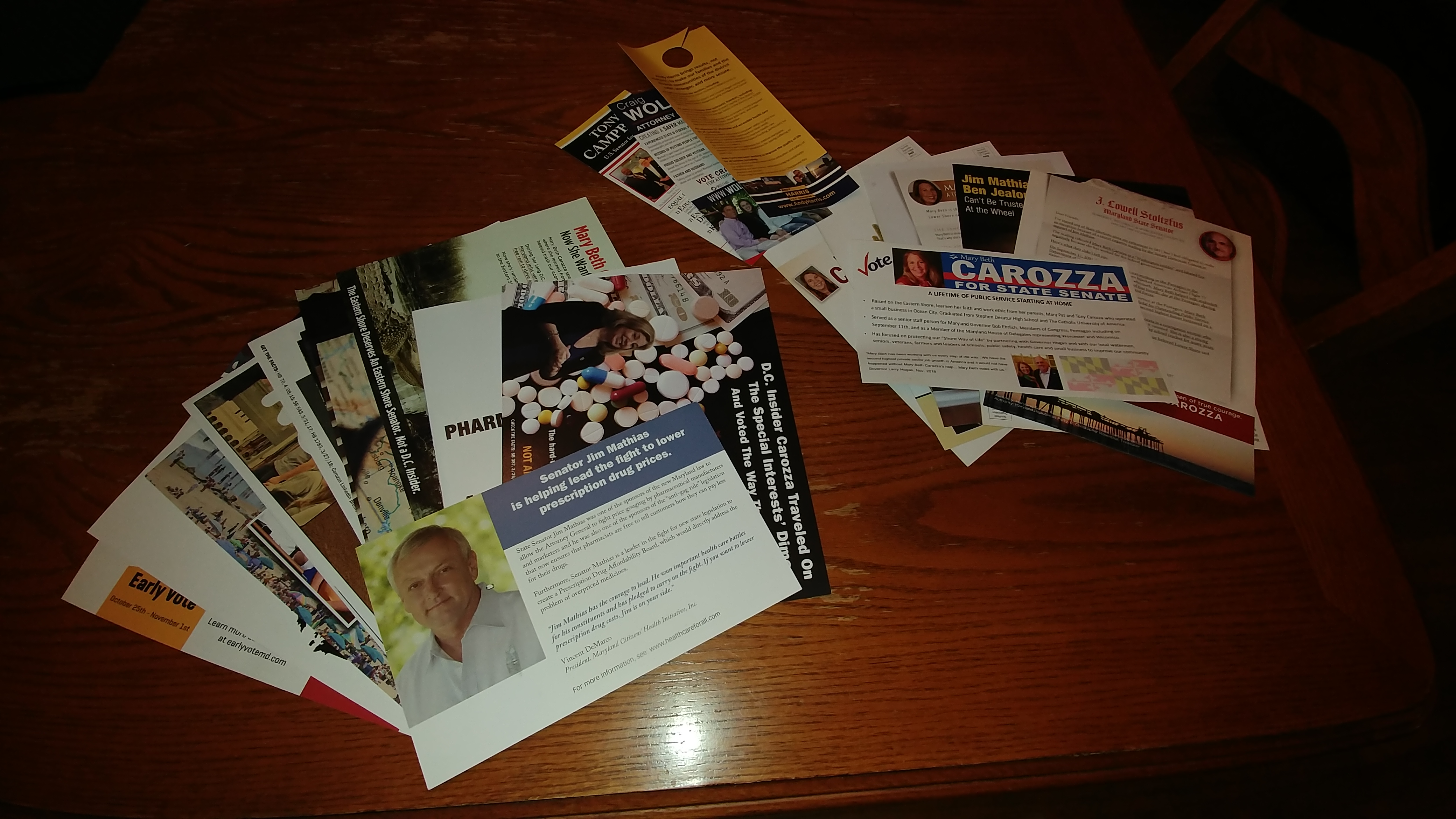
Last night I took a picture of my dining room table. In this photo – with the exception of the Campbell and Wolf items that I picked up – are all the mailings and dropoffs I’ve had so far this campaign.
Over the last five weeks I have collected a blizzard of stuff. On the left is the pile for Jim Mathias and on the right the stack for GOP candidates. mainly Mary Beth Carozza.
One thing I have found out is that the Maryland Democrats really care about me voting. There are 15 mailings in that left-hand stack, all but one from the Maryland Democratic Senate caucus. Twelve of them have been from the caucus on behalf of Jim Mathias, and they have followed an interesting, perhaps focus-grouped pattern.
Mailings 1 and 2, back in late September, told us how much Mathias fights for the Eastern Shore and even tries to convince readers he’s being helpful to Governor Hogan. But that soon changed: mailings 3 and 4 tried to tell us how Mary Beth Carozza (and frankly, as much as I have to type that all out, I’m going to start calling her MBC) hates education because she voted against certain bills (with good reason, in my opinion.) But number 4 also introduced a main thread that has since permeated most of the remaining mailings: MBC as Washington insider. Mailings 5 and 6 tried to tie MBC to increasing health care costs, then mailings 7 through 10 returned to the Washington insider theme, even invoking the “Swamp.” Numbers 11 and 12 go back to the insider theme, but talk about a Big Pharma-sponsored trip MBC made to Belgium – presumably as a Congressional staffer. (The citation is from a website called Legistorm, which is a subscription-based database covering Congressional staff. Hence, most of its information is behind a paywall.)
So here is the pot calling the kettle black, at least in terms of special interest money. While MBC took travel with a value described as “nearly $7,000” in mailing number 8, a look at Maryland campaign finance records shows that Mathias has easily exceeded that figure from Big Pharma over the last four years – something I noted here. I might add this was before his most recent report that pushed him into five figures.
(As an aside, that most recent report also shows Jim has spent just shy of a jaw-dropping $170,000 on TV in this brief portion of the cycle – a modest $2,500 to Comcast but the real money went in payments of $70,400 and $97,000 to a group called Screen Strategies Media – its client list includes Martin O’Malley and Planned Parenthood. Great company, huh?)
As I mentioned, there were 15 mailings on Jim’s behalf. Two of them came from the Senate Democrats with the intended purpose of boosting turnout – the first urged me to have a voting plan (I already did) and the second listed my “public voting record.” (Which, by the way, is spotless over the last four cycles.) As they warn, “Your voting record will be updated publicly after November, 2018.” Go right ahead and be my guest, folks. But for the average low-information voter that may have an unchecked space or two, nothing like a little intimidation from the “mobs” side of the ledger, eh?
The remaining pro-Mathias mailing came from a group that already “owns” him to the tune of $1,350 this cycle, the Maryland Citizens Health Initiative (MCHI). Regarding the mailing, the MCHI site republished this post from the Maryland Matters website that trumpeted their release and notes:
(MCHI president Vincent) DeMarco said the nonprofit organization spent about $40,000 on the mailings, which were reported as independent expenditures to the Maryland State Board of Elections.
Divided by three endangered Senators, that’s over $13,000 more in help for Mathias. It also puts into perspective how much the Senate Democrats are throwing into this race – figuring $40,000 for every three mailings means they are closing in on a $200,000 investment and given the amount of taxing power at stake that $200,000 is probably chump change in their eyes. All told I wouldn’t be surprised there’s over a half-million dollars spent trying to prop up Jim Mathias and save his Senate seat for the special interests.
Back to DeMarco and the MCHI. In case you were wondering where they stand, these are among the “accomplishments” DeMarco cites:
He played a key role in the enactment of Maryland’s life-saving tobacco tax increase of 2007, alcohol tax increase of 2011, and Firearm Safety Act of 2013, and anti-price gouging law for prescription drug prices of 2017 and is working to guarantee health care for all Marylanders.
It’s not session in Annapolis without seeing DeMarco lobbying for a higher tax on tobacco. Yes, MCHI is all for higher taxes, O’Malley gun restrictions, and more tax money thrown down the rathole of socialized medicine. As for the price-gouging law, it was one of those that was close to making my 2017 mAP but ended up on the cutting room floor. It was watered down to some extent going through the MGA, but if that’s your chosen featured bill you should know both Mathias and MBC favored it – they just chose to reward Jim with more campaign cash.
What MCHI is really after, though, is a bill that would force pharmaceutical companies to justify price increases deemed too steep. It may sound good, but taken from their business standpoint it would place a lot of their trade secrets at risk. MCHI’s justification for a previous version of their bill conceded that, “While the bill does not directly decrease the price of drugs, it is a first step on the path to lower, fair, and justifiable drug pricing.” No, it’s a first step to further clearing the market of small, innovative companies that may need to increase prices to cover development costs. Perhaps that’s why Big Pharma likes Jim so much – they just don’t seem to have the juice for MBC anymore. Maybe she wasn’t useful to them?
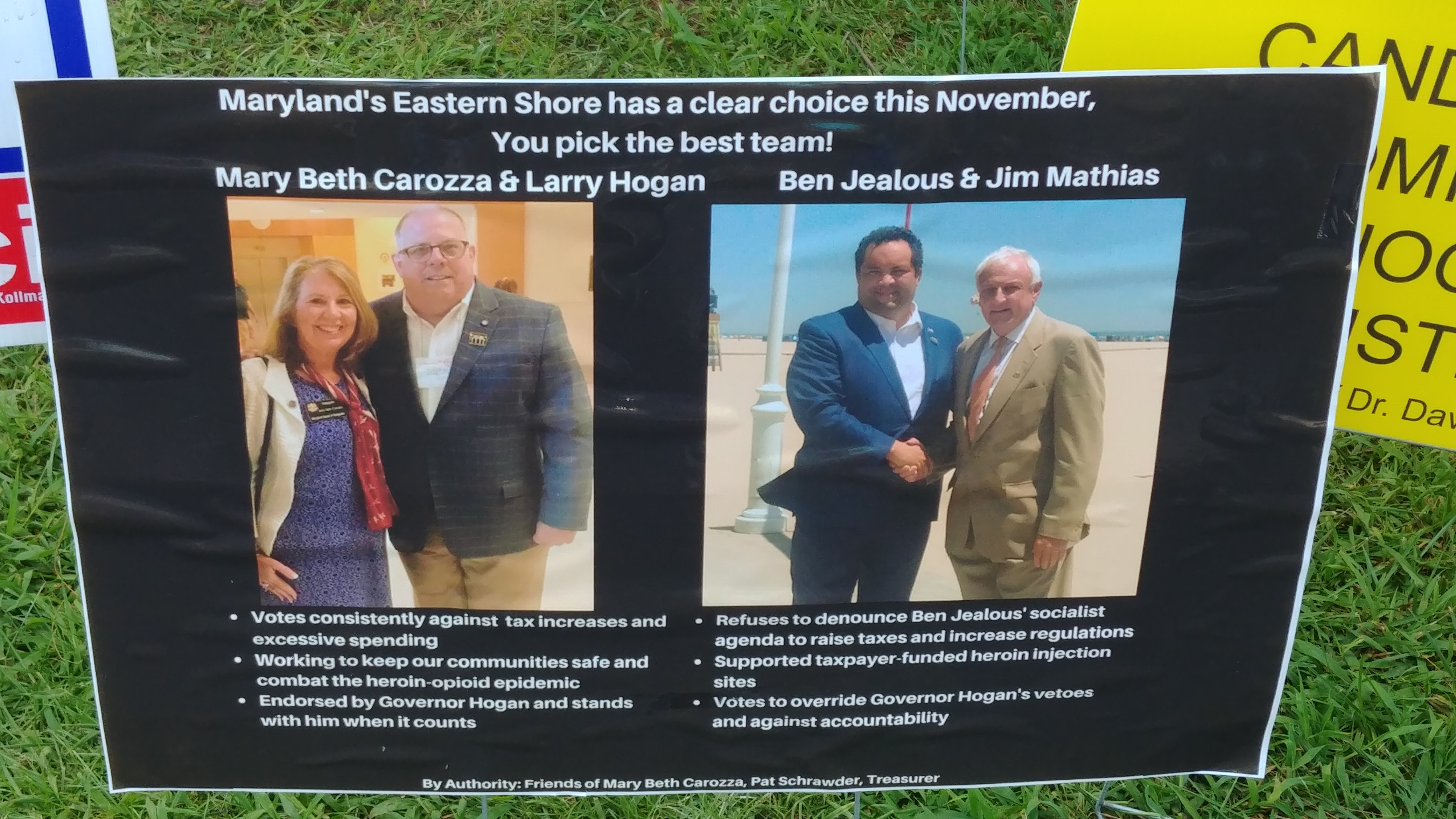
It should be noted that the Maryland Republican Party has done the heavy lifting to back MBC, and while they are (rightly) critical of Jim’s tax-and-spend voting record, they are really trying to pin a particular bill sponsorship on him – the infamous “Overdose and Infectious Disease Prevention Supervised Drug Consumption Facility Program” known as Senate Bill 288. Jim must have known it was bad news because he was for it before he was against it. This bill, though, was an extension of a 2016 needle exchange bill (SB97) that Mathias voted for and MBC opposed. Even earlier, Mathias voted for a measure eliminating a “one for one” restriction on a long-standing Baltimore City needle exchange program.
Moreso than the record, though, the MDGOP is using the endorsements of three noted individuals and a photo Mathias probably wishes he never stood for. Then again, Jim’s voting record would make Ben Jealous proud.
The MDGOP keeps touting the Hogan endorsement of MBC, but has more recently sent out letters of recommendation from First District Congressman Andy Harris, who called MBC “an authentic, dependable leader who shares our values and will do what’s best for our community,” and Mathias’s predecessor, former Senator Lowell Stoltzfus from Somerset County. Wrote Stoltzfus in part:
I’ve stayed out of State elections since my retirement in 2011 but I feel obligated to make an exception because of a recent negative mailing by the Senate Democrat Caucus in support of Jim Mathias.
The mailing ridiculed Mary Beth Carozza as a “Washington insider” and labeled her negatively because she has worked for the federal government.
Here’s what they didn’t tell you.
Stoltzfus goes on to relate that MBC was on the job at the Pentagon on 9/11, and conducted herself in such an exemplary manner after American Airlines Flight 77 crashed into the building that she received the Secretary of Defense’s Medal for Outstanding Public Service.
Out of the five mailers I’ve received on MBC’s behalf, 2 1/2 were positive toward her and 2 1/2 negative toward Jim Mathias – well, more specifically, his voting record and/or tying him to locally unpopular Democrats like Ben Jealous or Martin O’Malley.
That’s a stark contrast to the Mathias side having 10 out of 12 mailers be negative toward his opponent, with only a few referring to specific votes. They’re obviously hoping voters fail to understand there’s a bit of a difference between being a Congressional staffer and an Executive branch appointee, the latter of which is much of what comprises the Swamp. MBC did a little of both, but more of the time was spent working in Congress and not being a holdover of the previous administration causing headaches for the new boss.
To be so negative at this late juncture most likely means the incumbent (or, to be more candid, his special-interest backers) are worried. They have only one more recourse, and it’s going to be interesting to see if they fire that last bullet in the chamber before it’s all said and done. I know one thing, if nothing else: Annapolis Democrats are all about maintaining power by whatever means necessary, principles be damned. So I won’t be surprised if there’s one more special mailing from the Mike Miller swamp in Annapolis.
As I culled the vast number of possible items I had in my e-mail box down to a manageable few for this latest excursion into stuff I can handle in anything from a couple sentences to a couple paragraphs, I took a break – then promptly forgot I’d started this and let it go for several weeks. Sheesh. So, anyway…
The election season is here, and it’s blatantly obvious that the Maryland Republican Party feels local Senator Jim Mathias has a vulnerable hold on his position. One recent objection was the vote to both pass and overturn Governor Hogan’s veto on House Bill 1783.
If you want a cure for insomnia you could do worse than reading all 53 pages of the House bill. But what I found interesting is the vast difference between the amended House version and the Senate version that never made it past the hearing stage. The bills were intended to codify the recommendations of the 21st Century School Facilities Commission, but the House bill added two new wrinkles: eliminating the input of the Board of Public Works by upgrading the current Interagency Committee on School Construction to a commission and adding to it four new members (two appointed by the governor and two by the leaders of the General Assembly) and – more importantly for the fate of the bill – adding an appropriation to prevent it being taken to referendum. All those amendments came from the Democrat majority in the House Appropriations Committee, which meant that bill was put on greased skids and the other locked in a desk drawer.
Yet there wasn’t a Democrat who objected to this, and that’s why we have government as we do. It also proved once again that Senator Mathias is good at doing what the other side of the Bay wants – obviously since I have done the monoblogue Accountability Project since the term Mathias was first elected to serve in I know this isn’t the first time it’s happened.
But the fair question to ask is whether anyone else is listening? Results of a recent poll tended to be a little disheartening to me. According to the Maryland Public Policy Institute:
Marylanders support spending more money on school safety and career and technical education, according to a new statewide poll. But they are less enthusiastic about expanding pre-kindergarten or paying teachers more if those initiatives mean higher taxes or reductions in other services.
(…)
Broad majorities oppose paying more in income or property taxes to expand pre-K. Voters are against making cuts to roads and transportation (70% total less likely), public safety (70% total less likely), or children’s health insurance (77% total less likely) to afford expansion of pre-k education.
They should be opposing universal pre-K in general. Far from the days when kindergarten was optional and getting through high school provided a complete enough education to prosper in life, we are now working on taking children as young as 4 or even late 3 years old and providing schooling at state expense for 16 to 17 years – pre-K, K through 12, and two years of community college. This would be more palatable if public schools weren’t simply Common Core-based indoctrination centers, but as the quality of education declines quantity doesn’t make up for it.
For example, a real public school education would teach critical thinking, exhibited in these facts about offshore drilling and steps the industry is taking to make it safer. After all, logic would dictate they would want to recover as much product they invested in extracting as possible – spills benefit no one.
Interestingly enough, my friends at the Capital Research Center have also embedded a dollop of common sense into the energy argument.
This goes with the four-part series that explains the pitfalls of so-called “renewable” energy – you know, the types that are such a smashing success that the state has to mandate their use in order to maintain a climate that, frankly, we have no idea is the optimal, normal one anyway. (For example, in the last millennium or so we’ve had instances where vineyards extended north into Greenland – hence, its name – and times when New England had measurable snow into June due to the natural cause of a volcano eruption.)
Solar and wind may work on a dwelling level, but they’re not reliable enough for long-term use until storage capacity catches up. The series also does a good job of explaining the issues with the erratic production of solar and wind energy and the effect on the power grid.
On another front, the summer driving season is here and we were cautioned that prices would increase by the American Petroleum Institute back in April. Oddly enough, a passage in that API piece echoed something I wrote a few weeks later for The Patriot Post:
But while it isn’t as much of a factor on the supply side, OPEC can still be a price driver. In this case, both Saudi Arabia and non-OPEC Russia have put aside their foreign policy differences and enforced an 18-month-long production cut between themselves – a slowdown that has eliminated the supply glut (and low prices) we enjoyed over the last few years. And since those two nations are the second- and third-largest producers of crude oil (trailing only the U.S.), their coalition significantly influences the market.
Finally, I wanted to go north of the border and talk about 2020. (No, not THAT far north – I meant Delaware.)
Since Joe Biden has nothing better to do these days and needs to keep his name in the pipeline for contributions, he’s organized his own PAC called American Possibilities. (He’s also doing a book tour that comes to Wilmington June 10, but that’s not important for this story.)
A few weeks ago his American Possibilities PAC announced its first set of candidates, and so far they’re uninspiring garden-variety Democrats. Supposedly they were suggested by AP members, but we have two incumbent Senators in vulnerable seats (Tammy Baldwin and Jon Tester both represent states that went to Donald Trump), current freshman Rep. Stephanie Murphy of Florida (another Trump state), and challengers Chrissy Houlahan of Pennsylvania and Andy Kim and Mikie Sherrill of New Jersey.
As of this writing, all are still in contention; however, this comes with caveats. Baldwin and Tester are unopposed in their upcoming primaries for Senate seats, Houlahan and Kim are unopposed for nomination as well, and Murphy has token opposition. The one race that will test Biden’s “pull” is the NJ-11 race, where Sherrill is part of a five-person race on the Democratic side to replace retiring Rep. Rodney Frelinghuysen, a GOP moderate. All three House challengers Biden is backing are trying for GOP seats, as a matter of fact – no insurgents here. We’ll see in November if he fails.
Shifting sides on the political pendulum, here’s some good political news from our friends at the Constitution Party:
We received great news this week! The Constitution Party effort to gain ballot access in North Carolina exceeded the required number of registered voter signatures to qualify for ballot access in 2018 and 2020.
To do this they needed 11,925 valid signatures in a timeframe that stretched about five months – so far they have over 16,000 total signatures and 12,537 have been declared valid (at least until the NCGOP sues to deny them access because it will be deemed to hurt their chances – see the Ohio Libertarian Party cases for examples of this.) If that development is avoided, it will be the first time the Constitution Party has had ballot access in the state.
Honestly, I believe the two “major” parties should be made to live with the same petitioning for access standards the minor parties do. If they are that popular then it shouldn’t be a problem, right? Once the 2018-22 cycle gets underway, perhaps the same thing should be tried in Maryland.
Lastly is a housekeeping note: in updating my Election 2018 widget, I’ve decided to eliminate for the time being races that are unopposed and focus on the primary races only. So you’ll notice it’s a bit shorter.
After seven weeks of interim, now you know the truth: writing delayed is not writing denied.
On Wednesday night I put up a relatively quick post handicapping the various officer races for Maryland Republican Party leadership. But there was one person I may have missed, and his name is Gary Collins.
Over the last few days his social media has been on fire because he had noted his thought about trying for the brass ring, but deciding against it – only to find a lot of people want him to consider it anyway. It seems to me there can be floor nominations (although my recollection is rusty on this) so he may have something of a support base if he decides to try.
Back in the summer, though, Gary was one of the strongest Trumpkin voices screaming for my resignation, and I suppose he eventually got his wish because I did. Now he has to be careful what he wished for, though, because I’m going to give him (and anyone else who seeks the top spot) some free advice from an outsider who was once on the inside. It’s not so much on how to be chair of the party as it is a general treatise on philosophy. So here goes.
There are two numbers for the new Chair to remember: 818,890 and 1,677,926. The former number is the Democratic vote in 2014, and the latter in 2016. We can’t count on a weak Democrat that the party can’t get excited about to run in 2018, and you can be sure that the other party will be trying to tie the person who only won in 2014 by about 65,000 votes to the guy who lost two years later, in large part from Democrats and independents voting against him as opposed to being for their own flawed nominee, by over 700,000 votes. (You can fairly say that 1/3 of Hillary’s popular vote margin came from this state.) This is true even though Larry Hogan didn’t support Donald Trump and reportedly didn’t vote for him.
Thus, job one for the party Chair is to re-elect the governor and job 1A is to get him more help. You may not like it, and the chances are reasonably good the winner supported Trump from early on. But not everything Trump says or does will play well here, especially when 2/5 of the voters live in the Capital region.
Legislatively, this will be the year in the cycle the General Assembly majority is most aggressive. You can bet that paid sick leave will pass and they will dare Hogan to veto it. Even other crazy stuff like the “chicken tax” and a renewed push for the O’Malley-era phosphorus regulations have a decent chance of passing – both to burnish the far-left legacy of ambitious Democrats and to attempt to embarrass Governor Hogan. Meanwhile, if it’s an administration-sponsored bill you can be certain the committee chairs have standing orders to throw it in their desk drawers and lose the key. (Of course, identical Democrat-sponsored legislation will have a chance at passing, provided they get all the credit.) Bear in mind that 2017 will be aggressive because 2018 is an election year and the filing deadline will again likely be during session – so those who wish to move up in the ranks may keep their powder dry on the most extreme issues next session until they see who wins that fall.
Conservatives have a lot to lose. Larry Hogan is not a doctrinaire conservative, but he needs a second term for one big reason – sort of like the rationale of keeping the Supreme Court that #NeverTrump people were constantly subjected to. It’s the redistricting, stupid. They got rid of Roscoe Bartlett by adding thousands of Montgomery County voters to the Sixth District (while diluting the former Sixth District voters into the Eighth or packing them into the First) so the next target will be Andy Harris. If you subtracted out the four Lower Shore counties from his district and pushed it over into Baltimore City, you would only lose a little in the Democratic Third and Seventh Districts but pick up the First. The Lower Shore voters would be well outnumbered by PG and Charles County as part of the Fifth District (such a district split is not unprecedented.) Democrats dreamed about this last time out, and they want no part of an independent redistricting commission.
One place to play offense: vulnerable Democrat Senators. I live in Jim Mathias’s district, and it’s very interesting how much more of an advocate he was for an elected school board after 2014. He’s always tried to play up his somewhat centrist (compared to most Democrats. anyway) voting record, and I suspect there are a handful of other D’s who may try to do the same. Don’t let them get away with it, because over years of doing the monoblogue Accountability Project I’ve found (with a couple rare exceptions) that even the worst Republican is superior to the best Democrat as far as voting is concerned.
So whoever wins Saturday can feel free to use these ideas. As for me, I have far better plans for my weekend – I’ll wave in the general direction in Frederick as we go by. Fair warning: comment moderation may be slow or non-existent.
The other day I mentioned that I was so far out of the political loop that I didn’t even know who was running for state party chair – in elections past my e-mail box would be chock full of appeals from candidates, but not this time. So it took me to see something onRed Maryland to know who was in the running for the various positions. (I notice none of the RM brain trust is running to have their doors blown off once again, but I digress.)
At this point it looks like only two incumbents are running. We knew Chair Diana Waterman was not interested in another term, but it appears 1st Vice-Chair Mary Burke-Russell won’t be back, either, nor will 3rd Vice-Chair Eugene Craig III or Secretary John Wafer. (No more vanilla wafers when he’s running for something. Pity.) The only one assured of returning is Treasurer Chris Rosenthal, who’s been at it for at least a decade. (Maybe no one else wants the job.) Larry Helminiak is up once again for Second Vice-Chair, but this time he has opposition: Lee Havis (who ran the Cruz campaign in Maryland but became a strong Trump backer; he also heads the Maryland Grassroots Republicans group) and Tim Kingston, who I believe chairs the Queen Anne’s County party.
On the other hand, there are two other walkovers besides Rosenthal’s: Mark Uncapher is the lone candidate for Secretary and Michael Higgs is all by himself for First Vice-Chair.
This leaves two contested races: Maria Pycha vs. Shannon Wright for Third Vice-Chair and a four-way contest for Chair I’ll get to momentarily. Pycha is probably best known recently for managing Dan Bongino’s unsuccessful run for Congress, while Wright had a similar lack of success running for president of Baltimore City Council.
As has often been the case, the biggest race is for the Chair, and it has generally gone more than one ballot. But something tells me Dirk Haire is going to win on the first try, despite having three opponents. William Newton has been a political fighter in a thankless area, but that serves to his disadvantage because he won’t have a support base. Meanwhile, no one has ever heard of Sajid Tarar and Red Marylandalready dug dirt up on him.
The race, then, basically comes down to two-time former Comptroller candidate William Campbell (who also unsuccessfully ran for Chair in 2010) and Haire. But if you recall my post about slates in the last convention I attended, you may recall they were a hit:
Having done this before and not been on any sort of slate, my advice to those of you wishing to try in 2020 is to get on one. Unless you have stratospheric name recognition in the party, it’s highly doubtful you’ll advance to the national convention based on past results. It’s a sad state of affairs that this process generally benefits the “establishment” but it is what it is, and the best way to combat it seems to be putting together a slate. Remember, the bottom half of this field was littered with non-slate hopefuls, distasteful as that may seem.
Insofar as I know, there is only one slate and that is the Conservative Club slate that found success in the spring. Haire is on that slate along with Higgs, Kingston, Pycha, Uncapher, and Rosenthal. It will be tough to defeat this sort of saturation bombing (although it can be done) but I think what actually hurts Campbell is the split vote among those who may not prefer Haire because he is a party insider (he has served as General Counsel to the MDGOP.)
Obviously I have no say in the matter, and what will drive the MDGOP through 2018 is the popularity of Governor Hogan to a point where it almost matters not who is Chair. Just smile and look pretty. But I think at this stage of knowing the players a little bit as I do my ballot would go Campbell, withhold, Helminiak (in the sense of leaning that way, with reservations), Pycha, Uncapher, Rosenthal.
But there was a reason why this is in the department of “okay, so…” – this and $5 might get you something at Starbucks. Hope you all have fun at the convention; luckily I have far better plans for the weekend.
As a Republican in Maryland, there are two things you have to account for in a statewide race: you have a smaller pool of party regulars in the voting bank when compared to the Democrat in the race and you will have less money and free media than the Democrat has at his or her disposal. These have been givens throughout the modern political era, and it’s a rare Republican who can overcome them.
But I think the idea of playing up just how low-budget a campaign is (against a well-funded Washington insider) doesn’t work well as a serious campaign ad. I’m going to share Kathy Szeliga’s ad so you can judge whether she plays this shtick (as well as the motorcycle riding angle) too much.
In truth, when I looked up the latest FEC reports (as of June 30), Van Hollen only had about a 2-to-1 cash on hand advantage on Szeliga, with $566,795 on hand. Admittedly, Van Hollen had definitely churned through a lot more money than Szeliga over the previous 15 months covered in his report, but he was also trying to fend off a well-known challenger for the Democratic nomination in Fourth District Congressman Donna Edwards.
And Kathy was determined to squeeze her nickels:
Our fundraising has been going well, but we didn’t want to waste a dime, so we shot the ad on an iPhone – saving the campaign thousands of dollars. And TV ads are expensive, so we decided to buy cable and focus on a strong social media push.
She would need more than a strong social media push, though: her 17,126 Facebook likes trail Van Hollen’s 21,333, while the margin is even worse on Twitter: Szeliga has just 2,349 followers compared to 28,780 Twitter followers for Van Hollen. (Of course, Chris has more of a national profile as a Congressman so that should be expected. As evidence, current Senator Barb Mikulski has 48,683 followers while Andy Harris has 6,281.)
But since the Democrat is afraid to debate in the hinterlands of the state (or include the third candidate in the race, Green Party candidate Margaret Flowers), perhaps the ante needs to be increased. This is what you really need to know about Chris Van Hollen: a description from his campaign website but edited for more truthfulness by this writer. Normally this would be a blockquote but I have it in normal text to make the edits (deletions struck through, additions in italics) more clear.
**********
Chris Van Hollen has been described as “one of those rare leaders who runs for office because he wants to DO something, not because he wants to BE something.” Yet it’s what he has done that should trouble the hardworking Marylanders he’s trying to win over.
This sentiment captures Chris’s approach to public service, an approach that he will bring to the U.S. Senate to fight – and win – for Marylanders who depend on the ever-expanding federal governmentto deal withon the challenges we face today.
Government-dependent Maryland families can count on Chris to be their champion – because that’s what he has been doing for over two decades. As for the rest of you, well, you are correctly described by our Presidential nominee as the “basket of deplorables” because you don’t share my ‘progressive’ vision.
Chris was first elected to public office in 1990, when he campaigned for the Maryland House of Delegates as part of the ‘Choice Team,’ which unseated ana pro-life incumbent opposed to women’s reproductive rights. So I have spent 26 of my 57 years on this planet in public office, and as you will see later on I was groomed for this practically from birth.
In Annapolis, Chris quickly earned a reputation as a champion for progressive causes and a talented legislator who was not afraid to take onblame powerful special interests for problems we in government created – like the NRA, Big Oil, and Big Tobacco – on behalf of hardworking families. I just didn’t let on that the NRA never pulled the trigger on a murder victim in Baltimore, Big Oil makes a fraction of the profit for putting in all the work compared to the ever-increasing bonanza we take in with every gallon, and we don’t have the guts to actually ban tobacco because we need their tax (and settlement) money.
He led successful fights to make Maryland the first state to requireinfringe with built-in safety trigger locks on handguns, ban the prospective job creation of oil drilling around the Chesapeake Bay, and prevent tobacco companies from peddling cigarettes to our kids, taking credit even though sales to minors have been illegal for decades. Chris also negotiated an historic tax increase in funding for all Maryland schools. Just don’t ask me to increase the choices you have to educate your children by allowing that money to follow your child.
Time Magazine said Chris was “a hero to environmentalists, education groups and gun control advocates.” The Baltimore Sun called him “effective” and “tenacious” and the Washington Post dubbed him “one of the most accomplished members of the General Assembly.” If you were a special interest that depended on a continual government gravy train, I was definitely your “fair-haired boy.”
In 2002 Chris was elected to Congress on a wave of grassrootsspecial interest support, ousting a 16-year Republican incumbent thanks in large part to some creative redistricting. There he brought the same brand of can-do activismsocialist failure with him. He led the successful effort to stop big banks from reaping outrageous profits fromhaving student loans as part of their loan portfolio – instead, we made sure Uncle Sam got that piece of the action and rigged the game so that even bankruptcy cannot save most graduates who can’t find a job to pay their loans from – and was also credited with helping Democrats win back control of the House in 2006, just in time to steer the national economy into the rocks. He became a Democratic leader and played a key role in the passage of the Affordable Care Actperpetual annual increase in health insurance rates and deductibles, the Wall Street Reformprotection law, and the Economic Recovery Act that helped rebuild our shattered economyhas helped saddle us with the worst recovery from recession in the last century.
When the Republicans took over the House in 2010, Chris’s colleagues elected him to lead the battle against the Tea Party budget sanity. In that role he has been leading the fight to protect Medicare and Social Security from GOP budget attacksnecessary reforms and protect vital investments in education, transportation, medical research and programs for the most needy. We have to buy those votes somehow and grease the right palms – debt is only a number anyway, right?
Chris has also unveiled a comprehensive plan to address one of the greatest challenges of our time – growing inequality in America. His ‘Action Plan to Grow the Paychecks of All, Not Just the Wealth of a Few’Redistribute Even More Wealth and Create More Government Dependency’ has been called a forward-looking blueprint for building an economya government behemoth that works for everyonethe ruling class inside the Beltway.
In the Senate Chris will continue to fight foragainst bold measures to revive the promise that every individual has the chance to climb the ladder of opportunity and lead a successful and fulfilling life. We Democrats can’t let an individual be successful on his or her own, particularly if he or she is a minority.
The son of a Baltimore native, Chris’s involvement in social justice and political action began at an early age. Chris’s mom and dad were both dedicated public servants, and growing up he saw their strong commitment to making the world a better place. As a student, he joined efforts to end Apartheid in South Africa and stop the nuclear arms race. And while Chris put himself through law school at night, he worked as a Congressional aide and then as an advisor to Maryland Governor William Donald Schaefer. So in my adult life I have never held a private-sector job or signed a paycheck. But I’m fighting for you because I am down with your struggle to balance a household budget when both parents are working multiple jobs!
Chris and his wife, Katherine, live in Kensington where they have raised their three children.
**********
The above is somewhat tongue-in-cheek, but along the line in this campaign I am very tempted to look at some of the local races on a more issue-by-issue basis, a “compare and contrast” if you will. I have no doubt that Chris Van Hollen is well to the left of most hardworking Maryland families.
But if Kathy Szeliga is as conservative as she says, perhaps we should downplay the “Washington insider” angle a bit because that’s not going to play inside the Beltway. The latest voter registration numbers tell the tale: just between the two counties directly bordering Washington, D.C. we find 31% of all state voters. Add in the close-by counties of Charles and Howard and the number edges close to 40%. Put another way, 2 in 5 Maryland voters have some degree of connection to the seat of federal government – even if they don’t work directly for Uncle Sam, their area was built on the economic impact of the government bureaucrat.
So the real question has to be about real solutions. Van Hollen cites a lot of things he has worked on, but one has to ask if the work he has done has actually solved the problem. Intentions might be grand for putting together a political webpage, but they don’t fly in the real world.
Even if you go back to his earliest days, consider these checklist items: as a youth, Van Hollen worked to stop apartheid in South Africa and against nuclear arms proliferation. Unfortunately, the transition away from apartheid also led to the decline of South Africa as a nation – just like a number of American inner cities in the 1950s and 1960s the nation was a victim of white flight because among those who were liberated were too many who used the occasion to settle scores instead of living peacefully as may have occurred with a slower transition. And that youthful resistance against nuclear proliferation yielded to political partisanship when Van Hollen supported the Iranian nuclear agreement. Perhaps the proliferation he sought to end was only our own.
Or ponder the effects of the policies Van Hollen backed in the General Assembly. Trigger locks became required for all guns sold in Maryland, so there’s already an extra expense. And I seriously doubt the bad guys have one on their guns, so if some citizen is shot and killed because they couldn’t disengage a trigger lock in order to defend themselves, will Van Hollen apologize or believe more legislation is needed?
And like many liberal policies, Chris took the first step and his cohorts have walked them a mile. We went from banning oil drilling in the Chesapeake (which may not be economically viable anyway, but we have no way of finding out) to thwarting the state’s efforts to drill for its proven natural gas reserves in the Marcellus Shale region (as well as other prospective areas including Annapolis and parts of the Eastern Shore.) That cost the state hundreds of possible jobs. Meanwhile, the state of Maryland perpetuates the hypocrisy of encouraging people to stop smoking with a small portion of the taxes they rake in with every pack – a sum that “progressives” annually want to increase as one of the state’s most regressive taxes.
Nor should we forget the policies Van Hollen has supported over the last eight years. Just ask around whether your friend in conversation feels they are better off with their health coverage, or if the economy is really doing well for them. If they have student loans, ask them what they think of the price of college. In all these areas, government that considers meddling as its task has made things worse for the rest of us in Maryland.
These are the questions Kathy Szeliga should be asking, rather than joking about her low-budget campaign. The aggressor sets the rules, and to win over the voters the candidate has to define the opponent for them. My definition of Chris Van Hollen is that he’s part of the problem, so the task is to make sure voters know that before explaining the solution.