
Both parties are fractured, but on energy, each is unified

Commentary by Marita Noon

There is no shortage of news stories touting the splits within each party.

The Democrat divide is, as NBC News sees it, between dreamers and doers—with the International Business Times (IBT) calling it: “a civil war over the party’s ideological future.” The Boston Globe declares that the “party fissures” represent “a national party torn between Clinton’s promised steady hand and Sanders’ more progressive goals.”

The Republican reality is, according to IBT, a battle between moderates and conservatives. The party is being “shattered” by the fighting between the establishment and the outsiders. The New Yorker said the days following the Detroit debate have “been the week of open civil war within the Republican Party.” Former standard-bearer, Mitt Romney, laid the foundation for a floor fight at the party’s Cleveland convention. Peggy Noonan, in the Wall Street Journal, states: “The top of the party and the bottom have split.” She describes the party’s front runner this way: “He is a divider of the Republican Party and yet an enlarger of the tent.”

Candidates from both sides of the aisle claim to be unifiers. But when it comes to energy issues, each party is already unified—though each is totally different.

Generally speaking, the Democrats want more government involvement—more government-led investment and federal regulation. In contrast, Republicans want the free market—consumer choice—not government to determine the winners and losers.

The next president will have a significant impact on how America produces, uses, and distributes energy.

In response to frequent questions from talk show hosts regarding the candidates’ energy plans, now that the field has winnowed, I set out to write a review. However, my research revealed that a candidate-by-candidate analysis would be repetitive. Instead, I’ll lay out the distinctive direction each party would drive energy policy and highlight the minor differences within the candidates.

First, one must look at climate change, as, despite repeated failed predictions, it has been the driver of energy policy for the past decade.

The Democrat candidates believe that climate change is a crisis caused by the use of fossil fuels. Therefore, both Senator Bernie Sanders and Secretary Hillary Clinton opposed the Keystone pipeline and lifting the oil export ban. Each supports restricting drilling on federal lands and federal hydraulic fracturing regulations to supersede the states’ policies. At Sunday’s CNN Debate, both opposed fracking—though Sanders was more direct about it. Sanders and Clinton favor increased Environmental Protection Agency (EPA) efforts to encourage the use of renewable energy sources.

They would continue the policies, such as the Clean Power Plan, advocated by President Obama—with Sanders being more progressive than Clinton. He wants to institute a tax on carbon emissions, ban all drilling on federal lands, and has sponsored the “keep it in the ground” bill. She would “phase out” hydraulic fracturing on public lands, end tax credits for fossil fuels and increase government fees and royalties. Both support tax credits for renewable energy.

In the transition away from fossil fuel use, Clinton would utilize nuclear power, while Sanders would put a moratorium on nuclear plant license renewals. She supports hydropower.

Over all, the Democrats approach can be summed up as anti-conventional fuels—resulting in higher costs for consumers.

USNews states: “Clinton and Sanders also have expressed frustration with their political colleagues who deny the link between fossil fuel combustion and climate change.”

The four remaining Republican candidates have slightly differing views on climate change—though, unlike their “political colleagues,” none bases his energy policies exclusively on it.

Donald Trump is the biggest opponent of climate change having called the man-made crisis view a “hoax” and tweeting that the Chinese started the global warming ruse “in order to make US manufacturing non-competitive.” In his book, Crippled America, Trump opens his chapter on energy with a tirade on climate change in which, talking about historic “violent climate changes” and “ice ages,” he acknowledges that the climate does change, but concludes: “I just don’t happen to believe they are man-made.”

Senator Ted Cruz is next. He’s stated: “If you’re a big-government politician, if you want more power, climate change is the perfect pseudo-scientific theory … because it can never, ever, ever be disproven.” He, too, supports the view that global warming is a natural phenomenon rather than man-made.

Senator Marco Rubio believes the climate is changing. He’s said: “The climate’s always changing—that’s not the fundamental question. The fundamental question is whether man-made activity is what’s contributing most to it. I know people said there’s a significant scientific consensus on that issue, but I’ve actually seen reasonable debate on that principle.” He’s added: “And I do not believe that the laws that they propose we pass will do anything about it. Except it will destroy our economy.”

Governor John Kasich’s views cut “against the grain in the Republican Party” in that he believes climate change is a problem—though he doesn’t support curbing the use of fossil fuels. His state, Ohio, is rich with coal, oil, and natural gas and he believes low-cost reliable energy is “the backbone of America’s economy.” The Hill quotes him as saying: “I believe there is something to [climate change], but to be unilaterally doing everything here while China and India are belching and putting us in a noncompetitive position isn’t good.”

Regardless of their specific views, none of the Republican candidates sees climate change as an “existential crisis,” as Clinton called it on Kimmel Live—and their energy policies reflect that.

All four agree the Keystone pipeline should be built, are critical of the EPA’s aggressive regulations (instead, they support the regulation of energy production at the state and local level), and want to spur economic growth by increasing American energy production and reducing our reliance on foreign sources.

Though Kasich signed legislation freezing Ohio’s law requiring increasing use of renewables, Kasich is the most supportive of them saying: “I believe in wind and solar, there are big subsidies on it but that’s okay.”  He also acknowledged that mandating 20-25 percent renewables by a set date is “impossible” and will “throw people out of work.” Cruz and Rubio have voted against production tax credits for wind and solar and against setting a national renewable energy standard. In Iowa, Cruz stood up to the ethanol lobby (he’s repeatedly called for an end to the ethanol mandate), while Trump pandered to it. Rubio and Kasich would allow the ethanol mandate to sunset. In his book, Trump states that the big push to develop “so-called green energy” is “another big mistake” that is “being driven by the wrong motivation.” He calls renewables: “an expensive way of making the tree huggers feel good about themselves.” In contrast, he’s promised to “revive Kentucky’s coal industry.”

Overall, the Republicans views can be summed up as embracing the positive potential of America’s energy abundance—resulting in lower energy costs.

If you believe that effective, efficient, economic energy is the lifeblood of the American economy, you know how to vote in November. The contrast is obvious.

The author of Energy Freedom, Marita Noon serves as the executive director for Energy Makes America Great Inc., and the companion educational organization, the Citizens’ Alliance for Responsible Energy (CARE). She hosts a weekly radio program: America’s Voice for Energy—which expands on the content of her weekly column. Follow her @EnergyRabbit.
Odds and ends number 81

It’s Leap Day, so why not use the occasion to put up the odds and ends cluttering up the mailbox? After sifting through the stuff I thought might be useful but is now pretty much irrelevant, I’ve still come up with a post’s worth of things that take a sentence to a couple paragraphs to deal with.

As you may know, here in Maryland we have passed the halfway point of the “90 days of terror” I call the General Assembly session. While several of the items I cite aren’t on the agenda, I think you can file them under the “bright idea” category, as in “don’t give them any bright ideas.”

While the first idea (one of many Daily Signal items that caught my eye) isn’t really on the table in the state, locally they are kicking around the thought of assisting local students who want to attend Wor-Wic Community College. But Louisiana’s program is breaking the state, so it may be a cautionary tale for the county.

Look, you begin with one college campus and recent high school graduates but then the folks at Salisbury University will want in, then there will be a clamor to include other groups and schools. With any government program, mission creep is a concern and this is no exception. It’s a natural lead-in to an excellent piece by James Bovard at Mises Daily (for this the hat tip goes to my friends at Americans for Limited Government.) Once we set the precedent of free tuition, will the county ever get off the hook?

“(Politicians) realize that addicting citizens to government handouts is the easiest way to breed mass docility and stretch their power,” writes Bovard, and he is absolutely correct. Why do you think I advocate so much for starving the beast? It’s the only way out of this mess we have created.

But as the Daily Signal adds in another great piece, Republicans who want limited government find it a tough sell in minority communities despite the evidence that shoveling money into the welfare system isn’t helping. Perhaps this is because conservatives are losing the battle for debunking the lies being sold to the minorities and youth, despite Dan Bongino’s best efforts to change the narrative at the Conservative Review.

Then again, when you have the dissent-free atmosphere of college campuses these days (again from the Daily Signal), it’s easier to see why the “skulls full of mush” remain in their state.

Something that is on the docket in Maryland once again is a “death with dignity” bill. But my final piece from the Daily Signal points out that if you took Oregon’s assisted suicide rate and extrapolated the numbers nationwide, 10,529 people annually would take their own lives. By comparison, in 2013 just over 33,000 people died as a result of vehicle accidents and roughly the same number perished in firearm-related deaths. But the majority of those firearm deaths were suicides, with 11,208 being homicides. (Table 18 way back in this government report.)

So what we would be doing is likely reducing the firearm death figure by a little bit, but increasing the suicide rate by giving it less of a stigma. I’m not sure I agree with this because in this day and age it’s easy for the greedy grandkids to convince their rich grandma she is bound any day to catch Alzheimer’s and struggle on for years afterward. Why not save us, uh, we mean yourself the trouble, they would ask.

I wanted to bring up one more seeming juxtaposition in Maryland politics before I switch gears. A couple weeks back there was a candidates’ debate for the Republicans seeking the U.S. Senate seat (way too) long held by Barbara Mikulski. I believe there were five candidates present of the fourteen who filed, but the most notable absentee was Delegate Kathy Szeliga. As she noted, there was a Maryland GOP event held that same night. Under the heading of “An Amazing Event!” she wrote:

Thursday night, I was able to attend an event with three great governors… Bob Ehrlich, Charlie Baker (Mass. GOP Gov.), and Larry Hogan even stopped by! These men know how to win and govern in blue states.

We will win our U.S. Senate campaign the same way – by being authentic and showing voters that we truly care about our state and nation. Our ideas work and empower people over big government.

It’s interesting she points this out since we didn’t get to hear her ideas in the debate. On the other hand, fellow candidate Richard Douglas chided Szeliga indirectly by stating:

I am delighted to be participating in the Goucher College Republican candidate’s debate for the U.S. Senate on February 18, 2016. Only a serious family emergency could keep me away. Over many weeks, College Republicans and some of Maryland’s most devoted grassroots Republican activists have devoted enormous effort to this useful event. I warmly commend them for this effort, and from the beginning, my participation was never in doubt. Service in the armed forces and with two U.S. Senate committees teaches a vital lesson: people come first. I took that lesson to heart in Iraq, on a Navy submarine, and in the U.S. Senate as it reacted to the September 11, 2001 terrorist attacks. If elected to the U.S. Senate, I will never make party or President higher priorities than the people of Maryland.

As you recall, there were a series of questions I sent out to 12 of the 14 candidates (two had bad e-mail addresses so their mail bounced.) I mention this because I received Douglas’s answers yesterday as the second response to come in – haven’t heard from Szeliga yet.

Finally, if there were a third person I would like to add to monoblogue (at least on a weekly basis) it’s this lady. Each time I read Marita Noon’s posts on the political aspects of energy I nod my head in agreement, and this one was no exception – it even ties in to the lunacy on college campuses these days because this is what some of these crackpots do after college. I give you the movement to “keep it in the ground”:

“Keep it in the ground” is the new face of environmental activism. If those who understand the role energy plays in America and our freedoms don’t engage, don’t attend meetings and send statements, and don’t vote, the policy makers have almost no choice but to think these vocal few represent the many.

For example, there’s the case of Sandoval County, New Mexico, which has potential to be a wealthier county but can’t even give permission to drill an exploratory well without angst:

In the past few years, when oil prices were higher, Encana and WPX drilled some 200 wells in the same geology, 70 of them in Sandoval County. Not one single instance of any interference, damage, or invasion of fresh water aquifers has occurred. For that matter, over the past 50 years of production in Sandoval County, even with technology and safety standards that were not as advanced or rigorous as todays, there has not been one instance of aquifer harm.

(snip)

One “small drilling well” outside of a community on the edge of Albuquerque that could create jobs and help the local and state economy could be blocked because of a few dozen agitators who could cause the county to “keep it in the ground.”

When I read this it makes me think of the short-sightedness of several regional governmental bodies that have expressed their opposition to the simple act of seismic surveying of the waters off the coast, citing harm to marine life. (This didn’t seem to be a problem in 2013 when it was done to place wind turbines, though.)

I suppose they would rather wreak havoc on the migratory bird population with wind turbines, but I think both oil platforms and wind turbines can co-exist – an “all of the above” strategy if you will. It’s just that one will prove to be a boondoggle without subsidies and one won’t.

So as we wrap up this Leap Day, here’s hoping Donald Trump is the first to take a flying leap – to where I don’t care.

A look ahead: 2016 in Wicomico County

After doing this the last two years one would think I would be an expert at dissecting what will go on over the course of a year, but in this case my crystal ball is a little bit cloudy. Perhaps that’s because things are looking up for a change.

I went to the state Department of Labor, Licensing, and Regulation website and downloaded some figures which reflect great job creation news – particularly in the latter half of this year. Since June, Wicomico County employment figures are running between 1,300 and 1,800 jobs higher than the corresponding month of 2014. Conversely, in 2014 we never ran more than 753 jobs ahead of 2013 and by the end of last year we actually had fewer employed than the year prior. That downturn carried into this calendar year but by March we had turned the corner.

The growth in the latter half of the year was reminiscent of the boom period of 2004-06, when Wicomico County routinely gained 1,000 or more jobs in every month year-over-year.

So the question will be whether county revenues begin to increase. Unlike the boom of a decade ago, which was fueled by a rapid increase in property values that later translated into increased tax collections, this upturn doesn’t come with rapidly appreciating property values. And there are plenty of bills for the county to pay – two new schools with a third one now placed into the pipeline as well as new facilities for the Board of Elections, increased mandates for education spending and environmental cleanup from the state and federal governments, respectively, and a call from the city of Salisbury to assist them more with fire protection expenses through a more equitable revenue sharing. Certainly it appears that any new money has a number of hands reaching out for it.

Another question regards how well two relatively new leaders will work with each other. It’s fortunate that both County Executive Bob Culver and Salisbury Mayor Jake Day spent a little bit of time on the legislative side of things because it will help them understand the process the other has to go through to get things done. If there’s one thing we have learned from Culver, though, it’s that he’s a man of action who always seems to have a to-do list of improvements he’d like to see. It’s more autocratic than bureaucratic on the county side of the Government Office Building these days. Initial impressions of Day seem to be similar, although he’s made much less of an impact on taking office than Culver did insofar as personnel decisions are concerned.

But there are two key issues regarding education that will be out of Culver’s hands. One is the fate of the elected school board, which is now up to the Maryland General Assembly. The other is the new superintendent that will take over the county schools sometime in 2016. The Board of Education begins the selection process after the holidays – by the way, the county Republican Central Committee will be called upon to retain or replace two GOP members of that body this summer.

Getting around may become a little more difficult next fall as well, as the state will begin replacing 11 bridge decks on the U.S. 13 bypass. It’s a project that’s not supposed to impact summer traffic in 2017 but won’t be complete until 2018.

In comparison to previous years there doesn’t seem to be anything particularly contentious on the horizon – with the possible exception of the proposed large-scale chicken farms Radical Green is already up in arms against – which probably means we’re going to have an interesting year. If we can keep up the pace of job creation, though, eventually the local economy will get back to where it was a decade ago and prosperity takes care of a lot of problems.

Tomorrow I shift my focus to the state as a whole.

The course we should take

Ringing a bell about something that I was previously planning to post on anyway, my Central Committee cohort Julie Brewington wrote on social media today about a disagreement she had with the Assateague Coastkeepers regarding what they consider “factory farms” being proposed and built in Wicomico County. (So I’ll give the onetime blogger a hat tip.) Obviously the Coastkeepers have a concern about what they see as excessive pollution arising from what chickens naturally do, which is doo-doo. It’s been a concern of the state for years, and earlier this year you may recall Governor Larry Hogan thwarted the efforts of the outgoing O’Malley administration to curtail chicken farming via the Phosphorus Management Tool. Unfortunately, Hogan later conceded that these farms and their by-products are an issue worth regulating (with his Agriculture Phosphorus Initiative) to the point where some farmers would not be allowed to use this natural fertilizer. This edict disproportionately affects Eastern Shore farmers.

At the risk of excessive aggravation, I visited the Assateague Coastkeeper site for one simple reason: if they didn’t want the poultry industry and its huge economic impact of the area, what do they see as job creators? As I expected, I was disappointed in what I found: aside from a legislative agenda that would subsidize offshore wind, their overall strategic plan fails to address the economic impact their wish list would create or lay out an alternative scenario. (They are working on the “educational” part of the agenda, though.)

Not only do the Coastkeepers have an objection to the chicken farms, though, but they also object to offshore drilling off our coast despite its potential for good-paying jobs. In fact, their advocacy shuts the door to even doing the seismic testing needed to see how much oil and natural gas could be out there. It’s rather unfortunate that Ocean City and Lewes, Delaware have fallen for the scare tactics groups like the Coastkeepers use to try and prevent this technique, which is already used in the Gulf of Mexico. The Bureau of Ocean Energy Management (a federal agency) notes that:

To date, there has been no documented scientific evidence of noise from air guns used in geological and geophysical (G&G) seismic activities adversely affecting marine animal populations or coastal communities.  This technology has been used for more than 30 years around the world.  It is still used in U.S. waters off of the Gulf of Mexico with no known detrimental impact to marine animal populations or to commercial fishing.

If you want to know the truth, I think the Coastkeepers aren’t worried about the harm to marine life. They’re more worried that their smug assertions that there’s only a small amount of oil and natural gas out there – not really enough to be commercially viable – will be proven wrong. As technology improves for oil extraction, we could find there’s billions of barrels of oil or trillions of cubic feet of natural gas out there, meaning those nasty fossil fuels will be cheaper and obviously far more reliable than the bird-chopping windmills they want to build instead. Personally, I think if the market is there the wind turbines and oil rigs can co-exist – but I’ll bet the oil rigs create more local jobs.

Oil drilling, if it occurs, is probably a decade or more away, so in the here and now we have to be concerned with their opposition to expansion of the local poultry industry. And let’s face it: without Perdue, Mountaire, Tyson, et. al. there would be nothing on this part of the Eastern Shore to speak of except perhaps Salisbury University and Ocean City. Basically, Salisbury would be a slightly larger version of Princess Anne, which is a modest little county seat where the University of Maryland – Eastern Shore is located. That’s about it – there’s little commercial development in Princess Anne and not much to create jobs in Somerset County aside from UMES and the Eastern Shore Correctional Institution.

It’s understandable that someone who has chosen to live in a development bordering a rural area may object when a typical chicken farm opens up, but that is the deal with living by a farm. Any of us who grew up in a rural area can tell you that animals tend to smell sometimes, as does fertilizer. It’s all part of that “fresh country air.”

But to many thousands in the area, the smell of chicken poop is the smell of money – directly or indirectly, it’s how they make a living and thank God people around the world like to eat chicken. This region has had chicken farmers for generations, ever since the Perdue family put Salisbury on the map with their chickens.

So if this region is ever going to diversify its economic interests, one path we should explore is the path offshore. Let’s find out once and for all if there’s oil and natural gas out there, because as I said I think the Coastkeepers are worried that the answer is a resounding yes.

A paucity of passion

I am struck by the difference between two recent meetings.

Last week I covered the first hearing regarding the prospect of an elected school board. Yesterday I also read a story by Susan Canfora in the Salisbury Independent about the city’s rejection of a park land donation sought by the county.

In the former case, the arguments for and against were delivered in a relatively quiet room, but those who were out to save the forest burst into applause with each speaker on their side and cheered when the measure died for a lack of a motion. Canfora’s report noted that the City Council meeting was standing room only, with more people spilling into the hallway. Having been to that venue before, I know the room can get 80 to 100 people in it if you all inhale and exhale the right way.

Of course, there was resolution in the county’s case – the city said no to the donation. On the other hand, the process of getting an elected school board is in the early stages of its latest iteration. So in that respect I am doing a little bit of an apples-to-oranges comparison, but I did see a useful tool in understanding the approach one side may choose in the school board debate.

Those who favored the expansion of the ball fields grounded their argument in economic terms. They could cite concrete facts and forecasts of how much impact these tournaments have locally, in dollars, cents, and jobs. Softball tournaments bring in hundreds of players each summer, and those participants have to eat, sleep, and play someplace.

Conversely, those supporting the forest played to the emotions of the audience and City Council. Suddenly that 35 acre plot of land was a magnet for low-impact tourism and a vital part of the natural beauty of Wicomico County. Just for sake of reference, 35 acres covers about 1/16 of a square mile. The Centre of Salisbury sits on about 58 acres, so this forest plot is barely half the size of that parcel.

Those same appeals to emotion come out when opponents of an elected school board bemoan the loss of “diversity” they are sure would come about with an elected board.

It’s always intrigued me that those who wail loudest about diversity are the least diverse of any group – sure, they may fill quotas with every possible variation of outward appearance and behavior trait under the sun, but when it comes to diversity of thought: forget about it! It’s the side that’s afraid to hold presidential candidate debates because their standard-bearer, the one who fills the “woman” quota their party wants to check the box of, might have to actually defend her record (or lack thereof.)

But let me back up the focus. To me, diversity is for ideas, which is why legislative bodies often split along party lines. I highly doubt the NAACP, the teachers’ union, or any of the other opponents of an elected school board will stop trying to participate in the process when an elected board finally comes to fruition. They will certainly have a slate of candidates, and those candidates will probably have a monetary advantage in their respective races. On the other hand, I would certainly push for the most conservative school board possible. Hopefully I get more victories than the other side, but I doubt either will have a clean sweep and it may be there are times they have to meet somewhere around halfway.

Regardless of what Don Fitzgerald may claim, there is some cronyism involved with the current system. Rarely does a complete political outsider get a seat on the school board because the current system has as its judge and jury political insiders up and down the line. (The same would hold true with a nominating commission.) The best chance for a concerned citizen would seem to be the electoral process, particularly since the system as envisioned would rely mainly on districts of about 20,000 people – not an unmanageable size for a small, well-organized campaign. Granted, there may be times when running countywide could be an advantage but my suspicion is that those couple spots will be filled with current board members who already have name recognition.

If there’s one lesson I want the class to remember, it’s this: you can easily figure out which side has the facts and which side runs on emotion. Diversity is the reddest of herrings, so don’t let them fool you into thinking their idea of the concept is anymore than skin-deep.

A further obstacle

Perusing social media last night, I saw that Delegate Christopher Adams linked to an article by Bob Zimberoff in the Easton Star-Democrat. Since I have a website, I’m revising and extending my remarks in my comments therein.

Zimberoff’s article talked about the rush to get building permits in Caroline County. It wasn’t thanks to a business boom or new economic opportunity – terms for which neither apply in the Eastern Shore’s sole landlocked county – but a deadline builders were rushing to meet.

(Developer Blaine) Williamson wasn’t the only one to hurry to get a permit. In all of 2014, the Caroline County Department of Planning and Codes issued 40 total permits for construction of new residential units. In 2013, 34 permits were issued.

Already in 2015, 46 permits have been issued in Caroline as of June 30. Of those 46 permits, 30 were issued in June. According to Sara Visintainer, chief of staff for the Caroline County Commissioners Office, another 30 applicants started the permitting process in June but failed to receive permits because of financial burden or other considerations.

Every few years, the state of Maryland adopts the most current editions of several building codes, including the International Residential Code. While the code has mandated that new homes have fire sprinkler systems, previously counties were able to opt out of the requirement. (I thought I had written about one such effort before, and it turns out I was right.) Apparently that exemption is no longer allowed, and it’s sending a chill throughout the housing industry. I return to the Star-Democrat:

At Williamson Acres, modest starter homes list for $150,000 to $160,000.

“That’s the market value. That’s all I can sell them for,” Williamson said. “It costs so much to build them now, I’m not making much money. When you add the sprinklers on, I would actually be losing money.”

(snip)

With five vacant lots and three permits to build, Williamson said he intends to leave two lots undeveloped until regulations change or the housing market improves. Even with the BAT septic mandate, Williamson could profit $5,000 to $10,000 from selling new homes, but the sprinkler mandate effectively eliminated a chance at financial gain.

“I’m not going to build a house knowingly losing money on it,” he said. “The sprinklers are the straw that broke the camel’s back.”

So here is the situation. You will have a rush of construction over the next few months as those houses which got their permits prior to June 30 get built out, but then in a few months the market will slide as the dearth of new permits takes hold. In other words, this artificial boom will be short-lived.

My previous piece on the controversy here in Wicomico County back in 2011 noted the dubious benefits against the costs of the home sprinkler systems, but there is also the issue of how the cost may discourage rural development because it’s more expensive to use a well as a source as opposed to a municipal water system. To Radical Green, though, that’s a feature and not a bug, and you can bet your bottom dollar those who write the codes are squarely in the Radical Green camp – after all, those who believe we can build our way to absolute safety regardless of cost would also be the most fervent believers in the nanny state. We obviously want some element of safety and energy efficiency in our construction, but there comes a point when cost outweighs benefit and in a single-family residential setting sprinkler systems can be a deal-breaker.

Delegate Adams and his counterparts will be well-served in attempting to restore the exemption counties used to enjoy. Something tells me it wasn’t the rural legislators and regulators who took the exemption out, so you can call this a side skirmish in the War on Rural Maryland.

More counterproductive regulations

Do you recall the “new” water-saving toilets that you had to flush twice to get the job done? Don’t look now, but Rick Manning tells us that “technology” is coming to dishwashers:

What could go wrong?

Nothing so long as homeowners don’t mind grunge baked onto their dishes due to the failure to have sufficient water to clean off the food.  No matter how much Cascade and JetDry you put into the system, not enough water means disgusting baked on egg, and other delights.

The purported reason for the water limitations is to cut those dreaded greenhouse emissions to comply with Obama’s on-going global warming jihad.  In Obama’s Ivory Tower world, it is inconceivable that a dishwasher that doesn’t actually get dishes clean might cause people to take alternative action.  The most likely of which is to use much more water by hand washing every dish before it goes into the dishwasher and effectively only use the appliance for killing bacteria through the high heat drying process.  Or, perhaps people could go full Madge, and only hand wash dishes rendering the modern appliance and convenience useless.

The idea is to wash a full load of dishes in 3.1 gallons of water. As of 2012 an Energy Star dishwasher uses 4.25 or fewer gallons so we are going through all this to save perhaps 300 gallons of water a year, or about 10-12 average showers.

Of course, as Manning points out, this assumes a dishwasher gets all the items rinsed off and doesn’t bake it on but good. In our household we generally pre-rinse dishes to lend the dishwasher a hand, so that doesn’t really change our strategy. But when I was single I didn’t bother because, after all, that’s what the dishwasher was for!

There is a time when returns diminish to almost nothing. Sometimes I think the EPA believes in their heart of hearts that the optimum amount of water needed in a dishwasher would be zero, but that’s impossible unless you can clean the dishes with pixie dust and blow the debris away with unicorn farts.

The dishwasher is supposed to be a labor-saving device, and I know: for over a decade I lived in a house where the dishwasher was my two hands. There was really nowhere to place one in our kitchen. So it is a benefit to be able to use somewhat less water to do dishes – after you fill one side of the sink with a gallon or two of sudsy water and run the tap when it comes time to rinse on the other side it’s likely you’ll use 8 to 10 gallons of water. Thus, a dishwasher is an improvement both in water efficiency and time, because who wants to stand and do dishes for a half-hour?

That’s not to say that the market won’t demand a less thirsty dishwasher, but that should be up to the market. When low-flow toilets originally came out, there was a black market as consumers who could make the drive went to Canada to buy the good old-fashioned 3-gallon models. By next year, that old underground railroad may be back again to provide dishwashers that do it right the first time.

Larry Hogan’s maintaining an O’Malley legacy

By Cathy Keim

So who needs Martin O’Malley when Larry Hogan will carry on his work?

I was astonished to read that Governor Hogan is expanding the You’ve Earned It! mortgage assistance program from the original $20 million to an additional $70 million. (Hat tip: Gwen Cordner.)

The program is aimed at assisting potential buyers, particularly members of the so-called “Boomerang Generation,” who are employed and have good credit but are saddled with student debt that is proving a barrier to homeownership. These young people are more likely to live with their parents than were young people one or two decades ago and they are saddled with significantly more student loan debt than their predecessors.

The student loan debt in America is over $1 trillion dollars and growing. The federal government supports 95% of student loans and is making billions of dollars of profit on them. There is no incentive by the Feds or by the colleges and universities to cut the spigot. As tuition rises each year, the students borrow more money only to find out when they graduate that there are no jobs for them to earn enough to support themselves and pay their loans.

Another neat trick is that you cannot get out of paying back your student loans by going bankrupt. There is no escape. Is it any wonder that young people who are graduating with a national average of $29,000 in college loan debt must live in their parents’ basement because they cannot pay their loans and live independently on a barrista’s salary?

In a Wall Street Journal interview, Dr. Richard Vedder of the Center for College Affordability and Productivity links the tuition increases to “the 50-fold growth in federal student financial assistance programs since 1970. Former Education Secretary Bill Bennett was mostly right when he said federal aid programs enabled colleges to raise tuition fees, helping to fuel the academic arms race.”

Why do so many people need a college degree? Many of the jobs that require a college degree did not require it in the past. We can thank the government for that also. Businesses used to administer tests to see if the potential employee had the skills necessary to fill the position. The government struck down testing as unfair, so many businesses switched to a college degree requirement as a way to screen applicants without running foul of the government.

Over time the value of the bachelor’s degree was diminished and now many jobs require a master’s degree forcing more students into school longer and causing more debt.

This situation is a serious problem for all of us. We need our younger generation to be buying consumer goods, especially cars and homes, to keep the economy humming. They must do their part, even if the government has to step in to “help” them again. It helped them acquire student loan debt and now it can help them acquire mortgage debt.

But the story doesn’t end there. These mortgages must be for homes in a certified sustainable community. And who determines what is “sustainable?” This group:

Sustainable Maryland is a certification program for municipalities in Maryland that want to go green, save money and take steps to sustain their quality of life over the long term. Sustainable Maryland Certified is a collaborative effort between the Environmental Finance Center (EFC) at the University of Maryland and the Maryland Municipal League to replicate the success of theSustainable Jersey initiative throughout the Mid-Atlantic States, beginning in Maryland.

To become a certified sustainable city, the city must have a green team comprised of municipal workers, city leaders/businessmen and diverse citizens. This is a standard tactic to get leaders onboard a project and others will follow because if “Joe” is on it, then it must be ok. The city can apply for tax credits and grants to bring improvements such as bike paths or renovating old buildings. The municipal workers on the green team get paid for their efforts (it is part of their job), but the citizens are volunteers because their hearts are in the right place.

(Note: Salisbury is registered, but not certified yet. Snow Hill and Berlin are certified sustainable cities.)

(Editor’s note: one of the Sustainable Maryland “primary partners” is the Town Creek Foundation, which never met a Radical Green program it didn’t like.)

Once these debt-laden former students are ensconced in their subsidized mortgage home, they will be ready to marry and produce the next generation of liberty-loving citizens. The next generation will be taught in the fully implemented Common Core method, which will ensure that they never hear of their heritage as Americans. They will be assessed and evaluated from pre-school to the workforce. The thousands of data points gathered will ensure that they are nudged gently into the correct attitudes so that they will fit into the new world order. Teamwork and cooperation will be their strong suit while individuality and thinking deeply on any subject will be discouraged.

The water in the pot is almost to a boil. If we don’t jump this presidential election, I fear it will be too late.

So-called expert believes women can only be prostitutes and maids

Okay, now that I have your attention, allow me to add some context. If I did show prep for Rush Limbaugh, this story would be placed in the “lighthearted stack of stuff.” (This explains why I kept it around for a couple weeks.)

Back on April 20 – which somehow seems appropriate – the Washington Times ran the story I allude to in the title. It detailed an April 6 lecture by “a key figure behind New York’s statewide ban on fracking.” Biologist Sandra Steingraber said the following:

“Fracking as an industry serves men. Ninety-five percent of the people employed in the gas fields are men. When we talk about jobs, we’re talking about jobs for men, and we need to say that,” Ms. Steingraber says in a video posted on YouTube by the industry-backed group Energy in Depth.

“The jobs for women are ‘hotel maid’ and ‘prostitute,'” she says. “So when fracking comes into a community, what we see is that women take a big hit, especially single women who have children who depend on rental housing.”

Needless to say, if a conservative said that women were only qualified to be prostitutes and hotel maids, we would have that splashed all over the front pages for months on end. Instead, it took two weeks to leak out to the Washington Times and, aside from that, it’s barely been mentioned. A cursory news search for Ms. Steingraber only found a few articles on smaller outlets about upcoming speeches and minor reaction to this story.

The Times also quotes another anti-fracking activist who compares the procedure to rape:

Ms. Steingraber’s speech, titled “Fracking is a Feminist Issue: Women Confronting Fossil Fuels and Petrochemicals in an Age of Climate Emergency,” comes after Texas anti-drilling activist Sharon Wilson was criticized for comparing fracking to rape in a March 30 post on Twitter and her blog.

“Fracking victims I have worked with describe it as a rape. It is a violation of justice and it is despoiling the land,” Ms. Wilson said in her blog, TXSharon’s BlueDaze. “Victims usually suffer PTSD.”

I tell you, Valerie Richardson’s story could be comedy gold – but these people take this stuff seriously, and that’s a shame.

While the oil and gas industry isn’t female-dominated by any means, it’s often a function of physical strength and skill level – the women who are coming into the field aren’t typically found at the wellhead but in what the industry calls “downstream” jobs. None of them involve prostitution or scullery work, but they’re usually not going to get their hands overly dirty at the jobsite because they are the technicians and engineers as opposed to the guys doing the drilling and extraction. And that’s just fine – they’re making an honest living. So Steingraber may be right in the specific that nearly all wellhead jobs are held by males, but as an industry she’s well off base.

Yet the problem with this line of thinking is that it pervades the brains of liberals who occupy places of power, such as the EPA or, closer to home, the Maryland General Assembly. The Radical Green leftists in the MGA still haven’t received the “war on women” meme, but they don’t have to be as sly about it, either.

As you are likely aware I am currently working on the 2015 monoblogue Accountability Project, and some of my venom is saved for the idiocy which passes for oil and gas industry expertise. Pro-abortion legislators are continually trying to strangle Maryland’s fracking industry before it even makes it to the crib, as you’ll see when I wrap up the mAP in the next few weeks.

One good example is a proposal on the waste products of fracking, which is originally proposed would have made it illegal for a person to “accept, receive, collect, store, treat, transfer, or dispose of, in the state, waste from hydraulic fracturing.” Well, that pretty much covered it: a backhanded ban on the practice. I have at least one other example in the mAP, so be watching.

For America to prosper, we need to create our own energy. And when we have the bountiful resources that we do and can extract them at a reasonable, market-based price, why not do so? You can see the depths opponents have to reach to make their point, which means their argument is a futile one. Drill, baby, drill!

Informally making it formal?

When you stop laughing, hear me out.

It’s only been two months since he left office, but I think we can all agree our somewhat esteemed former governor is all but an official announcement away from throwing his hat into the 2016 Presidential ring. And when you consider that Hillary Clinton is continually being tarred by scandal after scandal (Benghazi and her e-mail questions) and blunder after blunder (the Russian “reset” button and discussing the “fun deficit”), Martin O’Malley almost looks sane. Come on, what else do you have on the Democratic side – the gaffe-prone Joe Biden? “Fauxcahonotas” Elizabeth Warren? One-term Senator Jim Webb of Virginia is the one who has the exploratory committee going, but the far left considers him a “Reagan Democrat” who they can’t support.

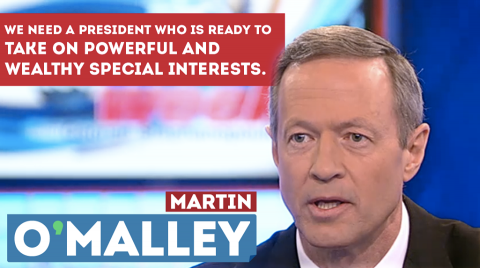
So when you see the above photo on the O’Malley Facebook page (which is where I got it) you have to ask if the “taking on powerful and wealthy special interests” message is meant for Hillary? After all, look how much the Clintons’ foundation has raked in over the years. And his message today about the presidency “not (being) some crown to be passed between two families,” would resonate with a lot of people who believed the propaganda about how disastrous the George W. Bush tenure was and are already tired of the constant turmoil surrounding the Clinton family.

Perhaps Delegate Herb McMillan put this best, noting, “Raising taxes on the poor and middle classes 83 times isn’t the same as taking on powerful wealthy special interests.” But it’s more than that.

Obviously the laughter among many who read this website comes from knowing how rapidly O’Malley would genuflect to particular special interests when it suited his purposes. Environmentalists got a lot of goodies during MOM’s reign: California rules on emissions, punitive restrictions on development in rural areas (via the “tier maps”), an ill-advised and job-killing moratorium on fracking, and of course the “rain tax.” Illegal immigrants, too, had a friend in O’Malley, but productive taxpayers – not so much. He also decided to work on legalizing gay marriage only after his electoral coast was clear in the state – if he had tried to run for re-election on the issue he would have lost the black vote in 2010. (Remember, that was before Barack Obama’s flip-flop on the issue.)

Say what you will about Martin O’Malley, but he is the lone Democrat openly considering the race who has executive experience – on the other hand, there are a number of GOP candidates who can boast the same thing: in alphabetical order there’s Jeb Bush, Chris Christie, Mike Huckabee, Bobby Jindal, John Kasich, George Pataki, Rick Perry, and Scott Walker. Depending on who the GOP puts up, the “experience” tag could apply to the Democrat. We’re not saying the experience would be a good one, but it is what it is.

Don’t be too shocked if the O’Malley’s March national tour makes a lot of stops in Iowa and New Hampshire. It’s his way of pandering to the special interests he cherishes the most, and if people are fooled by this sudden bout of populism it’s their own fault. Don’t say you weren’t warned.

Update: At Front Line State Jim Jamitis echoes these sentiments, with a great headline to boot.

MCAC and CBF to Hogan: drop dead

As I suspected, the slight bend toward agricultural interests that Governor Hogan made with the revised Phosphorus Management Tool regulations – now re-dubbed the Agriculture Phosphorus Initiative – was met with hostility from the environmental community. On Friday the Maryland Clean Agriculture Coalition and Chesapeake Bay Foundation released this joint statement:

We commend the Hogan Administration for taking the problem of phosphorus pollution seriously and are pleased that the Administration embraces the scientific evidence showing we must implement the Phosphorus Management Tool to better manage manure on oversaturated farm fields.

The environmental community was not involved in the drafting of Governor Hogan’s proposed regulations that were released on Tuesday, and we have gone over them carefully since. Unfortunately, the regulations do not provide the adequate protection or assurance we need, and as such, we must oppose them. Our concerns are detailed in the attached analysis.

The regulations include a significant loophole, referred to by the agricultural industry as a “safety net,” that makes it unclear if they would ever result in full implementation of this much-needed tool. We adamantly oppose this lack of a clear, enforceable end date for putting the Phosphorus Management Tool into place.

It is also unclear whether the proposed ban on phosphorus on fields with FIV over 500 would actually reduce the amount of manure being applied to farm fields or protect Maryland water quality. The Maryland Department of Agriculture has been unable to clarify this.

Additionally, the regulations add one more year of delay, and they include troublesome secrecy provisions.

We continue to whole-heartedly support legislation sponsored by Senator Pinsky and Delegate Lafferty (SB 257 / HB 381) to implement the Phosphorus Management Tool with a six-year phase-in. Given the difficulties we’ve had with the regulatory process over the past three years, we prefer having a strong statute in place.

Their statement is an expanded version of a statement I posted on Wednesday from the Maryland Clean Agriculture Coalition. The MCAC is an interesting group in that none of the 21 groups involved has a thing to do with farming; instead many of these are “riverkeeper” groups from around the state. These groups blame farmers for a disproportionate share of the problems with Chesapeake Bay, imagining they are just wantonly dumping manure into streams and creeks.

While the groups have done a comparison sheet (or “detailed analysis”) between the O’Malley and Hogan proposals, their chief complaint can be summed up in this paragraph:

The Hogan PMT provisions for an “evaluation” for assessing manure markets and transportation programs, available land acreage, etc., allow for this “evaluation” to stall movement of PMT implementation for a year while MDA conducts a re-evaluation. The result is the possibility of an endless year by year postponement and re-evaluation possibility. (Emphasis in original.)

The way I read this is that, whether the infrastructure is in place or not – and, to be honest, I’m dubious of whether it can be in place – the CBF wants to move ahead on the PMT issue. Even the large-scale concession of immediately stopping the application of manure to certain fields, which is a provision allegedly affecting 1 of every 5 farmers on the Lower Shore, isn’t satisfying to the environmental coalition. They demand the data on how this would affect farmers, but pooh-pooh the need for data on how these regulations might affect the rural Maryland economy through the actual on-site studies sought by the Hogan administration.

In short, the contempt for the agricultural community by these groups is palpable.

So Larry Hogan tried to walk the middle ground. In backing off his original dead-set opposition to the PMT as “mandating how (farmers) use their property” to implementing a slightly less onerous version he still alienated the environmental community as well as discouraging some of the farmers who will be most adversely affected.

This whole episode will hopefully be a lesson to the new administration: you won’t get the friendship or the votes of those who would just as soon see the Eastern Shore collapse economically thanks to the demise of the agricultural industry regardless of what you do. So stick to those issues you ran on: improving Maryland’s economy and lowering the tax and regulatory burden on its citizens. Remember, no amount of regulation is enough for liberals, so why cater to them in the first place?

Passing on prosperity

Since both have been mentioned in the news as potential Presidential candidates, governors Martin O’Malley of Maryland and Andrew Cuomo of New York have been natural rivals for the attention of the various interest groups that make up the constituency of the Democratic Party. It seems that they are always trying to one-up the other in enacting off-the-charts liberal legislation – when one allowed gay marriage, passed draconian gun laws, or pandered to illegal immigrants, the other tried to follow in rapid succession.

Martin O’Malley and Andrew Cuomo also both cast their lot with the radical environmentalists who claimed (falsely) that hydraulic fracturing for energy extraction would ruin their state’s environment. Yet while O’Malley relented ever-so-slightly in recent weeks, allowing the practice but with regulations one energy expert called “onerous and time-consuming,” Cuomo stopped the practice cold in his state by decreeing in an announcement last week that fracking would be banned, timed nicely after his re-election. Observers of both states are scratching their heads about these decisions, both in the media and in the energy industry. In New York, local media bemoaned the lost opportunity while landowners in the affected area called Cuomo’s ban a “worst-case scenario.”

Yet in the middle of all this sits the commonwealth of Pennsylvania, a state which has embraced the economic benefits of the practice to such a degree that Tom Wolf, the incoming Democratic governor of the state won’t ban it. (However, he may stiffen regulations and increase taxes on energy producers, which will be something to watch in the coming months.)

Granted, their good fortune of geography means Pennsylvania has the largest share of the Marcellus Shale which yielded all that natural gas, while Maryland only has a small slice and New York has a small but significant portion.  For their part, Ohio and West Virginia also have sizable portions of the formation, while Virginia’s share is similar to Maryland’s. Ohio has been nearly as aggressive as Pennsylvania in taking advantage of the shale – although recently re-elected Republican Governor John Kasich is also trying to increase taxes on producers – while West Virginia is lagging behind their neighbors and just beginning the process of allowing extraction.

It’s a given that fracking isn’t without risk, but neither are installing large solar farms or erecting 400-foot high wind turbines. Yet the natural gas and oil provided from fracking make for a much more reliable energy source than the intermittent electricity provided by the latter pair, sources which ironically need a natural gas backup to be consistent.

As time goes on we will see just what economic effects a fracking ban will have on the affected areas of New York. But as we have seen in states which have already began the extraction, the Empire State is missing out on the potential for investment and return that having the Marcellus Shale provides for those lucky enough to live over it. Hopefully our neighbors in western Maryland will see some benefits in the next couple years as Governor-elect Hogan puts “sensible” regulations in place to benefit all concerned parties.