Joining a crowded field
Honestly, this one came out of left field for me, but several published reports indicate Anne Arundel County Delegate Ron George will formally announce his intent in June to run for governor in 2014, abandoning re-election to his House of Delegates seat in the effort.
It’s interesting to me that, in a state where I’m continually told by conventional wisdom that the Democratic primary will determine the next governor, so many Republicans are considering the race. Most of my readers already know the field by heart, but just as a reminder it most likely includes (in alphabetical order) 2012 U.S. Senate candidate Dan Bongino, Harford County Executive David Craig, 2010 Congressional candidate and AFP Maryland leader Charles Lollar, and Frederick County Commission president Blaine Young. I’m becoming less and less convinced that early 2010 gubernatorial hopeful and Change Maryland leader Larry Hogan will make a run; in fact it wouldn’t shock me if at least two others of those mentioned above begged off the race.
There’s no question that George will be trying to make history as just the second governor in modern times to ascend from the House of Delegates to Government House, and the first to be elected – Gov. Marvin Mandel came into office in 1969 as the successor to Gov. Spiro Agnew, who became Vice-President under Richard Nixon. Mandel was elected by the legislature, as the office of Lieutenant Governor wasn’t created until 1970 in the wake of Agnew’s departure.
George hinted that his focus would be on economic issues, being quoted in the Capital as promising:
My plan is to really build a new Maryland – one that has true economic growth, not government-created jobs that don’t last long.
But is that the whole package? From a conservative’s standpoint, George is great on certain issues. But on the monoblogue Accountability Project, George only has a lifetime score of 73 and that puts him in the bottom third of Republican Delegates – one caveat being Republicans from that area tend to score a little lower as they cater to a more moderate district.
Evidence of that is easy to find, since his 2010 election website is still up. It includes accolades from well-known state Republicans Bob Ehrlich and Ellen Sauerbrey and praise from Reagan Attorney General Ed Meese, but also has a section devoted to “Democrats and Independents for Ron George,” including this from member Gil Renaut:
In the current “hyperpartisan” climate, he stands out as a delegate who can and does work across party lines for the public good.
But this site also poses a question which should give those up in arms about Agenda 21 and other environmental opportunism pause:
Did you know that Ron also supported and voted for The Clean Air Act, The Clean Cars Bill, The Chesapeake Bay Trust Fund, The Living Shoreline Protection Act, the Green and Growing Task Force, Performance Standards and Accountability that help Smart Growth, the Smart Green and Growing Commission, the Standing Bill and many, many more?
(snip)
That is how Ron George was nicknamed the Green Elephant.
Aside from the nickname, I can pretty much guarantee I knew this, hence his fairly low score on the monoblogue Accountability Project. I recall, however, that this bid to curtail illegal immigration was one of his bills I wrote testimony on some years back.
So while he has some appeal to the center of the political spectrum and those people who equate “it’s for the Bay” with “it’s for the children”, is that enough to propel him to the GOP nomination? After all, in a statewide election the question generally is why vote for Democrat-lite when you can get the real thing?
And on a more political level, why not announce before the state Republican convention when all the activists are there to be catered to? Yes, we had a messy race for Chair but the distraction may have been helpful.
George is staking out a position alongside David Craig, as both are apparently trying to portray the pragmatic centrists as opposed to the more fiscally conservative Blaine Young, the brash outsider in Dan Bongino, and the more socially conservative Charles Lollar. The latter three seem to be seeking the hearts and minds of the pro-liberty wing of the Maryland GOP, so maybe George’s entrance is good news for them.
Much, however, depends on what other surprises await as the 2014 campaign slowly comes into focus.
Denying common sense
Our illustrious president and his political front group, Organizing Against America For Action, are now trying to poke fun at climate change “deniers” in Congress. A video released earlier this week by the campaign suggests Republicans don’t know what they are talking about, claiming the overwhelming consensus of science is that climate change is real.
(Of course, this is put together by a party which has a member who worries about Guam tipping over, so take from it what you will.)
Seriously, there are two key problems with the assumption that Obama’s minions are making. First and foremost is the premise that mankind has anything to do with the climate whatsoever. Yes, we can affect weather in a limited way by seeding clouds and there is a proven effect of heavily populated and paved areas being slightly warmer than the surrounding countryside, but in the overall scheme of things changes in the sun would have vastly more effects than mankind would, regardless of how many SUVs there are. After all, there have been periods in earth’s history far warmer than today’s climate, as well as times much cooler.
Corollary to that point, the records of weather patterns go back less than 150 years, with fairly accurate and detailed observations only available for perhaps the last 50 or so. Simply put, we have very little to go on in terms of worldwide measurements to know how weather is behaving in comparison to how it was a hundred years ago. Superstorm Sandy may have had its match and more 500 years ago, but we have no way of knowing this.
And who is to say that our climate is the optimum one? Having a more temperate climate in the far reaches of the Northern Hemisphere wouldn’t be a bad thing because it opens much more land mass to agriculture.
Moreover, when the theory of anthropogenic climate change is something only modeled on computers – models which don’t account for all the possible data – how can a theory become proven fact? Given the right amount of inputs of selected data, a model could probably be made where global temperature decreases several degrees. On a planetary scale, man does not mean a hill of beans.
As has been the case for the last 30 years or so, the specter of climate chaos (formerly known as global warming, and, when that didn’t work, global climate change) is being used to force us into a lifestyle we may not have willingly endured otherwise. This push by OFA supposedly is to embarrass Republicans who are wise to the idea that “a crisis is too good to waste” and creating a crisis where none exists is a surefire method to assume more control.
So what is the New Fair Deal?
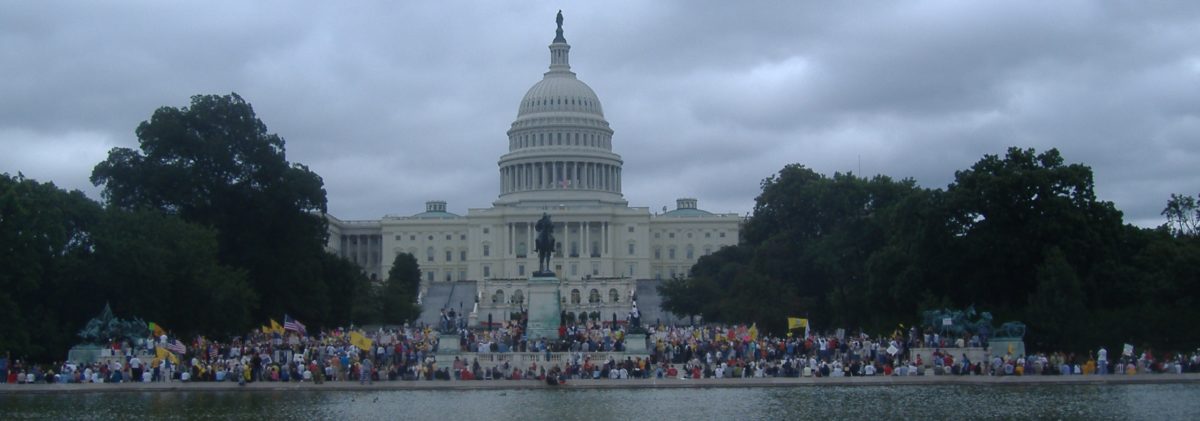
If you are one of those who follows conservative grassroots activism, it’s likely you may have heard about the New Fair Deal rally being held in Washington tomorrow afternoon to coincide with tax day. While it will certainly be a modest event by the standards of other TEA Party rallies such as the 9/12 rally in 2009 or various Glenn Beck-led gatherings since, organizers believe a few thousand will attend with many staying around after the speeches to buttonhole various members of Congress about this new legislative program aimed at reining in government.
But the better question is: what is the legislative program? The four planks can be summarized as follows:
- No corporate handouts
- A fair tax code
- Stop overspending
- Empower individuals
The eight Congressmen who will be authoring the legislation in question, some of whom are among the most libertarian Republican conservatives in Congress, are Reps. Jeff Duncan and Mick Mulvaney of South Carolina, Jim Jordan of Ohio, Doug Lamborn of Colorado, Tom McClintock of California, Mike Pompeo of Kansas, Dr. Tom Price of Georgia, and Reid Ribble of Wisconsin. Mulvaney, Pompeo, and Price are among the speakers tomorrow at the event, which will also feature Rep. Justin Amash of Michigan, Senator Mike Lee of Utah, activists Rev. C.L. Bryant, Deneen Borelli, Julie Borowski, Ana Puig, and Maryland’s own Dan Bongino. Borelli is featured in this video decribing some of the features of the New Fair Deal.
“The New Fair Deal is a four-part legislative package that ends corporate handouts, closes loopholes in a simple tax code, balances the budget, and empowers Americans with the choice to opt-out of Medicare and Social Security,” explained FreedomWorks president Matt Kibbe. “Individual freedom, economic empowerment and equal opportunity are the ultimate fair deal for Americans. No more pitting us against each other while politicians and big business pick winners and losers in the marketplace at the expense of everyday individuals,” he added.
It goes without saying, though, that the devil is in the details. For example, ending corporate subsidies is great for avoiding the next Solyndra or Ener1, but my friends at the American Petroleum Institute would argue that the tax package for oil exploration is vital to the industry’s success. They may have a point, so perhaps the best solution is to prioritize which subsidies would be axed first and which ones would have more of a transition. Being a fairly mature industry, it may take somewhat longer for the oil and natural gas companies to deal with these changes, as well as the sugar farmers who were targeted in the video. I could see a time window of three to five years for these industries, but green energy? Cut them off yesterday.
As far as a “fair tax code” I honestly don’t think there is such a thing, particularly with the proposal of a two-rate system as specified. I like the idea of a “skin in the game” tax where everyone has to pay at least 1 percent (for someone making $20,000 a year that’s $200 – not a back-breaker if you know it’s coming) but I disagree with the progressive rate change from 12% to 24% at $100,000. If we are to have a flat tax, it should be one rate regardless of income. Why would I take the overtime which would push me from a salary of $98,000 (and an $11,760 tax bill) to $101.000 only to have that and much more – since the tax bill would steeply jump to $24,240 – entirely eaten up by taxes? I understand the populist idea of the secretary paying less than the billionaire, but the solution proposed would be ripe for complication because of situations like the above. I’d rather work on repealing the Sixteenth Amendment and creating a consumption tax, which would be the most fair of all because one can control their level of consumption to the greatest extent.
Another area which suffers from being too broad is the concept of “overspending.” Even if you cut off all discretionary spending tomorrow we would still have a deficit. Yes, we do need to eliminate the concept of baseline budgeting posthaste but we also have to lose the mindset which makes people fear their budget will be cut if they don’t spend their full allocation. While thousands and thousands of federal workers are superfluous to the task of good government, we have to educate the public as to why they need to be let go – you know the media will be portraying them as victims just like they tried to make a huge case that sequestration would be devastating.
Of the four planks presented, though, I really like the idea of the last one as expressed – the power of determining your own retirement and health care needs. In just 14 years I will be eligible for Social Security, but to be quite honest I don’t expect a dime from it because the system will be bankrupt by then in my estimation. (My writing was intended to be my “retirement” but real life intruded a little more quickly than I imagined it would.) The same goes for Medicare. If I had the choice, I would tell the government to give me back the money I paid into Social Security and Medicare – let me decide how to invest it best. This legislation may well allow me that option, although I suspect it will be tailored more to those under 40 who still have plenty of time to weigh all their retirement choices.
(Remember, though, I am on record as saying “Social Security should be sunsetted.” Nothing they can propose would eliminate that stance.)
The key to any and all of these changes taking place, though, is to remember none of this happens overnight. As it stands right now, the earliest we can make lasting national change in the right direction is January of 2017. Moreover, these Congressional visionaries and any other allies we may pick up along the way will be standing for election twice before a new President is inaugurated – and if the Republicans nominate another milquetoast “go along to get along” Beltway moderate who doesn’t buy into this agenda, the timetable becomes even longer.
But there is an opportunity in the interim, though. What statement would it make if Maryland – one of the most liberal states in the country according to the conventional wisdom – suddenly elected a conservative governor and confounded the intent of the heretofore powerful liberals in charge by electing enough members of the General Assembly to foil their overt gerrymandering attempts? No doubt it’s the longest of long shots, but let the liberals think they have this state in the bag. Wouldn’t it be nice to watch them fume as a Governor Charles Lollar, Larry Hogan, Blaine Young, or Dan Bongino is inaugurated – this after the stunning ascension of Speaker of the House Neil Parrott and President of the Senate E.J. Pipkin? Those who survived the collective hara-kiri and cranial explosions throughout the liberal Annapolis community would probably be reduced to bickering among themselves and pointing fingers of blame.
Our side often points to Virginia as a well-run state, but I think there are even better examples to choose from. Certainly there would be a transition period, but why not adopt some of these ideas as well as other “best and brightest” practices to improve Maryland and create a destination state for the producers as opposed to the takers?
If this sort of transformation can occur in Maryland, I have no doubt Washington D.C. would be next in line.
Free as the wind?
I thought wind was free. So why will electric bills go up $1.50 or more a month to provide us with wind power?
That seems to be the direction Maryland is going after the Senate approved its version of offshore wind on a 30-15 vote, with Republicans providing most of the sanity. The same was true in the House, but this hot air and rhetoric still passed there 86-48. And as I read the proposed law, the $1.50 monthly limit only applies through June 30, 2016. It’s covered in Section 3, and as Section 10 states:
AND BE IT FURTHER ENACTED, That Section 3 of this Act shall take effect June 1, 2013. It shall remain effective for a period of 3 years and 1 month and, at the end of June 30, 2016, with no further action required by the General Assembly, Section 3 of this Act shall be abrogated and of no force and effect.
A pricing schedule can always be changed, but the portfolio requirement that 2.5% of Maryland’s electricity be created by offshore wind isn’t part of that restriction. If history is any guide, the percentage will be increased in order to try and coerce the market into building this offshore boondoggle 10 to 30 miles off Ocean City.
In his usual “bull in a china shop” fashion, Delegate Pat McDonough blasted O’Malley’s scheme and made a little wager:
I know this story may be hard to believe, but the Governor wants to construct 40 wind turbines that are 80 stories high (think: Baltimore’s tallest building) and 20 miles out in the ocean. This has never been done before. The cost of this green pork scheme is currently calculated to be $2 billion. I believe that estimate is very shallow compared to the eventual real costs. Of course, the usual ATM machines, meaning the people of Maryland, will be mandated to pay for these monstrosities through another new surcharge. The surcharge will be about $2 per month for consumers and unlimited for the business community. I will purchase a free crab cake for every rate payer in the State if this project costs $2 billion or less.
Someone else can have my crab cake as I don’t care much for them – not that I expect dinner on McDonough anytime soon. A more reasoned criticism was delivered by experienced O’Malley needler Larry Hogan of Change Maryland:
It seems Martin O’Malley’s priority is to make electricity and motor fuels more expensive. He wants an increase in the gasoline tax while simultaneously pushing a wind energy policy that is not cost effective and guarantees that electricity will be more expensive for rate payers. The timing couldn’t be worse.
There are no assurances that this offshore wind proposal will not devolve into crony capitalism that reward friends of the governor and political donors.
While there may be political support for offshore wind among narrow special interest groups, 96% of Marylanders are opposed to higher taxes. And make no mistake, the Governor’s offshore wind proposal is simply a tax by another name.
This governor has raised taxes and fees 24 times, taking $2.4 billion out of the economy each year. That is likely soon to be at least 25 with top-elected officials including the Governor rigidly adhering to increasing the motor fuel tax and adding charges to consumers’ electric bills.
Actually, Larry, O’Malley’s priority seems to be that of making life itself more expensive.
It just boggles my mind that we have a governor who “can’t imagine” using proven resources and technology to drill for oil offshore or explore for natural gas under the hills of western Maryland yet wants to go into an area with limited experience and a lack of reliability. You know those howling winds we’ve had the last few days with our most recent winter storm some thought was a “second Sandy“? Wind turbines don’t work in those conditions, nor do they have a history of reliability. Who pays if one of these 400-foot behemoths tumbles over in the middle of a hurricane?
If a private investor thinks it’s a grand idea to put up a wind farm and capture the free energy thought to be blowing around out there over Davy Jones’ locker, I say knock yourself out. Just don’t make the rest of us pay for it.
If it were such a great idea, one would think they wouldn’t need the coercing force of law to make it so. Bluewater Wind failed to make it, and that should be the clue our illustrious governor buys.
Depressing regularity
You know, it seems like every time I see a release from Change Maryland they remind us exactly how many tax increases Martin O’Malley has inflicted on the state – the total is now 24, going on 25. Something tells me that they could probably provide the exact dollar amount raised by all these tax hikes and how far short of projections they came out to be – after all, if enough dollars were raised by tax hikes 1 through 24 we wouldn’t be discussing number 25, would we?
Anyway, here’s what Change Maryland’s Larry Hogan had to say about the latest drop in this Chinese water torture we commonly refer to as the tenure of one Governor Martin O’Malley:
The Governor complains that Maryland has crumbling roads and bridges and the worst traffic congestion in the country, but what he doesn’t tell you is that it’s his fault. There has been no comprehensive transportation strategy from the O’Malley administration. Over a billion dollars has been diverted from the Transportation Trust Fund, and the vast majority of the billions of dollars that has been spent on transportation have been wasted on expenses that are completely unrelated to fixing our road problems. Now he wants struggling Maryland families to pay for his mistakes and his lack of leadership.
Over the last 4 years, Governor O’Malley has spent over $1 billion in dedicated transportation funds for things completely unrelated to transportation – even the money left in the transportation budget was also spent in the wrong place. In his 2014 budget, O’Malley proposes to spend $1.1 billion – a whopping 46% of our state capital and operating transportation budget – on public transportation, even though only 8% of us use public transportation to commute.
What we need is a coherent transportation policy that makes roads a priority and realigns spending based on how Marylanders actually travel. We also need the Governor to restore all of the money he has diverted from the Transportation Trust Fund and immediately appoint a competent Secretary of Transportation. The last thing in the world Maryland needs is another tax increase.
Actually, I have to disagree with Larry on one point: there is a comprehensive transportation strategy going on with Martin O’Malley. It’s just not the one most people would consider.
Remember what happened when gas prices went up to $4 a gallon the first time, in 2008? People parked their cars and decided it was cheaper to use mass transit. While O’Malley can’t directly influence the price of oil because Maryland isn’t that large a piece of the overall energy market, he can work on the the perceived problem of traffic congestion in two ways: try to steer development to urban areas – as I’ll expound further on momentarily – and raise gas prices through taxation, not to fix the highways but to increase the footprint for and subsidy of mass transit. After all, the logical method of addressing problems in the traffic flow through adding capacity is so twentieth century, even though it works.
Several years ago the state assisted in the development of what was called a “Central Maryland TOD Strategy,” with TOD being the acronym for transit-oriented development. One of its strategies for encouraging this sort of “sustainable” development was the following:
The uncertainty and slow pace of financing for transit upgrades hampers the market for TOD. Regional transit financing tools, such as the FasTracks program in Denver, can accelerate the implementation of transit and TOD and build market momentum. These initiatives often face substantial political barriers, so a coordinated and effective regional outreach and messaging campaign is essential.
Guess what’s in the O’Malley gas tax proposal? A study on creating regional transit financing. Granted, the idea has some appeal because it would more than likely serve as a sort of user fee and hammer just those who live in the area served, but once that genie is out of the bottle it’s not going to be forced back in and we will see all sorts of new taxing districts, both inter- and intra-county. Imagine a higher flush tax for the septic-rich Eastern Shore, for example – in Salisbury Mayor Jim Ireton is proposing something along this line to come up with the city’s supposed nine-figure share of enacting the EPA’s Watershed Implementation Plan.
I’ve gone a little far afield in discussing this release, but one other goal mentioned in the Central Maryland TOD report was construction of the Red Line in Baltimore, and indeed that’s one of the prospective uses for the money raised by the gas tax, which, by the way, will automatically increase each year at the rate of inflation. No more messy votes for people like me to scour and make known.
That lack of accountability out of Annapolis is something else which happens with depressing regularity. How about making some changes to Maryland in 2014?
Hot air or black gold?
I found this to be interesting; unfortunately the omission is not surprising. Last week on the Energy Tomorrow blog, a map showing all the areas placed off-limits to oil and natural gas exploration was posted; meanwhile, as the piece by Mark Green points out, the governors of Virginia, North Carolina, and South Carolina called on the federal government to allow drilling off their coastlines. Needless to say, I didn’t see Martin O’Malley’s name on that letter because he’d rather waste time and money tilting at windmills, and “can’t imagine” anyone would want to drill for oil off the coast of Virginia. Better think a little harder there, governor.
The naysayers also would tell you there’s only a limited supply of oil off our coast, anyway. But who really knows? The estimates of Outer Continental Shelf energy resources are over 30 years old, created at a time when people believed in “peak oil” and that energy resources in this part of the country were pretty much played out. Hundreds of massive deepwater oil finds and millions of cubic feet of natural gas unlocked through fracking later, we know better.
Yet our governor swears up and down the market is there for offshore wind, and insists it would cost us no more than a couple bucks a month. But why can’t we have both?
It seems to me there are vast swaths of ocean area being debated about here, hundreds of square miles. How much space (and height) does a deepwater drilling platform really take up? Wouldn’t it be possible for the oil platforms and the windmills to coexist? I honestly don’t see how one would affect the other, with the possible exception of being careful to drill away from the underground infrastructure needed to transmit the electricity produced to shore. Aside from that, there’s a lot of ocean out there. Certainly the purists who like to look out over the ocean and gaze at the stars at night would object to the lights of oil platforms within their line of sight, but the same can be said for wind turbine towers (they have to be lit as well, so planes and boats don’t run into them.)
You know where I stand. But if we can have both and the market will support them, I say go for it. Bet I know which would be built first.
The $19 million question
Over the past few days mayoral candidate Joe Albero has taken to his Salisbury News website – you know, the one with no authority line – and thrice bashed incumbent Jim Ireton for scheming to raise city taxes and fees by $19 million. But is Albero correct in blaming Ireton?
Yes and no. One could extend blame to the party Ireton is a member of and the politician he supported twice for President for signing an Executive Order compelling the federal government and states to increase their tempo in restoring Chesapeake Bay. It allowed the EPA great latitude in determining a course of action (like these marching orders show – orders which include the stick of possibly “withholding, conditioning, or reallocating federal grant funds”) and established a “pollution diet” which had little to do with maintaining the economic viability of the region but more to do with pie-in-the-sky goals for the state of the Bay twelve years hence. This supposedly would “ensure that all pollution control measures needed to fully restore the Bay and its tidal rivers are in place by 2025.” (Yet, as I’ll discuss in a bit, that won’t be the end of the road. Far from it.)
Thus, the state of Maryland became a greater participant in the effort – not that Governor Martin O’Malley, who Ireton also supported for election twice, was exactly going to be dragged kicking and screaming into the prospect of further power over and control of Maryland’s Chesapeake Bay watershed population.
But it can be argued Ireton has his hands tied, and if Joe Albero wins? He still has to deal with it. As it turns out, this $76 million effort is just a portion of Salisbury’s share of costs to enact the Phase II Watershed Implementation Plan, lovingly presented to the EPA by the state of Maryland last year. This led to the mandate from the Maryland Department of the Environment for local officials to prepare a plan for Wicomico County:
As requested by MDE, each of the twenty‐three counties and Baltimore City were instructed to prepare a Phase II Watershed Implementation Plan that details / demonstrates how each jurisdiction will do their part in improving the water quality of the Chesapeake Bay and its tributaries across Maryland.
We in rural Maryland know all about MDE “requests.” They expect the City of Salisbury to reduce their nitrogen load to the Bay by 24% and phosphorus by 40% compared to 2010 levels by 2025. (The county as a whole has a slightly greater task, 25% and 44% respectively.)
But in the report, it details (Figure 6b) the city’s annualized cost over a 12 year period to implement the targeted reductions, and guess what? It comes out to roughly $18.9 million per year – not for the four years Albero refers to, but for the next twelve years. (For Wicomico County as a whole, the annualized cost is $57.9 million a year – a sum roughly half again the county’s budget, for the same time period. My quick math tells me that’s $700 million dollars over 12 years!)
Still, by 2025 we are supposed to have what’s termed a “fully restored” Bay, right? “Isn’t that short-term pain worth it?” proponents in the Radical Green world will likely say.
Let’s face facts here. Do you honestly think that on January 1, 2026 the Chesapeake Bay Foundation is going to release its annual water quality survey and say, “welp, the Bay now grades a 100 on our scale, so our work is done?” Not a chance in hell. The sad fact is that, regardless of what measures are taken, the only long-term solution which will really satisfy the CBF and the rest of Radical Green would seem to be entirely depopulating rural areas and packing people into cities, where all their waste can be treated in acceptable sewage plants (which sometimes leak) and otherwise allow the rural areas to return to a pristine, John Smith-era condition. Sorry, rural landowners, your property is now worthless. Poultry industry, you’re banished.
Joe Albero can bash his opponent all he wants, but it doesn’t matter because the problem isn’t Jim Ireton – it’s Radical Green. We just won’t have as much green to live on thanks to them.
Yet there is something which can be done. While we have the Phase II WIP in place, what we don’t know are the steps which need to be undertaken. In short, what we should be asking for is a precise accounting of where this $19 million is going to go every year. Otherwise, we know what happens when a large pot of money extorted from ratepayers is left out there – greedy hands line their pockets with it and waste it on boondoggle projects. (For an example, see: pilfering of gasoline tax to General Fund for deficit reduction rather than fixing roads and bridges, Maryland.) That’s where Joe should focus his efforts, because we’re already stuck with this tab unless he can convince a number of unfriendly courts otherwise. Unfortunately, the best time to act on this has long since passed, not that Maryland’s leadership would ever dare to tell Uncle Sam and his overreaching minions to go pound sand anyway.
Long-term, this subject should be front and center in any discussion of how federal mandates adversely affect the states. There is a lot more bang for the buck in reducing nitrogen levels upstream of Chesapeake Bay and in urban water treatment plants, yet instead some used the Bay and this WIP as an excuse to wrest control of land use issues from the counties by passing the Septic Bill (SB236.) This bill won’t solve the problem but creates a situation where we are beholden even more to our Annapolis and Washington, D.C. overlords.
Something that’s often forgotten is the fact America is one of the cleanest countries on earth; meanwhile, areas of the communist world have been rendered uninhabitable by environmental disasters created by an uncaring government. There’s no question people would prefer the Bay be clean, but the effort should be voluntary and balanced with regard to the rights of property owners. The EPA’s solution is neither voluntary nor balanced, and our charge in the future should be one of restoring accountability to an unchecked bureaucracy, respect for private property, and free will – in short, government closer to that which our Founders intended.
Odds and ends number 73
As I often do, here’s a collection of little items which grow to become one BIG item. And I have a LOT of them – so read fast.
For example, I learned the other day that Richard Rothschild, who spoke so passionately about private property rights (and the Constitution in general) will be back in our area Saturday, March 2nd as the speaker for Dorchester County’s Lincoln Day Dinner. That’s being held at the Elks Lodge outside Cambridge beginning at 3 p.m. Tickets, which are just $30, are available through the county party.
While Rothschild is the featured speaker, you shouldn’t miss some of the others scheduled to grace the podium, particularly gubernatorial candidates Charles Lollar and Blaine Young as well as Congressman Andy Harris. For a small county like Dorchester, that’s quite a lineup!
The controversy over the Septic Bill is far from the only item liberty-minded Marylanders have to worry about. Over the last few weeks, I’ve been bombarded with notices over a number of issues.
For example, after what State Senator E.J. Pipkin termed as a “structural failure” regarding hearing testimony on Senate Bill 281 (the gun-grabber bill) he offered an amendment to the Senate rules to handle these cases. However, I could not find a follow-up to that bill.
What I could find, though, was Pipkin’s statement that the state was making citizens into criminals, stating “The penalties embedded within the Governor’s Gun Control bill are extreme; they would criminalize paperwork errors in ways that destroy careers, lives, and families.” And he’s absolutely correct.
“This bill does not address the issue of gun violence in Maryland. The real issue is illegal firearms in Maryland, something the Governor’s bill does not target,” Pipkin concluded.
But guns aren’t the only problem. Unfortunately, we are one step closer to an offshore wind boondoggle in Maryland despite the best efforts of those who deal in the realm of reality to stop it. One bastion of sanity in Maryland is Change Maryland, whose Chair Larry Hogan expressed the following regarding offshore wind:
It seems Martin O’Malley’s priority is to make electricity and gas more expensive. He is pushing an increase in the gas tax and pushing a wind energy policy that is not cost effective and guarantees that electricity will be more expensive for rate payers.
At the close of the last session, the governor ignored the budgeting process which resulted in a train wreck. Instead he was out on the steps of the capital, leading wind energy activists in chant that said ‘all we re saying is give wind a chance.’
There are no assurances that this offshore wind proposal will not devolve into crony-capitalism that reward friends of the governor and political donors.
Actually, Hogan slightly misses the point because true capitalism would occur when the market continues to shun the expense and non-reliability of offshore wind. I guarantee that if this project goes through it will cost those of us who use electricity in Maryland a LOT more than $1.50 a month – subsidies can always change, just like tax rates on casinos.
The aforementioned Pipkin also weighed in on offshore wind:
This legislation may represent a shift in how private business is done in and regulated by the state.
This bill requires the Public Service Commission (PSC) to weigh new criteria in approving private development contracts to build off-shore wind turbines. The Commission will now consider prevailing wage and Minority Business Enterprise (MBE) participation as criteria in its contract award.
This could set new precedent. In the future, we could see every business now regulated by a state agency subject to prevailing wage and MBE requirements.
You think? Our Big Labor-friendly governor stops at nothing – nothing – to grease the skids for his union cronies. And surely this will extend to whatever road work is performed once the gas tax is increased by O’Malley and General Assembly Democrats. Wait, did I say road work? Hogan and Change Maryland question that assumption, too:
Change Maryland Chairman Larry Hogan backed transportation reform which has emerged as a key issue this legislative session after several years of being relegated to the back burner. Specifically, key members of the Maryland House of Delegates are advocating guiding principles to ensure much-needed investments are made in infrastructure and fundamental reforms made to transportation policy.
“Previous attempts to improve our transportation network in Maryland have been an abject failure. Our top elected officials are saying roads and bridges are crumbling, but what they won’t tell you is they are the ones who caused the problem in the first place,” said Hogan. ”Another myth that is being foisted upon us is that there is an urgent need to raise the gasoline tax, and that is simply not true.”
Hogan joins Del. Susan Krebs and other House members in instilling common-sense policy solutions to making transportation policy. These include protecting the transportation trust fund with a constitutional amendment, realigning infrastructure investments to reflect how Marylanders actually travel and restoring funds for transportation. (Emphasis mine.)
I highlighted the above phrase as a way to say, “bingo!” That, folks, is the problem in a nutshell.
This is a state which jacked up the tolls on the Bay Bridge to create a cash cow for other projects which don’t pay their own way, like the Inter-County Connector outside Washington. O’Malley’s gas tax is really intended to build rail lines most of us will never ride rather than build projects we could use, like perhaps a limited-access Easton bypass for U.S. 50, widening Maryland Route 90 into Ocean City, or building an interchange at the dangerous U.S. 113 – Maryland Route 12 intersection in Worcester County.
The gas tax proposal has led to acrimony in Annapolis, as Delegate Kathy Szeliga points out:
(Senate President Mike) Miller called House Republicans who oppose his gas tax proposal, “Neanderthals,” and “obstructionists.” In response to his comments, Delegate Szeliga tweeted, “Yabba-dabba-do, Mr. Miller,” further commenting that she hopes to obstruct and stop this massive 70% increase in the gas tax and government expansion. In response to Senator Miller’s jabs at Republicans, Delegate Herb McMillan added, “Even a caveman can see that it’s stupid to raise gas taxes when there’s no guarantee they’ll be used for roads.”
Kidding aside, you can call me a “total obstructionist” as well, Senator Miller. On the road to serfdom someone has to stand in the way, and I’m one of those someones.
Notice that I haven’t even talked about the federal government yet. One sure sign of a new year, though, is the ubiquitous Congressional scorecard. Two organizations which have released theirs recently are Americans for Prosperity and Heritage Action for America.
Not surprisingly, Harris scored a 95% grade from AFP, leading the Maryland delegation – former Congressman Roscoe Bartlett had the second highest grade at 91%. As for the rest, well, their COMBINED score was 50 percent. Heritage Action, however, graded Andy more harshly with an 81% grade (Bartlett scored 67%.) Once again, the remainder of Maryland’s delegation scored anywhere from a lackluster 17% to a pathetic 4 percent.
We’re also talking about immigration reform more these days. I happen to lean somewhat on the hawkish side, so I believe these reports from the Center for Immigration Studies are worth discussing. In one, former Congressman Virgil Goode of Virginia looks at what happened the last time we went down this road insofar as collecting back taxes from illegal aliens – a key part of the compromise provision – was handled after the 1986 reform.
The second CIS report looks at recommendations the bipartisan Jordan Commission made in 1997, after the 1986 immigration amnesty program failed. This middle ground made five recommendations:
- Integrate the immigrants now in the United States more thoroughly;
- Reduce the total number of legal immigrants to about 550,000 a year;
- Rationalize the nonimmigrant visa programs and regulate them;
- Enforce the immigration law vigorously with no further amnesties; and
- Re-organize the management of the immigration processes within the government.
That seems like a pretty good starting point to work from, particularly the first recommendation.
Another study worth reading is this one from Competitive Enterprise Institute called “The Wages of Sin Taxes.” In it, author Chris Snowden takes an unflinching look at who really pays for these tolls. As CEI states in their summary:
Most remarkably, Snowdon, a fellow at the Adam Smith Institute in London, demonstrates that financial burden supposedly placed on society through the consumption of alcohol, tobacco, high-calorie foods, has little basis in reality. The myth that these “sinners” cost the rest of us money is perpetuated in large part because “government has no incentive to tell the public that these groups are being exploited, and the affected industries dare not advertise the savings that come from lives being cut short by excessive use of their products.” This type of tax is actually a regressive “stealth tax” that allows lawmakers to take money from their constituents with the lowest incomes without the pushback an upfront tax would provoke.
I would put that in the category of “duh.” Ask yourself: how much state-sanctioned money and effort do you see given by government to prevent drinking, smoking, and gambling? Yet they rake their cut off the top in each of these three vices, which are only legal because government and society have compromised on these issues.
On the other hand, those who grow or smoke marijuana or do other illegal drugs are considered criminals and tossed in jail or fined. The same is true with prostitutes in most locales. If there were tax money to be made, though, and societal mores shifted ever-so-slightly toward a more libertarian viewpoint with regards to these self-inflicted actions, they would be legal – but you’d certainly still see the public service announcements about “just say no” or the dangers of selling one’s body. (Oddly enough, I doubt we buy time around the world to warn about the dangers of illegally immigrating to the United States. Why do you think that is?)
And I don’t think items like this upcoming movie will help the libertarian cause – not because of the message per se, but the poor quality of the animation. It reminds me of those cheesy Xtranormal movies people make, sorry to say.
I also have a couple items – as I get closer to wrapping this up – that I think are worth reading. Paul Jacobs is on Townhall giving our state a little tough love regarding the drive to tighten petition rules (in a state where it’s already very difficult to succeed) while Mike Shedlock is there making a point I’ve made for several years – my daughter’s generation is being hosed.
While he’s a little bit older than the Millennial Generation, I think Dan Bongino can relate. This video is now going viral on Youtube, in part thanks to the Blaze.
Finally, I think it’s worth alerting my readers that this may be the last edition of odds and ends for awhile. No, I’m not going anywhere but in the interest of bringing more readership I’m in the process of exploring the concept of a quicker posting tempo which may or may not feature shorter posts.
I’ve always felt the ideal post was somewhere between 500 and 1,000 words, but these odds and ends posts can run 2,000 words or more. Maybe it’s better for both readers and this writer to space things out and perhaps devote 200-300 words to an item rather than wait and collect a bunch of items which could get stale after a week or two. I can’t always control the length of my Ten Question Tuesday posts or ones where I report on an event, but I can work with items like these and see what’s truly worth writing about.
As the political world and internet evolve, I think the time is right to change up the mix and tempo here just a little bit. Certainly I won’t get to a point where I’m simply rehashing press releases but I think it’s a better use of my time to shorten the average post I write.
So there you have it: another post which weighs in at 2,000 words, exactly.
Wicomico Tier Map hearing provides guidance for County Council
On Wednesday night over 200 people jammed a converted gymnasium at the Wicomico Youth and Civic Center to hear what interested observers had to say about the prospect of a Tier Map to place the county in compliance with last year’s Senate Bill 236, better known as the “Septic Bill.” Over two dozen members of the public, including this reporter, stood up to give testimony on the concept of adopting a map as prescribed by the state in the adopted law. For Wicomico County and other jurisdictions without an approved map, the clock is ticking: they’ve passed a December 31, 2012 deadline to adopt an acceptable map and cannot legally allow a new “major subdivision” of more than seven lots.
At the hearing Wicomico County Council president Matt Holloway made it clear that no decisions would be made at the meeting. Instead, it was an opportunity to solicit public comment on the zoning issue. “(We will) hear input and discuss the septic bill,” said Holloway.
Wicomico County’s planning director Jack Lenox gave a brief overview of the proposal, noting that while Senate Bill 236 was not a zoning or subdivision bill, it “has the same effect.” Two-thirds of the county was already zoned as agricultural-rural, he added.
(continued at the Watchdog Wire…)
As bonus monoblogue content, here is my testimony as prepared for delivery last night:
Ladies and gentlemen of Wicomico County Council,
My name is Michael Swartz and I live on Mount Hermon Road in Salisbury.
The Septic Bill passed last year has been of keen interest to me, not because I’m a farmer, but because when it comes to government I tend to believe the closer the government is to the people, the better it performs.
While I noticed the Septic Bill passed last spring, it really didn’t get onto my radar screen until I realized over the following months what the impact would be on the local agricultural industry as well as how our county operates its own affairs. To me, it was another strike by Annapolis in what’s been called the “War on Rural Maryland”, a case of once again governing in the pursuit of centralized power rather than the benefit of the people.
So I was pleased to see that Delegate McDermott introduced a Septic Bill repeal bill this year in the General Assembly. To be quite honest, I held little illusion it would pass because power gained by the bureaucrats and majority party in Annapolis is rarely given up easily. Still, I took the time to write testimony for House Bill 106, which I will quote from.
In my testimony I wrote the following paragraphs:
There is little doubt that Chesapeake Bay defines Maryland as a state, and, while there are differences in opinion as to the best course to take in preserving the quality of the estuary for future generations, the goal for all is a cleaner Bay. These concerns have already been addressed on many fronts, with assistance from both the state and federal governments.
That assistance is not at question here, because the law which this bill aims to repeal is not a bill to directly clean up Chesapeake Bay. Rather, HB106 corrects an ill-considered measure which, if not changed, will permanently and adversely affect the farmers who create much of the wealth in rural areas of the state like the local government as elected by the people of Wicomico County.
When the county places land in a tier where development is permanently limited by the newly-created law, I believe the landowner is harmed as the potential value of his property is decreased via the lack of development options. Though some landowners have already given up development rights, which was their decision, I do not believe this can be a one-size-fits-all approach as the state is dictating. Instead, I believe that farmers are the best stewards of their land and many have already taken common-sense measures to protect both their investment and the health of the Bay, with planting cover crops being one prime example.
Because they realized our job is to allow farmers and the agricultural industry to engage in the practices they find best, at the end of last year our County Council considered a provision which would allow an agricultural landowner to voluntarily opt into a Tier IV designation. But Maryland Department of Planning and Zoning Secretary Richard Hall made it plain that, “The law pretty much makes clear that agricultural zones are to be in Tier IV, and so to opt in or opt out is not what’s in the legislation.”
What an attitude exhibited by Secretary Hall! Annapolis knows best, and we should just sit down and shut up. That’s not going to happen.
Unfortunately, my testimony and that of others did little good as House Bill 106 was killed in committee. However, I would like to publicly thank Delegate McDermott for sponsoring the bill and Delegate Charles Otto for voting for it in the House Environmental Matters Committee. It should be noted, though, that Delegate Rudy Cane – who ironically enough chairs the Agriculture, Agriculture Preservation, and Open Space Subcommittee within the Environmental Matters Committee, voted to retain a bill which won’t do a thing to preserve agriculture – although it may increase the amount of “open space” as farms go bankrupt and become overgrown.
To me, given the small percentage of the Bay’s nitrogen problem traceable to rural septic systems, the bill passed last year is akin to using a sledgehammer to kill an ant. Out here, we know better than that.
So, as members of the Wicomico County Council, the ball is now in your court. In my opinion, if we have to have a tier map, let it place the absolute minimum amount of land off-limits to future development. To those of you here from the state or from environmental organizations recommending a more restrictive map, such as what happened in Cecil County last night after their original tier map was rejected, let me just say you may as well prepare for a fight.
I’d like to commend this Council for placing the needs of the people first and holding this hearing. Now let’s do the right thing and adopt true Smart Growth, allowing prudent development where land can be improved to its highest and best use.
Here’s the PAC-14 video.
I come on at about the 20 minute mark.
The offer to grant control
I thought about adding it to an upcoming edition of odds and ends but decided this needed to be promoted to its own column. A few days ago I commented on a story in The Brenner Brief regarding an Ohio woman who was fighting her local utility over the installation of a “smart meter” and I added that our power company sends us a card each spring with an offer to have a new two-way thermostat installed.
Indeed, just like the swallows of Capistrano (or, for something closer to my birthplace, the buzzards of Hinckley, Ohio) it seems like a sure sign of spring is that mailing from Delmarva Power, and I received it earlier this week. Promoting the theme of “5 Things you may not know about Energy Wise Rewards Maryland” it claims the following:
- 25,000 Marylanders have already joined Energy Wise Rewards, or 1 out of 7 eligible homes in the region.
- Energy Wise Rewards has reduced customer bills by more than $3 million.
- Energy Wise Rewards avoids generating 27 million watts of energy per conservation period, supposedly enough electricity to power 10,000 homes for one hour.
- More than 25,000 Energy Wise Rewards devices are installed in our area, with a goal of 54,000 by year’s end.
- During a conservation period, the program removes more than 125,000 pounds of carbon dioxide from the air, like taking 24,000 cars off the road.
So their goal is to be in about 1/3 of the eligible homes by the end of the year, which would maybe save enough electricity to perhaps supply three homes for a year per conservation period. Three whole homes!
And if you take the $160, split between an $80 installation credit and up to $80 in annual reward credits, I can see where the $3 million figure comes from. In actual electricity costs to the utility, assuming there are 30 conservation periods a year, your savings might be a buck or two. (A home uses roughly 1,000 kilowatt hours a month.)
Yet what do you give up? The right to maintain your home at a temperature you choose. The flyer notes:
…on select summer Peak Savings Days, we’ll cycle off and on your (central air conditioning or heat pump) unit for short intervals (conservation periods.)
Your A/C compressor will continue to run for part of the time it did prior to the conservation period. You can expect a 1- to 3-degree rise in temperature, but most people don’t notice a change at all. (Emphasis mine.)
You might like your home at 72 degrees in the summer, but they want it to be 75 degrees.
Of course, when I worked a regular work schedule several years ago, I had a much simpler plan: I turned off my a/c when I went to work and turned it back on when I came home. I would keep the thermostat at 75 and normally when I walked in the door it would be 80 to 84 degrees in the house – an hour later, generally the time I finished my walk, it would be 75 degrees. It was a good system which fit my needs.
But if I bowed to Delmarva Power’s demands, it seems to me my cooling process would take a lot longer as the unit cycles on and off, never mind the wear and tear on the unit. And once you cede control for this purpose, what’s to say they won’t decide someday – in the name of conservation – to cycle it off completely until your home is warm enough for the temperature they say is best? (Generally the recommendation is 78 degrees.)
All this nanny statism is brought to you by a nasty bill which was passed in 2008 called the EmPOWER Maryland Energy Efficiency Act of 2008. And while the bill doesn’t allow a utility to directly regulate one’s thermostat – yet – that may become an option if the state decides on more ambitious goals beyond the 2015 end date of what’s being termed EmPOWER 2.0.
Don’t get me wrong: if energy efficiency is something you want, I encourage you to study the costs and benefits of making improvements. (A good payback period to me is five years or less; for example, if putting in a new energy-efficient climate control system costs $2,000 but saves you $400 annually in heating bills, it’s a good investment. But if it’s only saving you $100 a year, it’s not worth the outlay when it comes to energy efficiency. (Obviously repairs and upkeep can factor into this as well.)
If the state wants to make their facilities more energy efficient using the payback period I outlined above as a guide, well, knock yourselves out, kids. That seems to me a prudent investment, assuming of course the facility houses a legitimate government function.
But I’m very leery about putting a utility (and by extension, the government since this is a state mandate) in charge of my comfort. How we use our energy in our personal domicile should be up to us and the economic realities we face – obviously if we can’t afford a $1,500 fuel oil bill every winter, we have to turn down our thermostats or find cheaper alternative sources. But that’s a decision we as home occupants make, not someone at the utility company or state regulator.
New House of Delegates GOP leadership could be on tap
A story by John Wagner which ran online at the Washington Post website earlier this week suggested that changes could be in order for Maryland House Republican leadership, with an election held after this year’s session ends in April. In his piece, Wagner suggests the caucus could be leaning toward Delegate Leroy Myers, Jr. (R – Washington) as the new Minority Leader and Delegate Kathy Szeliga (R- Baltimore County) as the Minority Whip. They would replace current Minority Leader Delegate Tony O’Donnell (R – Calvert) and Minority Whip Delegate Jeannie Haddaway-Riccio (R -Talbot). O’Donnell has held the Minority Leader post since 2007, while Haddaway-Riccio took over as Whip in 2011. One Delegate who wished to remain anonymous confided that 22 Delegates are on board: “Enough to do it,” said the Delegate.
Leadership struggles in Maryland’s perpetual minority are not uncommon; most recently, in the summer of 2011, Mark Newgent at Red Maryland reported on an uprising featuring Delegates Nic Kipke (R – Anne Arundel) and Michael Smigiel (R- Cecil). At the time, the disagreements stemmed from a perceived lack of fiscal conservatism, with Kipke being quoted as being encouraged to run by a “contingent of delegates from the Anne Arundel County, the Eastern Shore, and Western Maryland.” It just may be the same restive group wishing for change this time, but just like I pointed out when I criticized Kipke’s anemic record of conservatism, the same can be said about Delegate Myers.
In looking at his overall record, Delegate Myers lags behind a number of other conservatives in the General Assembly. For example, he has often voted for Governor O’Malley’s budgetary plans as well as a number of other steps toward a Radical Green agenda, such as solar energy portfolio standards and overly broad coastal buffer zones. He’s also missed a large number of votes over the years for various reasons, including his son’s 2009 death in a motorcycle accident which occurred as that session was reaching its close.
Nor has Myers been an outspoken advocate for conservative causes, which makes the prospect of support from the body surprising unless that bid is coming from the more moderate members.
On the other hand, conservatives who are unhappy with O’Donnell’s leadership have a number of good, outspoken leadership choices:
- Delegate Neil Parrott (R – Washington) is best known for his leadership on the petition drives which brought three ballot questions to the voters in 2012. Although none succeeded at the ballot, the petitions motivated tens of thousands of voters to vote in the election; for example, opposition to both Question 4 and Question 6 outstripped the 971,869 votes cast statewide for Mitt Romney.
- Delegate Michael McDermott (R – Worcester) has developed a reputation as a fiery orator, one who can speak extemporaneously on a number of subjects. Chief among his initiatives this session is a bill to repeal the Sustainable Growth and Agricultural Prreservation Act of 2012, better known as the “Septic Bill” or “Tier Map Bill.” McDermott was considered enough of a thorn in the Democrats’ side that his district was redrawn to place both him and Delegate Charles Otto (R – Somerset) in the same single-member district.
- Since both Parrott and McDermott were elected in 2010, members may want a more veteran presence as leader. If they want one with a lengthy and solid conservative voting record, they could choose Delegate Warren Miller (R – Howard), a member since 2003. In this term he is primary sponsor of both a right-to-work bill and enacting a statewide E-Verify program.
While the current situation suggests there’s “enough to do it,” April 30 is a long way away. A lot can change in that time: deals can be made, Delegates get cold feet, or leadership reads the writing on the wall. Whether any or all of these happens remains to be seen, but it’s probably best that any leadership struggle waits until after the session to occur.
Odds and ends number 72
Perhaps rainy days and Mondays always get you down, but this potpourri of snippets I’ve collected over the last couple weeks will hopefully brighten your day. As always, they’re items which merit anywhere from a paragraph to four to five.
First of all, you are probably aware that Indiana and Michigan are the two latest states to throw the yoke of forced unionism off their workers and adopt right-to-work laws, with Pennsylvania also strongly considering such a measure. Conversely, I’m not hearing about hitherto right-to-work states making much of an effort to close their shops, which should tell you something.
And while Maryland is not a state one would consider a candidate ripe for such a refreshing change, there is a bill out there to bring our state out of the unionized Dark Ages and join other states where workers are free to choose affiliation regardless of where they work.
Best of all, this news comes from one of my favorite counties to cover, Cecil County. HB318 is being heard tomorrow, and their Republican Party leadership under county Chair Chris Zeauskas has taken a bold stand on the issue. They’re calling out Delegate David Rudolph, the Vice-Chairman of the House Economic Matters Committee, as “bought and paid for by compulsory unionism – and that’s wrong.” Certainly the unions donate thousands and thousands of dollars to state politicians, most of which goes to Democrats.
But the question I have is more local. To what extent has Big Labor “bought and paid for” Delegates Rudy Cane and Norm “Five Dollar” Conway, or State Senator Jim Mathias – the king of across-the-Bay fundraisers? Surely a significant portion of their largess comes from the coffers of workers who may not necessarily prefer these policies be enacted. HB318 can help change that, but my guess is – if they get to vote on it at all (neither Cane nor Conway is on Economic Matters) – they’ll play along with the union line like good little minions.
Meanwhile, our tone-deaf governor doesn’t get it on wind farms, and I had to chuckle when I saw even the Washington Post admits Big Wind “(d)evelopers and industry analysts say those and other (subsidy) concessions will make the project reliant on further federal tax incentives or help from other states to make it profitable.” At a quarter per kilowatt hour, you better believe it needs a subsidy. Yet the Post believes it’s “likely to pass.” That depends on the level of sanity in the General Assembly; yes, a dubious precipice to cling to, but one nonetheless.
And here I thought wind was free – that’s what people tell me, anyway.
I also thought Maryland had a top-notch school system, but President Obama’s Department of Education begs to differ. This nugget came to me from Change Maryland, which continues to occupy that little place in Martin O’Malley’s mind reserved for those who have pwned him:
In the second year of the $5 billion Race to the Top initiative, the Obama Administration singled out Maryland, Washington D.C. and Georgia as coming up short on progress in fundamental areas. According to the U.S. Department of Education, Maryland did not set clear expectations for the 2011-2012 school year in the development of a teacher and principal evaluation system which rendered the data meaningless and inconsistent. Lack of coordination between the state and local school districts was cited as the primary reason for the data collection failure.
“I would like to see Gov. O’Malley reach out to President Obama while he has his attention… and seek assistance on properly implementing the Race to the Top initiative,” said (Change Maryland head Larry) Hogan. “Our students and their parents deserve a way to measure how effective their teachers are.”
I have one bone to pick with that approach, though. I would really rather not have a dependence on federal money or a federal role for education, which is more properly a state- and local-level concern. But there should be some consistency in evaluations so that underperforming teachers and principals don’t lead to underperforming schools – unfortunately, that seems to be more and more the case.
And here’s yet another example of state incompetence. On Thursday, State Senator E.J. Pipkin blasted a process which shut out hundreds of people from testifying against SB281, the gun bill:
We can’t turn away people who take the day off, drive for hours and wait even longer, to have their voices heard. Turning away interested citizens in such a manner further fuels cynicism about our legislative process. Next time, they might not come back.
Yesterday, a system that can accommodate 100, 200, or 300 people, broke down when numbers reached into the thousands.
Thousands couldn’t get into the Senate’s Miller building to sign in to testify. Those who signed in but left the building were unable to reenter. At the end of the evening, some who stayed 10 to 12 hours, were brought through the committee room, allowed to say their name, home town, and whether they supported or opposed the legislation. (Emphasis mine.)
The reason I put part of the above statement in bold: that’s what they want. The majority – not just in the General Assembly, but in Congress and 49 other state capitols as well – really would rather we just leave them alone to do what they do, enriching themselves and a chosen few cronies while leaving the rest of us to pay for it and suffer the consequences of their actions.
Now for something completely different. Several years ago, I copied a late, lamented blog whose owner is no longer with us in offering “Sunday evening reading.” Well, today is Monday but there are some items I wanted to include that I read and felt they would add to the well-informed conversation in some way.
My old friend Jane Van Ryan (who I thought “retired” but seems now as active as ever) sent along the link to this piece by Paul Driessen which discusses the concept of “sustainability.” She thought I would have something to say about it, and I do.
Driessen’s main point is that the concept of “sustainability” as preached by Radical Green doesn’t take into account future technology. It would be like watching “Back to the Future” knowing that it was filmed three decades ago but set in the modern day today – for example, who drives a DeLorean these days? Sometimes their predictions seem quite humorous, but we know technology has taken many turns they couldn’t predict when the movie was written and filmed.
While oil, gas, and coal are “old” technologies, who’s to say we can’t improve on them? As long as there is a supply which comes to us at reasonable cost, you can’t beat their reliability when compared to wind which may not blow (or gale too hard) and the sun which seems to be stubbornly parked behind a bank of clouds as I write this. Instead of dead-ends like the E15 technology which ruins engines (but is acceptable to Radical Green) why not work with what works?
But perhaps there is a sense of foreboding brought on by the Radical Green propaganda of a collapsing ecosystem. One way this manifests itself is by a lack of willingness to have children, which goes in well with the decaying culture of life in this country.
Last week in the Wall Street Journal, author Jonathan Last advanced his theory that our nation is heading down the same road as other moribund industrialized nations – not necessarily because of policy, but because of falling birthrates. According to Last, we as a nation have been below the replacement birthrate for most of the last forty years. Whether this is through abortion or other lifestyle choices isn’t important to him; instead, it’s become an ongoing problem of our population aging – as Jonathan puts it, “(l)ow-fertility societies don’t innovate because their incentives for consumption tilt increasingly toward health care.” Put another way, those energy advances I write about above may not appear because more demand will come for health-related technology advancements.
Instead, what has primarily increased our population over the last few decades is immigration, a large part of it illegal. Normally I’m right with the Competitive Enterprise Institute, but I have to disagree with their stance on E-Verify. I can understand their point regarding civil liberties, but no one says mandatory E-Verify has to be permanent. Instead, I would like to see it set up to be a five-year plan with one possible five-year renewal – this would give us ample time to secure the borders and address those who are already here illegally. (Ideally, they would return to their country of origin and reapply to come here legally.)
Understandably, that may be a pipe dream but I’d prefer not to reward lawbreakers in a nation built on the rule of law. We have enough of that already given the greed of the redistributionist state.
And so ends another edition of odds and ends, right around the length I like.