Developing the Shore
There were a couple items I wanted to pass along because, as one who would prefer the area grow rather than shrivel up and die, we could use the help.
I’ll begin with Andy Harris:
(On Tuesday), Rep. Andy Harris (MD-01) joined Rep. Scott Rigell (VA-02) to pass legislation through the House that could create hundreds of jobs at an expanded Wallops Research Park, which is located near NASA’s Wallops Flight Facility. The bill removes restrictive federal government deed provisions that hinder job creation on the Delmarva. The legislation creates these jobs at no cost to hard-working taxpayers. Additionally, up to half of the potential high-paying jobs could be filled by Maryland’s Eastern Shore residents.
“We need to work to reduce undue burdens that the Federal Government is placing on the ability of local communities to create jobs,” said Rep. Andy Harris. “I will support any bill like this that helps foster an environment for job creation while costing hard-working taxpayers nothing.”
And then there’s former Harris opponent Senator E.J. Pipkin, working on the state side:
Senator E.J. Pipkin…announced that the Senate Finance Committee has approved his bill – SB 818 – to begin the process required to consider building a third span of the Chesapeake Bay Bridge.
Pipkin said, “I am elated that the Committee has taken the first step in the long journey toward what must happen – construction of another Bay Bridge span. No one who uses the Bay Bridge on a daily commute or on a weekend to visit Ocean City will debate the necessity for a third span.”
Senator Pipkin pointed out that the bridge carries an average of 68,000 vehicles each day. Five mile backups are not unusual at any time, but are common in the summer when an average of 100,000 vehicles cross the bay each day. “The bridge has the dubious distinction of having the worst traffic delays on the northeast coast,” he said. The Bay Bridge Transportation Needs Report revealed that 402 accidents occurred during its 3-year study period; a significantly higher volume than for similar highways.
(snip)
Before any large project can commence, the National Environmental Policy Act (NEPA) requires an Environmental Impact Statement. The process includes a public scoping process, data collection, analysis of policy alternatives and preparation of draft and final documents, all of which takes 6.1 years, as estimated in 2003. “Putting Maryland into the NEPA process would finally address the issue of a third span and enable us to make policy decisions to move forward,” declared Senator Pipkin.
Using the cost of NEPA studies for the ICC as a base and adjusting for inflation, the Department of Legislative Services projects a cost of $35 million between 2013-2017 for the NEPA study. The MdTA would pay for the cost of the study out of its operating expenses. “Last summer, the MdTA approved the largest toll increase in the State’s history, so it comes as a surprise that it now claims that this process would be too expensive.”
Pipkin stressed that SB 818 does not require that a third Bay Bridge be built, but enables us to move forward to the next step in considering our transportation needs. It will take 15 to 20 years to build a new Bay Bridge.
The role of government is not to provide a vehicle for crony capitalism, but work on those areas which benefit the public at large. It seems like the Harris/Rigell measure does just that. Knowing Wallops Island is a federal installation which is vital for the national defense (a legitimate Constitutional function) I see no problem with private enterprise having a share in that success. To be quite honest, I never knew there was a Wallops Research Park, but that’s in part because it’s a little off the beaten path. Maybe that was part of their problem as well.
Of course, the local infrastructure may need improvement as the main highway to Wallops Island is the same two-lane artery which takes tourist traffic beyond Wallops Island to Chincoteague. At some point if the new venture is successful we may have to see Virginia Route 175 dualized – but that’s probably at least a decade off.
Transportation woes are hopefully being addressed with Pipkin’s proposal as well. But I believe a third span would be much more practical several miles south of the existing Bay Bridge. Geographically it makes a lot of sense to have a span from Dorchester County to Calvert County at a point where the Bay is relatively narrow, but I could already imagine the hue and cry from environmentalists and NIMBY types, particularly on the Eastern Shore. This would also require Maryland Route 16 to be seriously upgraded, at least to Cambridge.
But there would be advantages as well, particularly on the tourism and accessibility front. Opening a southern route may encourage more commerce between the fast-growing counties of Southern Maryland and the Eastern Shore. Why should the mid-Shore reap all the benefits from a Bay crossing?
As Pipkin says, though, we are probably a couple decades away from a third span and by then there may not be anything left of the Lower Shore to connect with except for Ocean City. A state which is doing its best to strangle rural development in the War on Rural Maryland isn’t going to care whether we receive help or not, just as long as the tax dollars arrive.
Anti-tax rally in Annapolis March 22
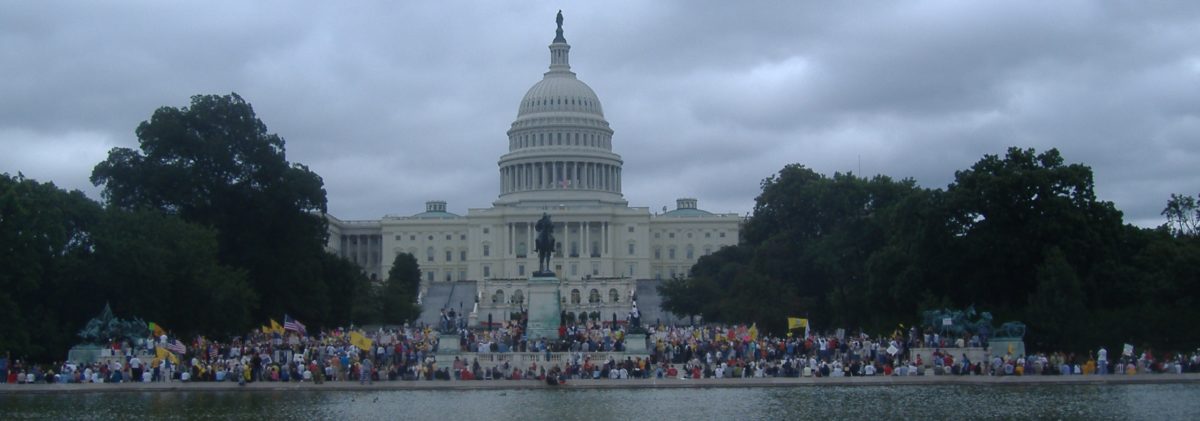
Looks like the TEA Party is going to rear up: while the House of Delegates is debating the State budget the tax revolt will be heard and seen all around Annapolis.
Thursday’s event is a last minute call to action. Tomorrow at noon there will be a group of cars circling the State House starting at noon honking their horn to show their opposition to increased spending. Others will be standing with posters opposing the elimination of the tax cap, stopping tax increases, and asking the government to hold the line on spending. There is also an opportunity to witness the debate first hand. Visitors are invited into the House Chamber in the gallery.
Delegate Susan Aumann (R – Baltimore County) said, “We are facing historic tax and fee increases, and it is government spending that is inhibiting the growth of Maryland’s economy.”
“Enough is enough!” Delegate Kathy Szeliga (R – Baltimore and Harford County) added, “From the beginning of session we had polling that proves 96% of Marylander’s say they pay enough in taxes.”
Tomorrow’s event is expected to draw supporters from all around the state.
The protest is spearheaded by a number of Republican Delegates from the Annapolis area, who are counting on the help of local activists to make a point. Admittedly, the thought of a line of cars circling the seat of government has its appeal because there’s no need to have a large group to make the point. It would be more of a newsworthy event than the equivalent small amount of protesters holding their antitax signs.
It’s probable that the protests won’t do any good, particularly when the Democrats run the General Assembly like their own fiefdom and Governor O’Malley needs the money for his spending initiatives and to refill the funds he looted to balance his previous budgets. And who are we kidding? Those funds will be raided yet again next year as O’Malley begins his push for the 2016 Democratic nomination.
But the success of this event will be more on the awareness front, as the Democrats have been known to overplay their hand. Let’s get as many out who can spare the time and get ourselves in the news.
A (somewhat) false alarm
On Sunday I received an e-mail from a friend and professional associate of mine wondering aloud if a coup d’etat was being perpetrated:
It appears from my cursory review (I could be wrong, but I don’t think so) that this EO gives this administration complete and utter control, up to and including confiscation, of all farms and equipment, and many, many other items of infrastructure if they, in so many words, choose to do so.
Well, I suppose I’m happy to report that, while the mainstream media has pretty much ignored the Friday afternoon document dump (something they are quite reliable for), Ed Morrissey at HotAir took a closer look at the Executive Order’s effects. In essence, this EO is a rewrite of one (EO12919) signed by President Clinton in 1994, but updated to reflect the new cabinet positions created since.
But there is a problem here; it’s just not the one we think it is.
The law Obama’s EO traces its origin to was passed in 1950, at the start of the Cold War. While the Soviet Union is no more and we have gone through twelve Presidents in that time span (not to mention some more or less undeclared wars and incursions to various points around the globe) the question really should be why, if the update was needed, did President Obama wait until just a few months before the end of his term? Or perhaps another question: why release this on a Friday afternoon when many millions are paying rapt attention to a basketball tournament?
The age-old quandry
I know I’ve made this point before, but Second Congressional District candidate Larry Smith argues that representatives should refrain from taking available funding for district projects, even if a Democrat may grab it.
Claiming opponent Nancy Jacobs “didn’t hold the line in Annapolis (thus) likely won’t in DC either” Smith criticized the Senator for a $100,000 earmark she secured for the Plumpton Park Zoological Gardens in Rising Sun. Larry also quoted a Washington Post story from last April where Jacobs made the case that “she recognized the political reality that Democratic leaders, who control both chambers, were going to divvy up the money regardless, and she didn’t want her constituents to get ‘shortchanged.’”
And it’s a subject which has often come up in state politics. I began talking about it way back when Nancy’s former cohort Senator Lowell Stoltzfus spoke about it at a Wicomico County Republican Club meeting, when he argued “that he was conflicted about that – on the one hand, it goes against his grain to spend this extra state money on items in the 38th District, but if we don’t get it, someone in another part of the state will be happy to grab it. (Stoltzfus) noted that one budget during the Ehrlich years did not have any money for legislative initiatives and he was quite happy about that fact back when it occurred.”
The key is within the statement – when the money wasn’t made available, this wasn’t an issue. And a key difference between Congress and the state of Maryland is that our budget is made by the governor, with the only input from the legislature being that of cutting. Obviously there is the possibility that the General Assembly could cut that part out of the budget but under a Democratic governor and General Assembly pigs will fly first. On the other hand, Congress sets the federal budget so if they put their mind to it they could eliminate all the earmarks. Smith could conceivably argue the point he makes about Jacobs would apply because she may be all in favor of earmarks once she goes into Congress, but using the Maryland General Assembly as an example is sort of an apples to oranges comparison.
There’s no doubt Smith is hanging his hat on being a fiscal conservative – just take a look at his 20-point plan of cuts. But it’s a little bit unfair to say, as Smith does, that “Jacobs single-handedly managed to cede the moral high ground that Republicans could have held regarding earmarks during Session 2012.” She was far from the only one.
So if you take an honest look at the situation, both parties have blame to share. But there’s some teaching we need to do, too. Too many people judge their representatives by how much bacon they bring home, but there are times when the bacon is lean and times where the fat should have been cut out. Obviously there are functions government needs to perform but too many people believe their projects need assistance. A discerning district wouldn’t give Jacobs credit for $100,000 to help a zoo, but it’s obvious she saw the probability she could get kudos for this.
The question of how much credit she got may be answered come April 3.
Bonus research
I was writing something the other day as a possible addition to another venue, and in doing the research kept the link on my bookmark bar for future reference. Well, as it turns out I didn’t need the extra research for the other piece but I wanted to make my point on the subject. So here are more of my thoughts on the prospect of an additional Maryland gasoline tax – something I originally visited in January.
The two pieces I found were comparisons – one being the current gasoline tax table provided by the Tax Foundation which shows Maryland’s gasoline tax rate is currently tied for 29th among the 50 states. The second is an older comparison table that I found, and the reason I wanted it was to determine where Maryland’s gasoline tax ranked among its peers when it was adopted in 1992. (I couldn’t find 1992, but figured 1994 was close enough.)
It’s quite telling to me that back in 1994 our state had one of the highest gasoline tax rates, with only a handful of states charging more: Connecticut, Montana, Nebraska, Nevada, Oregon, Rhode Island, and West Virginia. Worse yet, only Montana, Nevada, Rhode Island, and West Virginia charged more tax on diesel fuel. In 1994 our taxes were a full 30% higher than the national average, but because states have began to add various other fees and local tariffs we remain above the average insofar as excise tax is concerned but slightly below the mean in overall taxation per gallon. Apparently 20 years is long enough and we have to break out of the pack and lead the country once again.
Since several states now add various amounts of sales tax to the price of gasoline at the pump, it’s difficult to accurately say just where Maryland would rank if gasoline prices were significantly higher or lower than they are today should they adopt Governor O’Malley’s idea of an additional sales tax phased in over three years. But it’s obvious we would be paying more at the pump regardless of the price – even if Newt Gingrich could get gasoline back down to $2.50 per gallon that’s still an extra 15 cents per gallon, or around $2-3 per fillup depending on tank size. At $4 per gallon the fee goes up to perhaps $4-5 for every tankful.
(Note that there’s also a number of alternative plans being floated around for a straight per-gallon excise tax increase, which would make the impact more easily gauged. Adding 15 cents per gallon, as one proposal advocates, would put us just a tick behind North Carolina as the highest-taxing state in terms of excise tax.)
Regardless of what proposal to increase fuel tax is adopted, when combined with the additional tolls being charged by the Maryland Transportation Authority at their facilities (including the Bay Bridge) the cost of getting around via car will certainly jump. By next summer driving across the state from Cumberland to Ocean City and back on a 12-gallon tankful of gas each way may well cost $15 extra in taxes and tolls alone from the price in 2011 – before the new tolls were adopted for the Bay Bridge and other MTA facilities.
The stated reason for the increases are quite simple: the state claims it doesn’t have enough money for road and bridge construction. Yet the MTA toll increases spared the Inter-County Connector and gasoline taxes tend to come down harder on rural residents who have to drive farther to work and shopping. In sum, they tend to serve as a wealth transfer from rural to urban dwellers, particularly in the Washington metro area because the ICC tolls did not go up. Moreover, the tendency for gasoline taxes to be spent on mass transit provides a further shift in prosperity from rural to urban; one particularly galling when a mostly empty train or bus goes by.
The main reason the state “needs” this tax increase, though, is to patch over the holes created by several administrations by raiding the Transportation Trust Fund (TTF). It’s an art which has been perfected by Martin O’Malley because he wasted the $1 billion-plus raised by a series of 2007 tax increases Democrats rammed through the General Assembly on a program of further spending rather than simply addressing the vital functions the state is supposed to provide. So now he and Annapolis Democrats are coming back to the people of the state with hat in hand begging for more, and promising this time they’ll “protect” the TTF. Well, I want the protection first, and a number of bills in the General Assembly deal with this. Unfortunately, Delegate Norm “Five Dollar” Conway and Senator Edward Kasemeyer don’t seem to have much desire to move these bills. But I’ll bet they’ll move that gas tax along in a hurry.
It’s quite likely that over the next few years our gas prices will either be going up at an accelerated rate or not dropping as quickly as they could because the state of Maryland will take a larger bite from our wallet through the gas tax. Maryland doesn’t seem to want to be a national leader in anything except loony liberalism and high taxation, and the controversy over highway funding provides another perfect example.
Yes, we were ignored again
Expanding on a point he made when he spoke at our Lincoln Day Dinner, U.S. Senate hopeful Richard Douglas bemoaned the loss of 1,400 manufacturing jobs when heavy equipment maker Caterpillar decided to build a factory in Athens, Georgia.
The media approach was two-pronged, with the Senate candidate penning an op-ed on Baltimore’s Citybizlist website as well as a video:
Key among Douglas’s arguments is this, from the Citybizlist piece:
Public statements from company officials show Caterpilllar’s reasons for choosing Athens, Georgia: a deep pool of skilled workers, the nearness of Atlantic seaports for exports, and Georgia’s friendly business climate. Maryland has a tradition of heavy industry and a skilled labor pool. The world-class Port of Baltimore goes round-for-round with the ports of Charleston and Savannah. So why wasn’t Maryland even considered?
Where the comparison between Georgia and Maryland fails, of course, is the business climate. Maryland’s business climate is legendary for its hostility to private enterprise. Our state bleeds jobs, and as far as CEOs and corporate site selection consultants are concerend, Maryland is fly-over country.
Douglas goes on to explain that Athens is over 200 miles from the Savannah and Charleston seaports while the city of Baltimore has its own “world-class” port. And Douglas is right in citing Maryland’s poor business climate, although he fails to mention that Georgia is a right-to-work state. We’ve talked about that for years, but it’s apparent that Maryland won’t change its spots until the current Democratic regime is ousted from Annapolis at all levels. Having a Republican governor staring at a Democrat-controlled General Assembly is no solution, even in a state where the executive has as much power as Maryland’s does.
But there are two other things I believe Douglas missed that he (or anyone else elected to the Senate seat) would have some control over once attaining office.
First of all, it’s not apparent to the average person but Salisbury is the second-largest seaport in Maryland. While I’m no nautical expert, I would presume that the Wicomico River has enough depth to allow the barges I’ve seen transporting gravel and other commodities up and down the river but not enough to allow for seagoing ships like those traversing Chesapeake Bay. And that’s fine, since we’re several miles inland.
But wouldn’t it be possible to do a limited amount of container shipping through the Wicomico River, say, enough to support a manufacturer who creates something larger than a chicken? I don’t know the answer to that question.
The other thing which surprises me about Caterpillar’s choice is that there’s no direct highway connection from Athens to either of the seaports Douglas mentions. While Salisbury probably can’t become a major port, there are opportunities to connect to larger seaports and markets in the Northeast if we have some leadership in developing the infrastructure to take advantage of it. I’ve said for several years that having an interstate-grade highway connection from Salisbury (similar to the U.S. 13/50 bypass) northward through Delaware to I-95 would open up the area to development and further tourism. With more industry, we could also see the existing rail line through Salisbury double-tracked northward as well. (Obviously that’s more efficient as it allows freight travel simultaneously in both directions.)
If an area doesn’t grow, it shrivels and dies. Just take a drive like I do weekly through Virginia’s Eastern Shore, where both counties lost population in the last 10 years, and you’ll see what I mean. The young people aren’t staying, and part of the problem is a lack of suitable infrastructure for job growth.
Remember, while we may not have gotten the Caterpillar plant and its projected 1,400 jobs, we would be just as happy to get 14 job-creators who hire 100 workers apiece. And while they don’t necessarily have to be manufacturing jobs, it seems to me that America needs to begin making things again and if the conditions are changed to be more favorable to commerce we can create the workforce to do so.
He’s number 22: Harris tops Maryland delegation on Club for Growth scorecard
While the group can learn a thing or two about how to organize a legislative scorecard from someone who knows about it, the Club for Growth recently released its 2011 legislative scorecards for the House and Senate. And for all those who believe the Club for Growth backed Harris for a reason, well, I guess you have your proof. Too bad thoughtful people agree with most of the Club’s positions.
I’ll cut to the chase: here is the percentage score and rank among Maryland’s House delegation, by district. Bear in mind there are 435 House members:
- Andy Harris, 95% (22)
- Dutch Ruppersberger, 1% (419)
- John Sarbanes, 8% (365)
- Donna Edwards, 11% (335)
- Steny Hoyer, 8% (372)
- Roscoe Bartlett, 89% (42)
- Elijah Cummings, 9% (353)
- Chris Van Hollen, 12% (315)
On the Senate side, Barbara Mikulski scored 11% and ranked 72nd, while Ben Cardin attained a miserable 3% rating and finished 94th.
It’s obvious that Maryland can do its part to help enact pro-growth policies by helping to get rid of the anti-growth president we have now, but more importantly in this election ousting Ben Cardin and some of the low-performing House members we have. That’s not to say one of Bartlett’s GOP primary opponents wouldn’t have a similar score, though, so don’t consider this an endorsement of Roscoe Bartlett. (Harris is unopposed in the GOP primary.)
Is eliminating Ben Cardin a long shot? Yes, a prudent observer would have to admit it is. Cardin is a likable guy who reminds people of a kindly grandfather, and it’s obvious he has plenty of political instinct since he’s made a long career out of being elected every two to four years. (By my count, he’s won in 1966, 1970, 1974, 1978, 1982, 1986, 1988, 1990, 1992, 1994, 1996, 1998, 2000, 2002, 2004, and 2006. That’s sixteen elections, folks.)
But it can be done, and we have to state our case to Maryland voters. The same goes for several House seats where I think we have a fighting chance: the Second, Fifth, and Eighth districts are probably the most in play. Imagine holding our two we have now and winning those three – Democrats would be self-immolating themselves if their heads didn’t explode first.
There’s no question conservatives have the right ideas, it’s just that we have to get together and put them into practice. Of course, the Club for Growth isn’t perfect but I would argue it’s pretty damn conservative and this is a useful gauge on who needs to go in our current Congressional setup.
Tomorrow I have a sort of companion piece on one Senate candidate, although I could have probably written it regarding several others as well. He points out a truism about Maryland politics that I expand on.
A potpourri of political events
In times past I used to do a weekly election calendar. This won’t rise to that level but there are some upcoming items I think the local peeps ought to know about, with many courtesy of the Worcester County TEA Party. I love the smell of activism in the morning…or any time of day for that matter.
That same TEA Party group meets this coming Friday, March 9 at 6:15 p.m. at the Ocean Pines Community Hall. Their speaker will be Worcester County Commissioner Virgil Shockley, who will talk about the possible impact this bill will have on our county and on school funding in general.
The Ocean Pines venue will be used for Election Integrity Maryland’s poll watcher training on Tuesday, March 20 from 1:30 to 3:30 p.m. The same class will be held once again in Salisbury on Saturday, March 24 from 10 a.m. to noon. In both cases, the cost is $25 and you can register at the EIM website. Questions? Contact Cathy Keim at 443-880-5912 or e-mail her: cathy.keim (at) electionintegritymaryland.com – she’ll certainly steer you in the right direction.
Another interesting event held by the Worcester TEA Party will be on Friday, March 23 when they hold a mock GOP Presidential debate. Of course, we won’t have Mitt, Rick, Newt, or Ron there but their proxies will certainly give a good accounting for the candidates just in time for the April 3 Maryland primary (as well as Delaware’s on April 24.) This will be at the Ocean Pines Community Church beginning at 6 p.m.
And of course they’re going to have a bus departing for the Hands Off My Health Care Rally in Washington D.C. on Tuesday, March 27.
The McDermott notes: week 8
The session has sort of settled into a lull, as McDermott described more of the “routine” bills getting testimony and either passing through his Judiciary Committee or, as he puts it, they “met their fate.” None of them seemed like back-breakers to me, although Mike was quite descriptive with his opinion on a couple in particular. For example, in describing HB528, a bill which would limit the sentence allowed in county jails to be 12 months, McDermott stated that the change from 12 to 18 months was originally made when the state promised to chip in – now it has “become an unfunded mandate. Based on the fiscal note of $39 million, I am quite sure this is going nowhere, though it should serve as a warning to any who negotiate with the state,” said Mike.
Or HB1012, which would study the formation of a program to help ex-offenders: “I am skeptical of programs that tend to place the government in competition with existing private sector businesses.” Both assessments seem like fairly sound logic to me.
Odds and ends number 46
This morning most of my usual rundown of items that, as always, don’t merit a full post but perhaps 1-3 paragraphs, concern the goings-on here in the great state of Maryland. (Note: additional update at bottom.)
I’ve heard so much over the last week about the gas tax: first it was off the table in favor of an income tax hike, and now it’s just being backed up to the end of the General Assembly session. The Senate Republican slate is still pressing the anti-gas tax website, though, also making the point that the Transportation Trust Fund is about the least trustworthy option for placing extra revenue.
And gas prices aren’t just a state issue. The Republican Study Committee, a group of conservative Congressional Republicans, raises a valid argument:
Oil production on private and state-owned land – land beyond the federal government’s grip – grew 14% last year. At the exact same time, production on federal land fell 11%. Gas prices have nearly doubled since Obama’s inauguration, and energy analysts predict that more Americans than ever before will pay $5.00 per gallon this year.
The President’s response to soaring gas prices is to shrug his shoulders and say, “There’s not much we can do.” And his Secretary of Energy Steven Chu has actually called for raising gas prices to European levels. Italians currently pay about $9.00 per gallon!
This isn’t the energy policy Americans deserve. Aggressively increasing our energy production will help lower gas prices and create more jobs. To do it, we must unlock more areas for exploration, cut through the red tape that slows production, and green light common sense projects like the Keystone XL pipeline.
The smart and responsible path to American energy security is clear, and the Republican Study Committee’s Jobs Through Growth Act shows the way. We quite literally cannot afford to wait. (Emphasis mine.)
Read that first sentence again – oil exploration on private land grew, but public lands waned. And the Democrats’ response? They want to once again raid the Strategic Petroleum Reserve rather than admitting their culpability in holding up production for a decade or more – oil which could have already been on the market.
I’m a strong believer in the concept of “highest and best use” when it comes to land, although I adapt it somewhat to consider the resource value. Furthermore, I feel that recreational usage, preservation, and energy extraction need not be mutually exclusive over large tracts of land. It wouldn’t be any worse to see an oil well or fracking operation than to have a wind turbine hovering hundreds of feet in the air, either offshore or land-based, or a field full of solar panels.
As an example of how energy is becoming a national campaign issue, even in local races, I can direct you to Second District Congressional candidate Larry Smith, who both put forth his energy plan and challenged opponent Dutch Ruppersberger to” support the Keystone XL pipeline” and “stand up to President Obama and the special interest groups in Washington. It is time for him to fight for the people of his district and begin taking constructive measures to help end the pain at the pump.”
It’s good that Smith is another Maryland Republican who is taking the fight to the Democrat rather than his primary opponents. We can leave that for the other side, even when they’re correct in pointing it out.
Another race where this is occurring is the U.S. Senate race, where both the leading contenders are hammering the opponent. Dan Bongino recently called Ben Cardin the “milquetoast senator.” Bongino continued, “I like to say that Maryland is missing two senators because they just vote the party line. No reason for Maryland to get any national interest because there is no diversity of political thought.”
Richard Douglas called Maryland “desperate for leaders” and blasted the state’s junior Senator for being out of touch:
For most Americans, longevity brings wisdom. In Congress, longevity brings isolation. Isolation from the people invites tyranny. Such isolation is visible in Baghdad’s fortified ‘Green Zone,’ whose original architect was Saddam Hussein, not the American soldier. America must not tolerate creation of a Green Zone around Congress by politicians-for-life. A Senate leader who is truly concerned about the interests of his state and nation knows this. Like General Washington, he understands the critical value to the nation of a Farewell Address. He leaves on a warhorse, not a gurney.
Ben Cardin has held elected office since 1967. His time is up.
Indeed, it is time for a change, and these two gentlemen lead a group which would do a far better job representing the true interests of Marylanders.
And Free Staters could be well served without the need for tax increases, simply by adopting a more austere budget than the one proposed by Governor O’Malley. But it certainly wouldn’t be bare-bones, says Delegate Justin Ready.
Negotiations are taking place to avoid what liberal interest groups are calling a doomsday budget – one that would reduce approximately $500 million from Governor O’Malley’s proposed $36 Billion budget. A reduction of 1.4% out of the largest projected budget in Maryland history does not sound like doomsday to me, it sounds like a very good idea to get our state’s finances back on track.
It’s important to note that a cut of $500-$700 million out of Gov. O’Malley’s proposed FY2013 budget would still leave Maryland’s state government spending more than in last year’s budget. That’s not an unreasonable request to make of our government in a time when families have seen their budgets reduced dramatically.
So we would STILL spend more, but that’s not good enough for Annapolis liberals. They seem to want the whole enchilada, middle class (and everyone else not on the government teat) be damned.
But before I get to my new links, I wanted to add a quick news update: Mitt Romney won the Washington caucuses, although in truth it doesn’t mean much because the hard work of picking delegates to the national convention comes later on. Of course, I’m waiting for the Ron Paul cult to tell me that he’ll end up with all the delegates despite the fact he finished a distant second.
But there’s a simple truth at play: even if Paul got EVERY delegate from EVERY caucus, he would still be far short of the number needed for nomination. And getting 10 percent of the primary vote in a particular state isn’t going to get it.
I have one new link to share. She’s a California-based conservative who is most famous for the message below.
She’s also spoken about the Sandra Fluke imbroglio in this classic, no-holds-barred style. Her name is Kira Davis, and her website is quite interesting, so check it out.
And to close, another sad note of passing. Fellow Maryland blogger T.J. Grogg (The Grogg Report) passed away last week. She was 68.
Update: I had to add this in because Robert Stacy McCain just destroys Sandra Fluke and her $3,000 for birth control argument.
A sneak attack (on our county taxpayers)
Two similar (but not identical, thus not crossfiled) bills have been introduced in the General Assembly this term, measures which would thwart the will of voters in Wicomico County and elsewhere in Maryland.
First among them was SB740, which was introduced February 3 by Senator Richard Madeleno of Montgomery County, which is one of the counties that inhibits property tax collections in some manner. (The others are Anne Arundel, Prince George’s, Talbot, and Wicomico.) It’s a bill which would simply allow counties which have this sort of cap to circumvent it, provided the money goes to the county’s school board.
But HB1412, which was introduced on February 28 – and got the extraordinary benefit of a hearing just two days after introduction – would do grave damage to the financial bottom line of several counties, most particularly Wicomico. It’s notable that Delegate Norm “Five Dollar” Conway is a co-sponsor of the bill, which is led by Delegate John Bohanon of St. Mary’s County and also backed by members from Baltimore City and Baltimore, Howard, and Montgomery counties.
Apparently this will affect Wicomico County in two ways: first of all, their maintenance of effort (MOE) won’t come down to a more realistic level based on tax revenues – for FY2012 they were over $14 million short of the $50 million MOE goal, the largest percentage of any of the state’s 24 counties – and our MOE will likely automatically increase up to 2.5% each year after FY2015 because we’ll almost certainly be considered a “below average” county. At a starting point of $50 million, that’s an extra $1 million we would have to come up with (or roughly 1.5 cents per $100 extra on property tax rates, based on what the county currently receives) annually. That’s also faster than our revenue cap would allow, since it’s based on an increase of no more than two percent.
But the other problem the bill will create is shorting other areas of the county’s budget which depend on the state – according to the fiscal note for HB1412, “(i)f a county does not fully fund MOE and has not received a waiver, the county’s income tax revenues will be intercepted and sent to the school board.” In other words, we lose the local control we have on state funding.
Now some may argue that because the state is providing the funds, they should call the tune. I don’t disagree with that, but if they want to play that game I’d like to see an opt-out provision. Call their bluff: okay, if you want to take away our local control of the money then we don’t want to send you our taxes. Obviously that’s not going to happen anytime soon.
And the problem most people have with the local Board of Education isn’t one of necessity. Few would argue that we don’t need public education as an option.
But there are a lot of us who feel money should follow the child, regardless of where the parents wish to send them to school. By bringing that element of competition into it, schools are forced to improve and provide more bang for the buck. Certainly I’m aware that Wicomico County schools have been studied and found to spend a below-average amount on administrative costs, but it certainly seems to me that the things the Board of Education likes to project as cuts are the ones which provide the greatest shock value. Yet what would our financial situation be like if we simply increased the average class size to 25 students? How much help would that provide?
I seem to recall that once upon a time our County Executive vowed he would do zero-based budgeting as he did as Fruitland’s city manager, beginning each year from scratch. It doesn’t seem to work that way at the Board of Education, which seems to assume they are entitled to every dime they can extract out of our pockets and then some.
And, needless to say, this bill would also provide impetus to opponents of the revenue cap to push for its removal – “the children are hurting,” they’ll whine in a tone which will remind me of those who are dismissed as the “Bennett babes.” But that squeaky wheel got the grease, didn’t it?
I suspect the long-term answer, however, may be for Maryland to give local districts taxing authority like they have in most other states. Certainly this has its drawbacks – for example, my alma mater district derives revenue from both a local income tax and a local property tax, which is somewhat rare among Ohio districts – but at least there may be a little bit of a chance for local control and reform. (The reason for this dual taxation practice is that a vast percentage of the district consists of low-value agricultural land but many of the families on the eastern edge of the district have reasonably high-paying jobs in nearby Toledo and moved to the school district for its lower property taxes.) If a school board isn’t doing its fiduciary duty by the taxpayers, the option is there to “starve the beast” until needed changes are made.
I don’t know what the fate of these two bills will be, but if one or both are passed it will change the local financial landscape for the worse. Those on the side of the statists never fail to make everything they do hurt the “country class” like hell, and this will be no exception.
A giant lost
My “interesting news” I was planning on running today just doesn’t seem as interesting anymore.
Instead, I’m going to write about a man I didn’t know, had never met personally, and whose website I rarely link to and don’t visit all that often. Yet it’s that larger-than-life personality he had which merits this post.
There’s no question Andrew Breitbart was very brash in his assessment of liberals. I don’t know if he would have called himself the Rush Limbaugh of internet news – perhaps he may have called Rush the Andrew Breitbart of talk radio – but there are some similarities in style between the two. Like Rush, Breitbart infuriated critics because not only was he right, he seemed so damn self-assured about being so.
It’s interesting that I wasn’t really on top of this because I didn’t get a chance to read my e-mail this morning. I had what I thought would be a long day and my laptop has been acting up, so I took a cursory glance at what was on my cel phone’s e-mail list and went about my outside job. It wasn’t until I returned home that I found out the news.
In reading the story, I didn’t realize Breitbart was as young as he was – I was already a lad of 4 1/2 when Andrew came into the world. So the news is doubly sad because he had young children. That’s not to say that his death is anymore tragic than those of other men who had families with mouths to feed, but it points out something often missed about people in the public eye – many are parents and when their father dies at a young age it leaves just as much of a void in the lives of the children. Celebrity doesn’t discriminate in that respect.