
Harris slates townhall meeting
Sure, it’s kind of short notice and perhaps not the best time of day for us working folks but Congressman Andy Harris has scheduled a townhall meeting for tomorrow afternoon (Tuesday) from 4 to 5 p.m. at Adam’s Ribs in Fruitland.
Certainly there are a lot of topics which could be brought up – and it will be interesting to see if the moveon.org crowd or someone in a chicken suit shows up. But I’d like to hear what Harris has to say about getting the nanny state off our back. I understand that not a whole lot can be done while Democrats rule the roost in the White House and Senate, but there can be a number of opportunities for positive change in appropriations bills which have yet to be passed. We need to stay on the offensive.
But all in all I believe those of us who believe in the right things locally ought to come out and give our Congressman a show of support. Those few cranks protesting his office or donning a chicken suit aren’t the majority in this district or even this town – those who work hard to make a living despite the obstacles thrown up by government are. We just need not be silent or silenced.
Oh, and one more thing: it’s nice to see that our Congressman likes to show up in person for these townhall meetings. A phone call is so impersonal.
Andy’s Salisbury townhall
Finally, I get a chance to reflect on Monday’s townhall meeting with a suitable multimedia presentation.
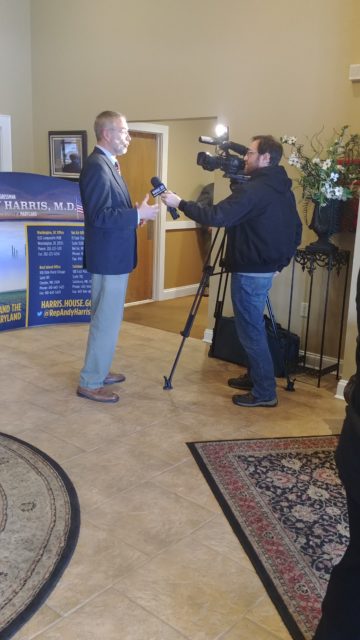
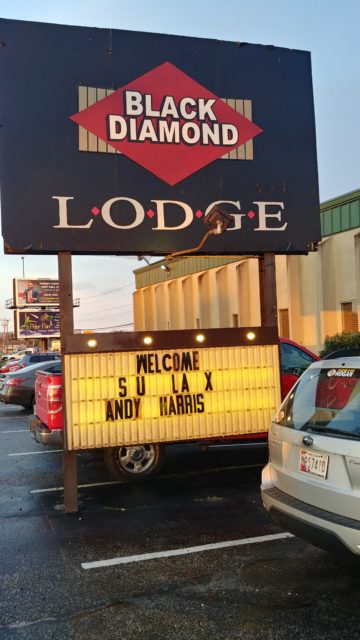
On Monday our Congressman, Andy Harris, culminated a day spent on the Lower Shore with a public townhall meeting at Chef Fred’s in Salisbury. Several dozen constituents took advantage of the opportunity to ask questions of Andy and otherwise say their piece.
His presentation began with a PowerPoint show which illustrated his main point of the evening: we have been “misled” for 20 to 30 years financially. Slides that showed the “reckless spending spree,” “tidal wave of debt,” “what drives our debt?,” and a comparison between the state we currently find ourselves in and the one in Greece before the EU bailout dominated his early remarks. One particularly interesting (and troubling) statistic: the foreign ownership that was just 5% back in 1970 is now 47 percent, with China the largest holder.
Against that stark backdrop, Harris told the group the aim of the House was to bring that debt under control. We “can’t be competitive with that amount of foreign debt,” he added. Their three-pronged approach was to trim spending without raising taxes – “increasing taxes is not the solution,” Andy said – and cutting regulation to “common sense” levels.
However, those cuts couldn’t just slash entitlement programs. “We have to establish a Social Security and Medicare system that’s viable,” stated Andy.
This took about the first fifteen to twenty minutes of the meeting. Most of the next two hours were spent answering questions on a number of subjects: among them the Federal Reserve, jobs and the economy, education, the PATRIOT Act, the Fourteenth Amendment, energy policy, and Medicare.
Perhaps my favorite question of the group was the one on education, which was asked as part of a soliloquy from a local teacher. It was a story from the front lines that lamented the amount of regulation placed on teachers, and Harris agreed that there was no federal role necessary in education.
I also thought Andy’s view on foreign aid was valid – we should require a country-by-country vote on foreign aid. This was friendly allies would be rewarded while those who oppose us would be first in line for cuts. Among those Harris favored retaining at least the present amount of aid for was Israel, our “staunchest ally” in the Middle East.
Andy also had a long explanation of his beliefs on the PATRIOT Act, a question asked by fellow blogger Julie Brewington of Right Coast. The process of resolving the act was “complicated” because of provisions which expired at different times and being of the belief that some parts of the PATRIOT Act were useful.
Of course, I asked a question, too. In short, what is wrong with the leadership?
Andy also revealed he’s a co-sponsor of a bill to clarify the Fourteenth Amendment doesn’t apply to “anchor babies,” which makes sense because the parents aren’t under our jurisdiction as non-citizens.
Quite a bit of the discussion focused on government health care.
As a medical practicioner, Andy eaasily explained some of the factors which allowed drug companies to sell drugs cheaply to Canadians as opposed to here in America. Technically, purchasing drugs from Canada enables drug companies to flout Canadian law, but the reason drugs are cheaper there is the formulary they use – in other words, their selection is far less than ours. Later, there was a question about Medicare doctor reimbursements where Andy made the point that cutting the payments to doctors was a form of “backdoor rationing” because limiting Medicare payments to doctors forced them to stop accepting Medicare patients. (How many people would willingly take a 30 percent pay cut for doing the same amount of work? That’s what they are asking doctors to do, as I understand it.) A more desirable effect could be had by increasing competition between insurance companies, Andy concluded.
There was a questioner who asked about the cuts to job services, but Andy reminded her that there were 47 programs out there which still had $1.5 billion to spend this fiscal year. Meanwhile, due to overregulation, the poultry industry was “on the brink of leaving the country.” We have the workforce to bring light manufacturing to the area, but needed to have a government which would allow businesses to thrive.
Term limits? Andy is a co-sponsor of a term limits bill. I also recall in 2008 he said he’d serve no more than 12 years.
NASA was a good program, but in a time of limited budget flexibility they needed to prioritize their missions.
“Energy independence has to be one of our top priorities,” opined Andy. I couldn’t agree more. He pointed out the Marcellus Shale formation under portions of Maryland and other neighboring states as a key untapped resource.
But, it can’t be an Andy Harris event without somebody protesting, whether in a chicken suit or not.
Mike Calpino, the Libertarian candidate for a County Council seat last year, mildly protested the direction the two principal parties had led the country by holding this sign out front before the event. However, no one disrupted the proceedings inside. Aside from an admitted RINO who thought the Republican Party needed to jettison its right wing, the dialogue was relatively friendly.
Two final quotes from the meeting:
Referring to our financial situation: “(There is) an unwillingness in Washington to face the music.”
“My philosophy is, that if we reduce the size of government, we free up capital and our American entrepreneurship to create jobs and business, to be the best in the world.” That was a reply to the self-described RINO.
Needless to say, the Congressman encourages input from constituents. His district office is downtown at 212 W. Main Street, right inside the Gallery Building.
Another Giffords attack casualty: the town hall meeting?
I was told by the editors this was a good article but there’s no room at the inn over at PJM this week, so you get this in its entirety. It happens to the best of us.
Most pundits look at the voting records when comparing the performance of individual members of Congress, but a less-noticed aspect of their job description comes in the area of constituent service and interaction. To many, a good public servant in Washington doesn’t just bring home the bacon but answers that Social Security question for Grandma or gets the neighbor’s son into one of the military academies.
As part of that service, many members of Congress hold public interactions with the residents of their district. It was at one of these meetings she dubbed “Congress On Your Corner” where Rep. Gabrielle Giffords was shot by a crazed assailant, Jared Loughner. Ironically enough, the attack, which killed six bystanders including a nine-year old girl born on September 11th and a federal judge, occurred in front of a Safeway supermarket.
There’s no question that the shooting has prompted even more heated discussion on the already hot topic of our national political discourse – blaming Sarah Palin, who was half a country away at the time of the incident, for having a hand in the attack proves this point – but perhaps the more chilling lasting effect will be to further close off our Congress from public interaction during the period when Washington is out of session. While the complaints of their voting public prompted many Democratic Congress members to eschew the usual round of summertime meetings or make them telephone-only, the threat of violence may cast a pall over the summer schedule this year. Being hung in effigy is one thing but getting shot is completely another.
Yet there are attempts to maintain the format in several areas, such as this Philadelphia television station or a Virginia state senator who changed his session from a telephone town hall to an in-person one in defiance of the Giffords shooting. The question, of course, is whether these will be exceptions to the rule.
Common sense would dictate, if and when a robust schedule of townhall meetings is resumed, that security measures will be stepped up with more of a law enforcement presence. This leads to the question of whether those who get angry and passionate about their pet issues will be discouraged from speaking up with the long arm of the law looking on. Since the TEA Party is continually miscast as a group of violent extremists – witness the quickly-formed bandwagon blaming the Giffords shooting on a member of the radical right wing – tolerance for perceived misbehavior at any such gatherings will be limited.
But the argument against any sort of crackdown is strong. Even in the midst of an anger-filled mob back in March when the health care bill was being passed and a number of Congressmen walked amidst the protesters in front of the Capitol, the worst incidents which (allegedly) occurred were verbal attacks on particular members who were the victims of flying spittle. Obviously at that moment a Jared Loughner in that crowd could have mowed down any number of elected officials and bystanders before Capitol police would have arrived for assistance.
Instead, we the people can look for an increase in those scripted, press-friendly events where the message can be controlled and interaction limited. Members of Congress may instead argue that their constituents are able to communicate easily with their staffers via e-mail or telephone and that they can have their concerns answered outside of a face-to-face meeting. That is, of course, if you don’t call into a voice mailbox that’s full, which happens quite often during those times one would most like to interact. And if you’ve had my personal experience with e-mailing my Congressman it’s likely you can expect a form letter in response well after the vote has been taken or the issue is moot.
Whether you favored Gabrielle Giffords’ voting record or not, by many accounts she was a stickler for constituent service. That fact may have turned the tide in her favor in November despite running as a Blue Dog Democrat who voted in favor of Obamacare but later voted not to keep Nancy Pelosi as Speaker of the House – she instead voted for Rep. John Lewis of Georgia. Giffords only eked out a victory over Republican Jesse Kelly by 3,641 votes out of over 270,000 cast.
And whether you had that concern with Social Security payments, wanted to debate the health care issue, or was a neophyte politician who was just elected to her student council and sought to know more about the political world – as was the case with Christina-Taylor Green, the nine-year-old Tuscon shooting victim – the fact remains that the ability to speak in person with their representative in Washington face-to-face is a cornerstone of our republic. In Giffords’ situation, only the most extreme and draconian safety measures may have saved the victims, but they may also have served as an intimidating factor to those who simply wished to make their views known to her on a one-to-one basis.
While we generally identify with only our own era of history, it’s understood that political discourse has always been passionate and on four occasions our leaders have been slain by a madman’s bullets. But it’s a republic we remain, and we can’t allow the tragedy of Gabrielle Giffords’ shooting to place our government and its representatives farther from the people.
MDGOP townhall meeting April 5th
Take Back Washington and Annapolis Town Hall Meeting
Monday, April 5th
6:30pm
Doors Open at 6:15pm
Wicomico County Youth & Civic Center
Danang Room
500 Glen Avenue
Salisbury, MD
This event is free and open to the public. If you plan to attend please email
Kim Jorns at kjorns@mdgop.org
Democrat Leadership in both Annapolis and Washington continue to tune out the people of Maryland. Frustrations are growing!
Join us for the opportunity to discuss the current state of Maryland and the Nation with
Audrey Scott, Chairman of the Maryland Republican Party.
Chairman Scott will discuss what the MDGOP is doing to put a stop to one-party rule in Annapolis and Washington and she will
LISTEN to your ideas, needs and concerns.
We hope you will join us for this open dialogue!
Authority: Maryland Republican Party, R. Christopher Rosenthal, Treasurer. Not authorized by any candidate or candidate committee.
**********
Of course, I plan on being there to cover the event, which is one of several being planned statewide that week.
Observations on the Conway-Mathias townhall meeting
On Saturday I was joined by about two dozen others - among them seemingly half the local blogger community – who wanted to pepper local Delegates Norm Conway and Jim Mathias of District 38B with questions about the direction this state is going and just what they would do to send it in the proper direction. At times this was a very contentious meeting when the questions began to be asked.
First they were introduced by Salisbury Mayor Jim Ireton.
Part of his introduction was an appeal to keep the library downtown, but as for Conway and Mathias Mayor Ireton noted that, “one of the reasons I support them is that they don’t vote no for the sake of voting no and they don’t vote yes for the sake of voting yes.”
Mathias began his presentation by stating “I’m just like you in many ways,” pointing out he had been a businessman, vetoed two budgets as mayor of Ocean City, and argued about increasing fees. Along with us, he felt that the state “should have a dependable budget” and asserted that he’d “stand up and take responsibility for the good things we’ve done and the tough things we’ve done.”
Jim seemed very defensive throughout the presentation, and speaking on the budget remarked that “we thought we’d close the (budget) gap (in 2007)…but we didn’t know the ‘great recession’ was on the way.” He made it clear that there were “a thousand sets of fingerprints to blame” so we needed “a thousand sets of hands to lift us up.”
Noting that much of the industry which had once been the backbone of the Shore – companies like Campbell Soup and Dresser – had abandoned the area, those entities which had taken their place like Salisbury University, Wor-Wic College, and Peninsula Regional Medical Center helped take up some of the slack but our number one industry remains agriculture. On that note, Mathias pled the case that they “tried very hard to get building permits for the chicken houses.”
Unlike Mathias, who sat throughout the meeting, Norm Conway stood up to give his remarks.
One thing I didn’t know about Conway is that he’d been an elected official since 1970, beginning with the Central Committee and graduating to Salisbury City Council in 1974 before running and winning his current post in 1986. He recounted some of the mentors who had led him into his lifetime of public service as a teacher, school official, and political officeholder.
As a committee head in the General Assembly, he “tried to build alliances…build bridges” as Norm reminded those assembled that the sum total of the Eastern Shore delegation was 13 – 10 House members and three Senators. (Seems like it should be 12 because there are only three Eastern Shore districts – 36, 37, and 38. Point is we have a small delegation.)
Certainly those in attendance had known that Maryland “had some rough times over the last 2 or 3 years” as “revenues dropped off a cliff.” In the last year the Board of Public Works had chopped $1 billion out of the budget – it had been in balance at sine die of the General Assembly last April but once the fiscal year started July 1 things were already behind.
Norm observed, however, that revenues may be finally leveling off. His anecdotal basis of that claim was seeing more people shopping and in restaurants over the last few months, and to him that was “clear evidence” of a recovery.
But now the General Fund budget being debated was less than that approved for FY07 four years ago thanks to the shrinking revenues. Yet the untouchable area has been K-12 education and it was only this year the tuition freeze had been shelved, after three years of no change.
As for the actual budget process, this year it was the Senate’s turn to begin the budget process (it alternates yearly between the Senate and House of Delegates.) Conway predicted the budget would be on the floor by the second week of March. One lament Conway had was the difficulty of maintaining funding for roads because once that area was cut it was “tough to catch up.” Yet we had to balance the budget and create jobs since Maryland’s 7.5% unemployment rate, while well below the national average because of the insulation of federal jobs, was still at a “high water mark.”
So far the meeting had gone fairly smoothly and people had listened attentively. Then the questions began.
Local Americans for Prosperity co-chair Joe Collins got the ball rolling by pointing out the examples of Dresser leaving and the Evolution microbrewery deciding to locate just across the state line in Delaware (after considering a downtown Salisbury location) and asking what can they do for the business community?
Mathias, who reminded us he was on the Economic Matters Committee, told us that part of the issue was local regulation. But he and Conway had urged a reduction in regulations, and Mathias called the poultry industry regulations “overbearing.” Jim also called it “embarrassing” that a permit for a fishing pier desired by a local businessman had languished for two years – that owner “should have had it in his hand by now.”
The former mayor also made the complaint that “as mayor, I was closer to a one phone call fix” but the state is a “matrix.” The only group which stays long-term is the bureaucracy.
Collins interjected that it sounded like Mathias was “making the case for less government.” Jim agreed that there was a need for incentives, less regulations, and more opportunity.
Delegate Conway spoke his piece, talking about how the poultry industry could be gone in a decade if things continue on their path, but bringing up the point that he has to work with other members and “help them.” But as head of the Appropriations Committee, “I do” use that as a weapon against the Maryland Department of the Environment in an effort to help local poultry farmers.
So when it was asked what they were doing to get rid of the bureaucracy, Conway pointed out that 400 vacant positions had been eliminated this fiscal year – but that may not be permanent.
Delegate Mathias then pointed out that, “bureaucracy is not just numbers…every business needs to have trained people.” Yet the government will have to continue to shrink, added Jim. Earlier this decade, we were largely in the ‘roaring Twenties’ of the 21st century.
Local businesswoman Sally Jones then asked about unemployment insurance, noting how much it affected her business.
The problem, responded Mathias, was that businesses were moving to a higher table on the unemployment scale and that raises their premiums. One change last year was adding part-time workers to the rolls, a move the Chamber of Commerce supported but Jim opposed (as did I.) But Jim also couched it as an issue between big business (like Wal-Mart, as Jim naturally mentioned) against small business and the NFIB.
Yet I happen to know there’s also a federal impact, as the bailout being proposed comes with strings attached. With Maryland’s fund in peril, the state is looking for an infusion of federal cash but in order to get it they have to “reform” their system (after just doing so five years ago.)
At that point, a questioner asked about illegal immigrants and the fiscal impact they have on our state, but neither Delegate was aware of a financial number and Mathias “doubt(s) my committee” has ever asked for one. Remember, Maryland is well known as a sanctuary state and is adopting a two-tier driver’s license system just for them. (That was a contentious bill, and many Delegates – including Conway and Mathias – asked their name by withdrawn as co-sponsors after numerous changes were made to gut that bill.)
Shifting gears, fellow blogger Joe Albero asked about the death penalty in the wake of the Foxwell case. Conway expressed his support for the death penalty but voted to weaken it in order to make sure it stayed on the books, noting wistfully “they have it where they want it” for now. He’s working on a bill to be heard tomorrow which would add scientific evidence to the criteria where the death penalty can be sought. Delegate Mathias chimed in that there “will be improvements” to sex offender laws and echoed Conway’s support for capital punishment.
Another fellow blogger (and the other AFP local co-chair), Julie Brewington, asked about the gas tax and why so much of it goes to public transit. Mathias said that he wouldn’t support an increase but also countered that “we all know we have to make that contribution” and perhaps change the funding mechanism for fixing roads as cars get more efficient. After our economy finally recovers, this will be “a different country than we know.” (He also had a sidebar about the one staunch Republican who supported Obama’s stimulus plan – that man runs a paving company.)
But here was a case of the quid pro quo which permeates Maryland politics. Delegate Mathias recounted his first votes, which were to override vetoes by Governor Ehrlich of various Baltimore City and County issues. He was going to sit them out (since he never voted on the original legislation) but was reminded by Norm Conway that the items he liked getting as mayor of Ocean City had to have the approval of Baltimore-area legislators to be done. In this case, they support the public transit predominant on the other side of the Bay as a trade-off for things we need.
One item that Conway said has been proposed in the past and could be revisited to address transportation would be a regional sales tax.
Johnnie Miller, a proponent of energy legislation, wondered why renewable energy bills pass the House easily but die in the Senate Finance Committee. He pointed out Delaware is way ahead of us in that area. More interesting was the fact he and fellow advocate John Palmer had written the draft of legislation to be introduced this year (they were only awaiting the legal language to be set) for energy policy.
To address the question, Delegate Mathias pointed out these bills generally come with a “strong fiscal note” which seems to scare off support. (Tellingly he also said, “maybe one day I’ll be on the Senate Finance Committee.” File that under “worst-kept secret.”)
This touched off a long and sort of meandering discussion which eventually returned to jobs and development. While it was pointed out (properly) that renewable energy was only made competitive when subsidized by the government and certain interests were more focused on rent-seeking than energy policy, the philosopical question was asked “how is it that government ever thought they could create development?” To that, Delegate Conway replied that there were a number of public-private projects under discussion but when pressed couldn’t name any local examples.
Delegate Mathias attempted to bail Conway out by postulating that even with the increasing amount of real property now owned by government (such as the ever-expanding Salisbury University and even the newly-purchased Pollitt’s Folly parking lot for the Civic Center) there are still jobs and disposable income being created by them. With all due respect, Delegate Mathias, at what cost to us? (I used that term because Delegate Mathias used it often.)
This is basically how it ended, since the time allotted for the meeting room was only two hours and it was booked for another group. I didn’t get a chance to ask my question, but did say my piece to Delegate Conway about the increasing proportion of the state budget comprised from federal dollars. To him, it was just our money coming back to us but that doesn’t address the philosophical difference I have that the money belongs to us in the first place and all that having a middleman does is keep some pencil-pusher (who may or may not live in Maryland) employed.
There was also a comment made by a guy whose name I didn’t catch which, to sum up, said that we should watch the Delegates in action before being overly critical. Come to Annapolis and watch them work on a Monday night or some other time during the week, he said.
That’s all well and good for a lobbyist or perhaps CASA de Maryland, but most working people in far-flung regions of the state don’t have the time to drive up to Annapolis and watch the legislature grind its sausage. We count on them to do what’s right and what’s proper in being stewards of our taxpayer money.
Instead we get “I’ll scratch your back if you scratch mine” politics, trading favors at the expense of the taxpayer. So much for “One Maryland.”